- 480 pages
- English
- ePUB (mobile friendly)
- Available on iOS & Android
eBook - ePub
About this book
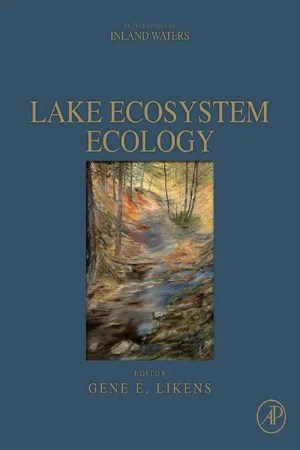
A derivative of the Encyclopedia of Inland Waters, Lake Ecosystem Ecology examines the workings of the lake and reservoir ecosystems of our planet. Information and perspectives crucial to the understanding and management of current environmental problems are covered, such as eutrophication, acid rain and climate change. Because the articles are drawn from an encyclopedia, the articles are easily accessible to interested members of the public, such as conservationists and environmental decision makers.
- Includes an up-to-date summary of global aquatic ecosystems and issues
- Covers current environmental problems and management solutions
- Features full-color figures and tables to support the text and aid in understanding
Information
Hydrodynamics and Mixing in Lakes
Biological-Physical Interactions
C.S. Reynolds Centre of Ecology and Hydrology and Freshwater Biological Association, Cumbria, UK
Introduction
As formal branches of science, limnology and ecology are each around a century in age. Both disciplines feature prominently in the evolving understanding of inland waters, where they are invoked to explain observable phenomena and their role in shaping the abundance, structure, and variability of the biotic communities. It is also true that, from the pioneer studies onwards, much of the scientific investigation has been focused on the mutual relationships among the biota and their chemical environments, most especially with regard to the important nutrient elements. Physical factors were not overlooked altogether: it is well known how the specific heat of water, its curiously variable coefficient of thermal expansion, and its transparency each influence the stability and duration of seasonal thermal stratification or to the underwater distribution of macrophytic plants and photosynthetic algae. The benefit to aquatic organisms of the mechanical support contingent upon the high density of water is also generally understood. On the other hand, the mathematics of fluid motion in lakes proved to be less amenable to solution, so its impact on the evolutionary ecology of the pelagic biota – those of the open water, mostly living independently of shores or the bottom oozes – for a long time remained wholly intuitive. Although broad patterns of wind- and gravity-generated currents could be described and modeled, the smaller scales of water movement and the quantitative description of turbulence were, until the last twenty years or so, relatively intransigent to solutions relevant to the function, selection, and evolutionary ecology of aquatic biota, or even to such matters as the transport and dispersal of organisms, particles, and solutes. This chapter reviews briefly the physical properties of fluid motion at the macro and microscale in inland water bodies, seeking to establish the spatial and temporal scales that impinge directly and indirectly on the organisms that live there, as well as on the functional adaptations that enable them to do so.
Water Movements – The Concept of Scale
From the major oceanic circulations down to the (Brownian) behavior of the finest colloidal particles and the diffusion of solutes, water characteristically comprises molecules in motion. Curiously, the propensity of water molecules to polymerize into larger ‘aquo complexes,’ which is responsible for the relatively high density and viscosity of liquid water, makes them resistant to movement, so there is a constant battle between, on the one hand, the energy sources driving motion (the Earth’s rotation, gravitational flow, convectional displacement due to thermal expansion and contraction and, especially, the work of wind forcing applied at the water surface of lakes; and, on the other, the resistance of internal viscous forces. Thus, the energy of external forcing is dissipated through a cascade of turbulent eddies of diminishing size and velocity, to the point that it is overwhelmed at the molecular level.
Turbulence in the upper water column affects pelagic organisms through several mechanisms operating at a range of temporal and spatial scales. Mixing influences the distribution of regeneration and recycling of dissolved nutrients, the dispersion of zooplankton, the location of rewarding feeding grounds for fish, and the resuspension of detrital particles, including biotic propagules. In relation to the depth of light penetration, the penetration of mixing may constrain the exposure of entrained photosynthetic algae and bacteria to lig...
Table of contents
- Cover image
- Title page
- Table of Contents
- Copyright page
- Editor
- Contributors
- Introduction to Lake Ecosystem Ecology: A Global Perspective
- Lake Ecosystems: Structure, Function and Change
- Hydrodynamics and Mixing in Lakes
- Lakes and Reservoirs of the World
- Lakes and Reservoirs: Pollution, Management and Services
- Subject Index
Trusted by 375,005 students
Access to over 1.5 million titles for a fair monthly price.
Study more efficiently using our study tools.
Frequently asked questions
Yes, you can cancel anytime from the Subscription tab in your account settings on the Perlego website. Your subscription will stay active until the end of your current billing period. Learn how to cancel your subscription
No, books cannot be downloaded as external files, such as PDFs, for use outside of Perlego. However, you can download books within the Perlego app for offline reading on mobile or tablet. Learn how to download books offline
Perlego offers two plans: Essential and Complete
- Essential is ideal for learners and professionals who enjoy exploring a wide range of subjects. Access the Essential Library with 800,000+ trusted titles and best-sellers across business, personal growth, and the humanities. Includes unlimited reading time and Standard Read Aloud voice.
- Complete: Perfect for advanced learners and researchers needing full, unrestricted access. Unlock 1.5M+ books across hundreds of subjects, including academic and specialized titles. The Complete Plan also includes advanced features like Premium Read Aloud and Research Assistant.
We are an online textbook subscription service, where you can get access to an entire online library for less than the price of a single book per month. With over 1.5 million books across 990+ topics, we’ve got you covered! Learn about our mission
Look out for the read-aloud symbol on your next book to see if you can listen to it. The read-aloud tool reads text aloud for you, highlighting the text as it is being read. You can pause it, speed it up and slow it down. Learn more about Read Aloud
Yes! You can use the Perlego app on both iOS and Android devices to read anytime, anywhere — even offline. Perfect for commutes or when you’re on the go.
Please note we cannot support devices running on iOS 13 and Android 7 or earlier. Learn more about using the app
Please note we cannot support devices running on iOS 13 and Android 7 or earlier. Learn more about using the app
Yes, you can access Lake Ecosystem Ecology by Gene E. Likens in PDF and/or ePUB format, as well as other popular books in Biological Sciences & Ecology. We have over 1.5 million books available in our catalogue for you to explore.