eBook - ePub
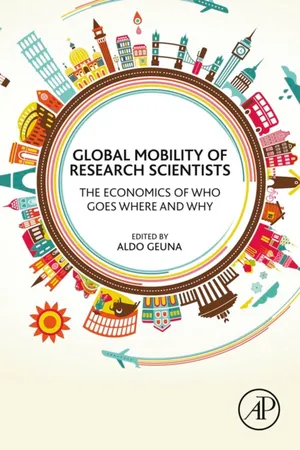
Global Mobility of Research Scientists
The Economics of Who Goes Where and Why
- 330 pages
- English
- ePUB (mobile friendly)
- Available on iOS & Android
eBook - ePub
About this book
Global Mobility of Research Scientists: The Economics of Who Goes Where and Why brings together information on how the localization and mobility of academic researchers contributes to the production of knowledge.
The text answers several questions, including "what characterizes nationally and internationally mobile researchers?" and "what are the individual and social implications of increased mobility of research scientists?"
Eight independent, but coordinated chapters address these and other questions, drawing on a set of newly developed databases covering 30 countries, including the US, the UK, France, Germany, Italy, Japan, Russia, and China, among others.
- Combines theoretically sound and empirically fascinating results in one volume that has international and interdisciplinary appeal.
- Covers topics at the forefront of academic, business, and policy discussions
- Data used in the chapters available at a freely-accessible website
Information
Topic
BetriebswirtschaftSubtopic
EntscheidungsfindungChapter 1
What Do We Know of the Mobility of Research Scientists and Impact on Scientific Production
Ana Fernández-Zubieta1, Aldo Geuna2,3, and Cornelia Lawson2,3,4 1Institute for Advanced Social Studies – Spanish Council for Scientific Research, Campo Santo de los Mártires, Córdoba, Spain 2Department of Economics and Statistics Cognetti De Martiis, Università di Torino, Turin, Italy 3BRICK, Collegio Carlo Alberto, Moncalieri, Turin, Italy 4School of Sociology and Social Policy, University of Nottingham, Nottingham, UK
Abstract
In this chapter we review the literature on the analysis of researcher mobility and productivity, highlighting recent changes in the research system—internationalization, intersector mobility, and collaboration and career diversification—which make researcher mobility more relevant for the dynamics of knowledge creation and dissemination. This review reveals that, to date, we still know little about the consequences and motivations of increased mobility for individual researchers. We contribute by presenting a typology of researcher mobility, and considering the relevance of multiple mobility events throughout a researcher career. Finally, we review the modeling problems related to analyzing the effect of mobility on academic performance at the individual level, and suggest various solutions.
Keywords
Academic mobility; Intersector collaboration; Job-to-job mobility; Life course perspective; Productivity1. Introduction
The establishment of research networks and the mobility of researchers across different countries, fields, and sectors have become a major policy objective in recent years (OECD, 2008; EC, 2012). Studies of mobile inventors’ social capital show that links to the original location are maintained and that knowledge flows are deeply embedded in labor mobility (Agrawal, Cockburn, & McHale, 2006, 2011; Almeida & Kogut, 1999; Breschi & Lissoni, 2003). Thus, mobility generates positive spillovers among firms (Cooper, 2001; Møen, 2005), sectors (Crespi, Geuna, & Nesta, 2007; Zucker, Darby, & Brewer, 1998), academic institutions (Azoulay, Zivin, & Sampat, 2012), and countries (Hunt & Gauthier-Loiselle, 2010; Moser, Voena, & Waldinger, 2014). The evidence also shows that university scientists can increase their individual visibility and credibility by moving to a different academic environment and improving their performance, patterns of collaboration, and career development (Azoulay et al., 2012). Therefore, both the research system and the individual researcher can benefit from mobility.
Recent developments in the research system are demanding a better understanding of the consequences of mobility across locations, sectors, and career stages. First, globalization of the research community and increasing levels of international mobility (Auriol, Misu, & Freeman, 2013; Franzoni, Scellato, & Stephan, 2012; Moguerou & Di Pietrogiacomo, 2008) and collaboration (Glanzel, Debackere, & Meyer, 2008) are making the geographical mobility of researchers more relevant to an adequate flow of knowledge across locations. Second, the importance of improved knowledge transfer between research sectors (Gassmann, Enkel, & Chesbrough, 2010; Howells, Ramlogan, & Cheng, 2012; Powell, Koput, & Smith-Doerr, 1996) calls for a stronger emphasis on moves between public and private sectors. Third, the increased number of foreign PhD students and PhD graduates joining firms, and the greater number of fixed-term academic positions and the rapid diversification of academic work roles, are requiring a better understanding of the labor markets for researchers and the career consequences of mobility (Enders, 2005; Enders & Weert, 2004; Mangematin, 2000; Stephan, 2012; Zellner, 2003).
This chapter focuses on the mobility of academic researchers across locations, sectors, and career stages; its social relevance; and its consequences for researcher performance. We propose an approach to the analysis of researcher mobility that considers multiple mobility events throughout a researcher’s career (Eurobarometer, 2005). We start by reviewing the relevant literature on researcher mobility to understand its increasing importance, advantages, and disadvantages. We develop a typology of mobility events based on a life-course perspective, which allows us to present and select the more relevant mobility events during a researcher’s career. We also discuss the modeling difficulties (including selection bias, unobserved heterogeneity, and reverse causality) related to analyzing the effects of researcher mobility, and we suggest ways to overcome them.
2. Why Are We Increasingly Interested in Researcher Mobility?
Researchers have always moved across countries and sectors, and throughout their careers. Current research systems, however, are characterized by higher levels of internationalization and increased importance of intersector mobility and collaboration, as well as career diversification (temporariness and changes in work roles), all of which are making researcher mobility more significant to the development of the research system.
Data from the Organisation for Economic Co-operation and Development and the United Nations Educational, Scientific and Cultural Organization (UNESCO) Institute for Statistics (hereafter UIS) show a five-fold increase in foreign students worldwide between 1975 and 2012. Since 2000 alone their number has almost doubled (OECD, 2014),1 whereas in the United States, the number of international students has increased by 32% since 2000–2001 (Institute of International Education, 2012). The trend is similar in the United Kingdom, where the number of international students in research degree programs in UK higher education institutions increased threefold between 1994/1995 and 2012/2013.2 There is less precise and less comparable information available on the nationalities of research scientists. Moguerou and Di Pietrogiacomo (2008) show that the share of nonnational science and technology professionals without citizenship in the 27 countries of the European Union at that time increased from 1.6% to 2.4% in nine European member states between 2000 and 2006. An analysis of the mobility patterns of published authors listed on Scopus between 1996 and 2011 shows that the share of mobile authors differs among countries and regions. In Switzerland nearly 20% of authors have had a foreign affiliation, whereas in the rest of Western Europe the share is 12%, in Southern Europe it is 9%, and in the United States it is 7.4%; in China, Japan, and Brazil, however, this share is only 5% (OECD, 2013).3 The same study shows that the United States is the most internationally connected because it is the most important destination for researchers from other parts of the world (confirmed in Franzoni et al., 2012). In the United Kingdom, one of the European countries with a high level of internationalization, Higher Education Statistics Agency data show that in 2012/2013, 28% of research-active academic staff were of a non-UK nationality.
At the same time, an increasing share of researchers, especially among postdoctoral researchers, is leaving academia because of a lack of available academic positions (Stephan, 2012). For instance, in the United States about 37% of doctoral graduates are employed by private-sector firms; the shares are similar for Germany (39%) and the United Kingdom (32%).4 In Japan about 56% of all PhD students for whom destinations are known moved to take up positions outside of academia after graduating (NISTEP, 2009). Once doctorate holders join a specific sector following the completion of their PhD degree, they are primarily mobile within that sector, especially in countries with high-intensity research and development, such as Germany and the United States (OECD, 2014).
Within academia, there has been a greater shift toward employment with part-time and fixed-term contracts, particularly through an increase in positions financed by external grants. For example, in the United States the number of postdoctorates in scien...
Table of contents
- Cover image
- Title page
- Table of Contents
- Copyright
- Contributors
- Acknowledgments
- Introduction
- Chapter 1. What Do We Know of the Mobility of Research Scientists and Impact on Scientific Production
- Chapter 2. International Mobility of Research Scientists: Lessons from GlobSci
- Chapter 3. International Careers of Researchers in Biomedical Sciences: A Comparison of the US and the UK
- Chapter 4. Mobility and Productivity of Research Scientists
- Chapter 5. Who Leaves and Who Stays? Evidence on Immigrant Selection from the Collapse of Soviet Science
- Chapter 6. China’s “Great Leap Forward” in Science and Engineering
- Chapter 7. Which Factors Influence the International Mobility of Research Scientists?
- Chapter 8. Destinations of Mobile European Researchers: Europe versus the United States
- Chapter 9. Appointment, Promotion, and Mobility of Bioscience Researchers in Japan
- Chapter 10. Moving Out of Academic Research: Why Do Scientists Stop Doing Research?
- Index
Trusted by 375,005 students
Access to over 1.5 million titles for a fair monthly price.
Study more efficiently using our study tools.
Frequently asked questions
Yes, you can cancel anytime from the Subscription tab in your account settings on the Perlego website. Your subscription will stay active until the end of your current billing period. Learn how to cancel your subscription
No, books cannot be downloaded as external files, such as PDFs, for use outside of Perlego. However, you can download books within the Perlego app for offline reading on mobile or tablet. Learn how to download books offline
Perlego offers two plans: Essential and Complete
- Essential is ideal for learners and professionals who enjoy exploring a wide range of subjects. Access the Essential Library with 800,000+ trusted titles and best-sellers across business, personal growth, and the humanities. Includes unlimited reading time and Standard Read Aloud voice.
- Complete: Perfect for advanced learners and researchers needing full, unrestricted access. Unlock 1.5M+ books across hundreds of subjects, including academic and specialized titles. The Complete Plan also includes advanced features like Premium Read Aloud and Research Assistant.
We are an online textbook subscription service, where you can get access to an entire online library for less than the price of a single book per month. With over 1.5 million books across 990+ topics, we’ve got you covered! Learn about our mission
Look out for the read-aloud symbol on your next book to see if you can listen to it. The read-aloud tool reads text aloud for you, highlighting the text as it is being read. You can pause it, speed it up and slow it down. Learn more about Read Aloud
Yes! You can use the Perlego app on both iOS and Android devices to read anytime, anywhere — even offline. Perfect for commutes or when you’re on the go.
Please note we cannot support devices running on iOS 13 and Android 7 or earlier. Learn more about using the app
Please note we cannot support devices running on iOS 13 and Android 7 or earlier. Learn more about using the app
Yes, you can access Global Mobility of Research Scientists by Aldo Geuna in PDF and/or ePUB format, as well as other popular books in Betriebswirtschaft & Entscheidungsfindung. We have over 1.5 million books available in our catalogue for you to explore.