- 160 pages
- English
- ePUB (mobile friendly)
- Available on iOS & Android
eBook - ePub
Rubber Seals for Fluid and Hydraulic Systems
About this book
Rubber Seals for Fluid and Hydraulic Systems is a comprehensive guide to the manufacturing and applications of rubber seals, with essential coverage for industry sectors including aviation, oil drilling and the automotive industry.Fluid leakage costs industry millions of dollars every year. In addition to wasted money, unattended leaks can result in downtime, affect product quality, pollute the environment, and cause injury. Successful sealing involves containment of fluid within a system while excluding the contaminants; the resilience of rubber enables it to be used to achieve these two objectives and create a tight sealing effect. A sound understanding of the complex factors involved in successful fluid sealing is essential for engineers who specify, design, operate and maintain machinery and mechanical equipment.This book focuses on the characteristics of rubbers as seals, their manufacturing procedures, the implications of their physical and chemical characteristics for the sealing function in the fluid and hydraulic systems, how rubbers seal and prevent leaks, what properties are required for sealing function, and how they change before and after installation.The chapter on Manufacture of Seals and 'O'Rings includes approximately 25 workable starting point formulations based on different rubbers, with cure and property data of those formulations as guidelines for technologists and engineers.
- Emphasis on important areas such as applications of rubber as fluid seals in the nuclear, aviation, oil drilling and automotive industries
- Includes a chapter on Rubber Expansion Joints as the function of such expansion joints as pipe connectors is indirectly linked with leakage and prevention of fluid flow through the pipes
- The chapter on Manufacture of Seals and 'O'Rings includes approx. 25 workable starting point formulations based on different rubbers, with cure and property data of those formulations as guidelines for technologists and engineers
Information
Topic
Physical SciencesSubtopic
Fluid MechanicsCHAPTER 1 Introduction
Seals prevent escape of fluids from a hollow cylinder when a shaft penetrates the wall of the cylinder. Most commonly, the shaft will have a rotary or linear movement. If a seal is not made as per functional requirements, or installed and maintained properly, it may fail, causing loss of fluid. The two main functions of a seal are to keep the fluid in while keeping dirt and debris out.
Fluid leaks in hydraulic and lubricating systems are a commonplace occurrence in much mechanical equipment, and they are undesirable and embarrassing events fuelling increased cost of any manufacturing and equipment maintenance activity. Often fire hazards and accidents are direct consequences of such leakages. In many situations, in spite of anticipation of such hazards, leaks are overlooked and the leaking system is not attended to, since the operating engineers do not take the threat of accidents seriously. For years, leakage has received low level attention by corporate management at many industrial manufacturing plants. One reason is that leaks are often viewed as inevitable, and corrective actions such as repair and replacement are done only when convenient.
According to a recent report by John C Cox, Business Development Manager of Swagelok Company Solon Ohio [1], fluid leakage costs industry millions of dollars every year. For example, a few small leaks in a facility using air at 100 psig with an electric consumption cost of 6 cents/kwh can waste more than $22 000 annually. Delaying the replacement of a leaking steam trap worth $100, or not repairing it with proper sealing, could waste $50 per week. Since an average facility can typically have hundreds of steam traps throughout its operations, leaking traps may be squandering hundreds of thousands of dollars each year. In addition to wasted dollars, unattended leaks can result in downtime, affect product quality, pollute the environment and cause injury. System vibration, pulsation and thermal cycling are all common causes of chemical processing system leakage. It can be assumed that any type of fitting connection may leak, regardless of whether pipe or tube is used, especially when mechanical vibration is present. This ‘vibration fatigue’ is an unavoidable factor that can be aggravated by poor metallurgical consistency in the construction material, undue stress imposed on the connection from side load, other system design characteristics, or simply improper installation practices.
Seal Failures And Fluid Leak
The increasing speed of mechanical systems, warranted by the desire for increased productivity, leads to higher operating temperatures and reduced fluid viscosities. This, associated with higher pressures, causes an increasing tendency for fluids to leak. Such leakage in fuel systems that handle highly inflammable solvents cannot be overlooked as there is a high probability of fire hazards. It has become common practice to include a safe leakage route in the system design, to an escape or collection point in order to minimize the risk. However, this is a wasteful solution both in terms of cost and additional space needed for such a device. Unattended leaks result in downtime, affect product quality and pollute the atmosphere, in addition to wasting dollars.
If a seal leaks for no apparent reason, or shows cracks and blisters, it could be reacting with the fluid it is sealing. This problem is especially severe if the fluid has a molecular structure similar to that of the seal rubber. If this fluid interaction is the cause of seal failure, one has to see how to avoid the problem.
Blisters and internal cracks indicate that a seal is interacting with a fluid. Such failures, which are evident only upon close examination of the seal, are caused by fluid permeating into and expanding microscopic voids in the rubber.
Rubber seal materials are normally chosen on the basis of chemical compatibility with the fluid being transferred, but even if seal and fluid are chemically compatible, they can still interact physically, leading to leakage. Failure results from the fluid literally digging into the seal and bursting it from the inside. The reaction produces blisters or cracks in the seal that eventually provide a path for fluid leakage. This problem is especially acute at high temperatures and pressures, but it can show up even under less severe operating conditions. Work with seals for oil wells has provided insight on how to recognize failures caused by fluid/seal interaction. Fluids interact with seals because no seal material is 100% solid. Typically, molecular voids or air spaces make up about 3% of a seal's volume at its glass-transition temperature [2]. Under pressure, fluid diffuses into these voids and reaches an equilibrium state. Any change in equilibrium creates a positive internal pressure in the voids. If the pressure exceeds a critical level, the voids expand, forming a blister or rupture. Blistering is characteristic of highly elastic materials used to seal supersaturated gases, that have the following physical properties:
-
low hardness (low shear modulus)
-
low cross-link density
-
high elongation (>200%) [3].
An example of leak prevention with a rubber seal in a thread fitting that is gaining popularity is the Society of Automotive Engineers’ (SAE) straight thread. The SAE straight threads are mechanical types, designed to only hold the fitting in place; they do not provide a seal. This is provided by a rubber inset, typically located at the base of the male thread (Figure 1.1). The rubber compresses against a flat surface near the entrance to the female port. This type of threaded seal offers the advantage that the maintenance, accessibility and replacement of the fitting is significantly easier for the installer.
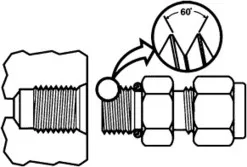
Figure 1.1 SAE straight-thread fittings – straight threads are mechanical types; they do not provide a seal
In another interesting report, the principal author, S. Hunt of Dominion Engineering Inc., states the following in one of his chapters [4]:
Leakage has a number of significant consequences including spread of contamination, pronounced hazard, damage to equipment, loss of efficiency and power reduction. For average plants the annual cost of leakage is in the range of $850 000 to $2.4 millions per unit. A proactive approach to reducing rather than responding to the leaks has the potential to reduce leakage related costs in savings of $200 000 to $500 000 per unit per year.
Successful sealing involves containment of fluid within the system while excluding contaminants. For example, in a typical reciprocating sealing system, rubber materials are found to have dimensional variations due to manufacturing tolerances, loads and deformations in the cylinder under pressure. System pressure on the seal surface attempts to compress the seal axially. This compression forces the seal more tightly against its contacting metal surface. The resilience of rubber creates a tight sealing effect containing the fluid and excluding any contaminants.
The mechanical engineer who is familiar with metals looks to a rubber technologist whenever leakage in a fluid system is encountered. Leakages are encountered in a range of disciplines, such as fluid flow, lubrication, hydraulic system and piping technologies. The leak needs to be rectified for at least the life-time of the component where the seal is fitted. Mechanical engineers involved in many branches of industry are more familiar with metals rather than elastic rubbers. Often they turn to rubber technologists, since rubber is a unique and appropriate material for sealing fluid leaks unlike rigid metals. ‘What materials make a good seal?’ asks Professor Michael F. Ashby and he answers ‘Elastomers – everyone knows that’ [5]. The terms elastomer and rubber are scientifically interchangeable, although the latter is used in some areas to refer only to natural rubber, which comes from the latex of hevea trees, as opposed to synthetic rubber, which is generally a petroleum oil by-product. Some standards use the term elastomer for cross-linked materials, but there is no general agreement on this. In the literature, the terms elastomer, polymers and rubbers are synonymous.
How can a rubber seal be explained simply? It can be visualized as a cylindrical item compressed between two flat surfaces as shown in Figure 1.2.
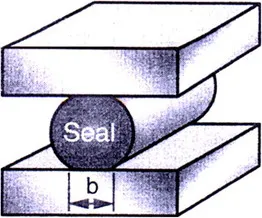
Figure 1.2 Rubber compressed between two flat surfaces
The seal must form the largest possible contact width ‘b’ and must not damage the contact surfaces. The seal itself must remain elastic so that it can be dynamic or static.
Although the author enumerates some application details of rubber seals, the primary focus of this book is on the characteristics of rubbers as seals. Their manufacturing procedures, the implications of their physical and chemical characteristics for sealing in fluid and hydraulic systems, how rubbers seal and prevent leaks, what properties are required for sealing function, and how they change before and after installation are also discussed. It is hoped that this will draw mechanical engineers closer to rubber technology.
The author has experience of working with mechanical, chemical, aviation and ship building engineers to solve their leakage problems, it is hoped, therefore, that this book will benefit those people, as well as scientists and technologists engaged in leakage prevention management. The author believes that this book might contribute its share in combating fluid leak threats. During his search, he found no book that dealt exclusively with rubber as industrial fluid seals was available in the literature, although valuable information related to the subject could be found in industry documents and research reports. These are cited where relevant, and detailed in the Reference Sections. A sound understanding of the complex factors involved in successful fluid sealing is essential for engineers who specify, design, operate and maintain machinery and mechanical equipment. Rubber seal specialists will show how an understanding of basic engineering factors can be used to practical advantage. Fluid sealing technology is based on principles as diverse as lubrication, friction, wear, properties of materials, mechanical design, fluid mechanics and heat transfer. All of these factors are to be considered and studied in depth in designing different types of rubber seals, seal materials and sealing applications.
References
1
www.swagelok.com/downloads/webcatalogs.
2.
Hertz, D.L. Jr Sour hydrocarbons – the elastomer challenge. Meeting of the Rubber Div., American Chemical Society, Las Vegas, Nev., May 20–23, 1980.
3.
Hertz, D.L. Jr The hidden cause of seal failure. Machine design, April 9, 1981.
4.
http://mydocs.epri.com/docs/public Establishing an effective fluid leak management program: Sealing technology and plant leakage reduction series. Electric Power Research institute (EPRI), Palo Alto, CA 2000, Technical report no: 114761, 2002.
5.
Ashby, M.F. Material selection in mechanical design, 3rd edn. Elsevier Butterworth, Oxford, 2005.
CHAPTER 2 Rubber Properties for Functional Seal Requirements
Rubber seals are used in a range of applications, in which the forces that operate on them are very different. To optimize the performance of a seal, the forces that operate in a given application, tog...
Table of contents
- Cover
- Title Page
- Dedication
- Copyright
- Preface
- Acknowledgements
- Notice (Disclaimer)
- Chapter 1: Introduction
- Chapter 2: Rubber Properties for Functional Seal Requirements
- Chapter 3: Seals for Radioactive Media - in Nuclear Plants
- Chapter 4: Rubber Seals in Aircraft
- Chapter 5: Rubber Seals for Oil Field Service
- Chapter 6: Rubbers, Chemicals and Compounding for 'O' Rings and Seals
- Chapter 7: Rubber Expansion Joints
- Chapter 8: Swelling Aspects of Rubber Related to Seal Performance
- Chapter 9: Rubber to Metal Bonding
- Chapter 10: Manufacture of Seals and 'O' Rings
- Chapter 11: Storage and Service Life of Rubber Seals
- Bibliography
- Glossary
- Index
Trusted by 375,005 students
Access to over 1.5 million titles for a fair monthly price.
Study more efficiently using our study tools.
Frequently asked questions
Yes, you can cancel anytime from the Subscription tab in your account settings on the Perlego website. Your subscription will stay active until the end of your current billing period. Learn how to cancel your subscription
No, books cannot be downloaded as external files, such as PDFs, for use outside of Perlego. However, you can download books within the Perlego app for offline reading on mobile or tablet. Learn how to download books offline
Perlego offers two plans: Essential and Complete
- Essential is ideal for learners and professionals who enjoy exploring a wide range of subjects. Access the Essential Library with 800,000+ trusted titles and best-sellers across business, personal growth, and the humanities. Includes unlimited reading time and Standard Read Aloud voice.
- Complete: Perfect for advanced learners and researchers needing full, unrestricted access. Unlock 1.5M+ books across hundreds of subjects, including academic and specialized titles. The Complete Plan also includes advanced features like Premium Read Aloud and Research Assistant.
We are an online textbook subscription service, where you can get access to an entire online library for less than the price of a single book per month. With over 1.5 million books across 990+ topics, we’ve got you covered! Learn about our mission
Look out for the read-aloud symbol on your next book to see if you can listen to it. The read-aloud tool reads text aloud for you, highlighting the text as it is being read. You can pause it, speed it up and slow it down. Learn more about Read Aloud
Yes! You can use the Perlego app on both iOS and Android devices to read anytime, anywhere — even offline. Perfect for commutes or when you’re on the go.
Please note we cannot support devices running on iOS 13 and Android 7 or earlier. Learn more about using the app
Please note we cannot support devices running on iOS 13 and Android 7 or earlier. Learn more about using the app
Yes, you can access Rubber Seals for Fluid and Hydraulic Systems by Chellappa Chandrasekaran in PDF and/or ePUB format, as well as other popular books in Physical Sciences & Fluid Mechanics. We have over 1.5 million books available in our catalogue for you to explore.