- 1,024 pages
- English
- ePUB (mobile friendly)
- Available on iOS & Android
eBook - ePub
Nanostructures for Drug Delivery
About this book
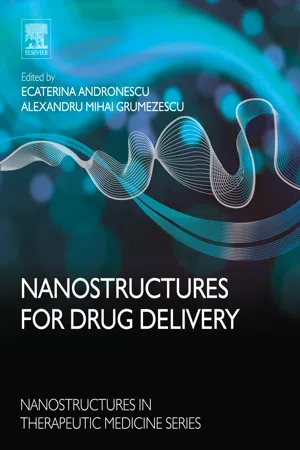
Nanostructures for Drug Delivery extensively covers the various nanostructured products that have been tested as carriers in target drug delivery systems. In addition, the book analyses the advantages of, and issues related to, using nanostructured materials in drug delivery systems, also detailing various nanocarrier preparation techniques.
As delivering the drug to the target site is a major problem in providing effective treatment for many diseases, this book covers the latest advancements in numerous nanotechnological products that are being used in disease detection, controlled drug delivery, as biosensors, and in tissue engineering that have been developed for more efficient patient healthcare. Due to the versatility of nanostructured materials, it is now possible to deliver a drug at its target site in a more accurate and efficient way.
This volume is an up-to-date, state-of-the-art work that highlights the principal mechanistic aspects related to the delivery of active nanoscale therapeutic agents (natural or synthetic) and their release profile in different environmental media. It highlights nanoscale encapsulation strategies and discusses both organic and inorganic nanomaterials as carriers and delivery platforms.
- Demonstrates how nanostructures are successfully employed in drug delivery stems and as drug delivery agents, allowing biomaterials scientists and biochemists to create more effective drug delivery systems
- Offers an overview of recent research into the use of nanostructures in drug delivery techniques in a cogent, synthesized way, allowing readers to quickly familiarize themselves with this area
- Includes examples of how the application of nanostructures have improved the efficiency of drug delivery systems, showing medical scientists how they are beneficial
Information
Chapter 1
Therapeutic nanomaterials: from a drug delivery perspective
Chityal Ganesh Kumar
Yedla Poornachandra
Sujitha Pombala CSIR-Indian Institute of Chemical Technology, Hyderabad, India
Abstract
Limitations in conventional chemotherapy have resulted in efforts to develop a good drug delivery system for the treatment of several diseases. Many promising drugs that were identified failed to reach the market due to associated drug delivery problems. The ultimate aim of drug delivery systems is to tailor-make the drug formulation to meet the individual requirements under the control of pathophysiological or in vivo conditions, rather than the in vitro characteristics. However, a challenge remains to develop cost-effective, better, and safer nanomaterials for efficient drug loading and controlled drug release. In the recent past, several nanomaterials have been identified with appreciable biocompatibility and therapeutic properties. This chapter focuses on the subject of nanomaterials with regard to their synthetic routes and application as potential drug delivery agents. Different nanomaterial types, including polymeric nanomaterials, dendrimers, nanoparticles, carbon nanotubes, and quantum dots, have been discussed and a number of case studies have been presented.
Keywords
nanotechnology
nanoscience
nanomaterials
drug delivery
nanoparticles
dendrimers
polymers
quantum dots
antimicrobial
therapeutics
1. Introduction
Nanotechnology is an em...
Table of contents
- Cover
- Title page
- Table of Contents
- Copyright
- List of Contributors
- Foreword of the Series
- Preface
- Chapter 1: Therapeutic nanomaterials: from a drug delivery perspective
- Chapter 2: Core–shell drug carriers: liposomes, polymersomes, and niosomes
- Chapter 3: The new nanocarriers based on graphene and graphene oxide for drug delivery applications
- Chapter 4: Nanostructured nanoparticles for improved drug delivery
- Chapter 5: Design of functionalized materials for use in micronanoscale drug delivery devices and smart patches
- Chapter 6: Niosomes: a novel approach in modern drug delivery systems
- Chapter 7: Nanofibrous and nanoparticle materials as drug-delivery systems
- Chapter 8: Brush polymer-based nanostructures for drug delivery
- Chapter 9: Drug delivery systems based on titania nanostructures
- Chapter 10: Redox activated polymeric nanoparticles in tumor therapy
- Chapter 11: Polymeric micro- and nanoparticles for controlled and targeted drug delivery
- Chapter 12: Novel gels: implications for drug delivery
- Chapter 13: Nanosuspension drug delivery system: preparation, characterization, postproduction processing, dosage form, and application
- Chapter 14: Polymer-based nanocarriers for therapeutic nucleic acids delivery
- Chapter 15: Multifunctional therapeutic hybrid nanocarriers for targeted and triggered drug delivery: recent trends and future prospects
- Chapter 16: Lipid-based nanocarriers for ocular drug delivery
- Chapter 17: Nanoparticulate carrier(s): an emerging paradigm in new generation vaccine development
- Chapter 18: Pathogen-specific nucleic acid aptamers as targeting components of antibiotic and gene delivery systems
- Chapter 19: Multifunctional nanosized emulsions for theragnosis of life threatening diseases
- Chapter 20: Therapeutic nanostructures for pulmonary drug delivery
- Chapter 21: Nanostructures in transdermal drug delivery systems
- Chapter 22: Advancement in pulmonary drug delivery systems for treatment of tuberculosis
- Chapter 23: Nanosized devices as antibiotics and antifungals delivery: past, news, and outlook
- Chapter 24: Drug delivery mediated by confined nanosystems: structure-activity relations and factors responsible for the efficacy of formulations
- Chapter 25: Therapeutic use of monoclonal antibodies: general aspects and challenges for drug delivery
- Chapter 26: Targeted drug delivery via chitosan-coated magnetic nanoparticles
- Chapter 27: Drug delivery: advancements and challenges
- Chapter 28: Stimuli-responsive liposome and control release drug
- Chapter 29: Nanotechnology to enhance transdermal delivery of hydrophilic humectants for improved skin care: a model for therapeutic applications
- Chapter 30: Nanostructures for drug delivery: pharmacokinetic and toxicological aspects
- Index
Trusted by 375,005 students
Access to over 1.5 million titles for a fair monthly price.
Study more efficiently using our study tools.
Frequently asked questions
Yes, you can cancel anytime from the Subscription tab in your account settings on the Perlego website. Your subscription will stay active until the end of your current billing period. Learn how to cancel your subscription
No, books cannot be downloaded as external files, such as PDFs, for use outside of Perlego. However, you can download books within the Perlego app for offline reading on mobile or tablet. Learn how to download books offline
Perlego offers two plans: Essential and Complete
- Essential is ideal for learners and professionals who enjoy exploring a wide range of subjects. Access the Essential Library with 800,000+ trusted titles and best-sellers across business, personal growth, and the humanities. Includes unlimited reading time and Standard Read Aloud voice.
- Complete: Perfect for advanced learners and researchers needing full, unrestricted access. Unlock 1.5M+ books across hundreds of subjects, including academic and specialized titles. The Complete Plan also includes advanced features like Premium Read Aloud and Research Assistant.
We are an online textbook subscription service, where you can get access to an entire online library for less than the price of a single book per month. With over 1.5 million books across 990+ topics, we’ve got you covered! Learn about our mission
Look out for the read-aloud symbol on your next book to see if you can listen to it. The read-aloud tool reads text aloud for you, highlighting the text as it is being read. You can pause it, speed it up and slow it down. Learn more about Read Aloud
Yes! You can use the Perlego app on both iOS and Android devices to read anytime, anywhere — even offline. Perfect for commutes or when you’re on the go.
Please note we cannot support devices running on iOS 13 and Android 7 or earlier. Learn more about using the app
Please note we cannot support devices running on iOS 13 and Android 7 or earlier. Learn more about using the app
Yes, you can access Nanostructures for Drug Delivery by Ecaterina Andronescu,Alexandru Mihai Grumezescu in PDF and/or ePUB format, as well as other popular books in Technology & Engineering & Electrical Engineering & Telecommunications. We have over 1.5 million books available in our catalogue for you to explore.