- 688 pages
- English
- ePUB (mobile friendly)
- Available on iOS & Android
eBook - ePub
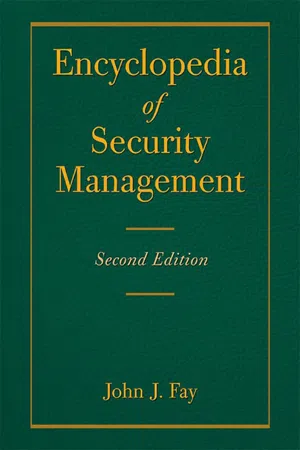
Encyclopedia of Security Management
About this book
The Encyclopedia of Security Management is a valuable guide for all security professionals, and an essential resource for those who need a reference work to support their continuing education. In keeping with the excellent standard set by the First Edition, the Second Edition is completely updated.
The Second Edition also emphasizes topics not covered in the First Edition, particularly those relating to homeland security, terrorism, threats to national infrastructures (e.g., transportation, energy and agriculture) risk assessment, disaster mitigation and remediation, and weapons of mass destruction (chemical, biological, radiological, nuclear and explosives). Fay also maintains a strong focus on security measures required at special sites such as electric power, nuclear, gas and chemical plants; petroleum production and refining facilities; oil and gas pipelines; water treatment and distribution systems; bulk storage facilities; entertainment venues; apartment complexes and hotels; schools; hospitals; government buildings; and financial centers. The articles included in this edition also address protection of air, marine, rail, trucking and metropolitan transit systems.
- Completely updated to include new information concerning homeland security and disaster management
- Convenient new organization groups related articles for ease of use
- Brings together the work of more than sixty of the world's top security experts
Information
I
Business Principles
AGE DISCRIMINATION
The Age Discrimination in Employment Act of 1967 (ADEA) protects individuals who are 40 years of age or older from employment discrimination based on age. The ADEA’s protections apply to both employees and job applicants. Under the ADEA, it is unlawful to discriminate against a person because of his/her age with respect to any term, condition, or privilege of employment, including hiring, firing, promotion, layoff, compensation, benefits, job assignments, and training.
It is also unlawful to retaliate against an individual for opposing employment practices that discriminate based on age or for filing an age discrimination charge, testifying, or participating in any way in an investigation, proceeding, or litigation under the ADEA. The ADEA applies to employers with 20 or more employees, including state and local governments. It also applies to employment agencies and labor organizations, as well as to the federal government. ADEA protections include:
Apprenticeship Programs
It is generally unlawful for apprenticeship programs, including joint labor-management apprenticeship programs, to discriminate on the basis of an individual’s age. Age limitations in apprenticeship programs are valid only if they fall within certain specific exceptions under the ADEA or if the EEOC grants a specific exemption.
Job Notices and Advertisements
The ADEA generally makes it unlawful to include age preferences, limitations, or specifications in job notices or advertisements. A job notice or advertisement may specify an age limit only in the rare circumstances where age is shown to be a “bona fide occupational qualification” (BFOQ) reasonably necessary to the normal operation of the business.
Pre-Employment Inquiries
The ADEA does not specifically prohibit an employer from asking an applicant’s age or date of birth. However, because such inquiries may deter older workers from applying for employment or may otherwise indicate possible intent to discriminate based on age, requests for age information will be closely scrutinized to make sure that the inquiry was made for a lawful purpose, rather than for a purpose prohibited by the ADEA.
Benefits
The Older Workers Benefit Protection Act of 1990 (OWBPA) amended the ADEA to specifically prohibit employers from denying benefits to older employees. Congress recognized that the cost of providing certain benefits to older workers is greater than the cost of providing those same benefits to younger workers, and that those greater costs would create a disincentive to hire older workers. Therefore, in limited circumstances, an employer may be permitted to reduce benefits based on age, as long as the cost of providing the reduced benefits to older workers is the same as the cost of providing benefits to younger workers.
Waivers of ADEA Rights
An employer may ask an employee to waive his/her rights or claims under the ADEA either in the settlement of an ADEA administrative or court claim or in connection with an exit incentive program or other employment termination program. However, the ADEA, as amended by OWBPA, sets out specific minimum standards that must be met in order for a waiver to be considered knowing and voluntary and, therefore, valid. Among other requirements, a valid ADEA waiver must:
• Be in writing and be understandable.
• Specifically refer to ADEA rights or claims.
• Not waive rights or claims that may arise in the future.
• Be in exchange for valuable consideration.
• Advise the individual in writing to consult an attorney before signing the waiver.
• Provide the individual at least 21 days to consider the agreement and at least seven days to revoke the agreement after signing it.
If an employer requests an ADEA waiver in connection with an exit incentive program or other employment termination program, the minimum requirements for a valid waiver are more extensive.
Source
The U.S. Equal Employment Opportunity Commission. <http://www.eeoc.gov/types/age.html>, 2006.
BEST PRACTICES
Dennis Dalton
Pursuing quality requires making a commitment to doing things in the best possible way. In today’s organizational environment we would call this “pursuing best practices.” But what does this mean exactly? To properly understand the context of best practices we need to consider three fundamental realities:
• There are no absolute criteria for defining best practices within security today.
• Best practices do not have to be measurable by empirical means.
• Best practices can be common practices.
On the surface, each of the three considerations appears to fly in the face of the very essence of what best practices should be all about. Yet ironically all three embody the very essence of best practices for a security manager. Let’s examine each briefly.
First, security is a non-codified profession. Unlike corporate safety with its guidelines as set forth by underwriters and regulators, the security industry has not subscribed to a set of standards. Consequently, security professionals are pretty much driven by the codes of other professional business counterparts, an occasional state requirement, an underwriter prescription, or a court decision.
Even though there may be no prescribed, empirical criteria for measuring the attainment of best practices, decision makers can determine if they are on the right track when such practices:
• Directly contribute to the bottom line.
• Add value in a demonstrable way.
• Maximize efficiency and effectiveness.
Established practices can become best practices. For example, requiring employees to display a photo identification badge is an established practice that is not always done well. When an organization enforces the established practice by use of a system of incentives and disincentives, and when statistical evidence shows that the practice contributes to cost savings, such as preventing theft, the common practice becomes a best practice.
A security manager can evaluate security practices by asking a simple question: “Am I getting the job done?” If the security manager’s responsibilities include criminal investigations, the evaluation criteria can be how quickly the investigation was completed, whether the investigation succeeded in solving a crime or correcting a crime condition, the cost of the investigation, recovery of property, and a settlement from or restitution made by the offending party. In looking at the totality of investigations, the security manager can compare total costs against total recoveries and also use historical data to demonstrate that crime-related losses in previous years were higher than crime-related costs currently.
Challenging Basic Assumptions
Are the common assumptions associated with staffing levels and deployment, allocation of security systems and devices, and operating practices relevant in today’s organizational culture? Or are there other opportunities available to be pursued that will yield the same result at a lower cost while actually maintaining or increasing the quality of the service delivered? As an example, with respect to criminal investigations, is it better to create a prosecutorial threshold (that is, no loss under an established value will be criminally pursued) rather than using civil litigation as a means of seeking appropriate remedies for all losses? By establishing such thresholds, both the manner in which investigations are pursued and the allocation of resources could vary significantly. Only those incidents involving a loss equivalent to a significant monetary value would be pursued from a criminal perspective, and those investigations would require an adherence to a higher standard of investigational pursuit. It is important to note that the best practice here is the establishment of a value threshold. The actual value you establish will vary depending on the type of organization and value of the assets.
Allocating Staff Resources
To “get the job done” how many staff people do you require? This is much different from the traditional approach of seeking authoriz...
Table of contents
- Cover
- Title page
- Table of Contents
- Copyright
- Contributing Authors
- Foreword
- Preface
- Chapter 1: Business Principles
- Chapter 2: Emergency Management Practices
- Chapter 3: Information Security
- Chapter 4: Investigation
- Chapter 5: Legal Aspects
- Chapter 6: Physical Security
- Chapter 7: Protection Practices
- Chapter 8: Risk Analysis
- Chapter 9: Security Fields
- Chapter 10: Security Principles
- Chapter 11: Terrorism
- Chapter 12: Liaison
- Index
Trusted by 375,005 students
Access to over 1.5 million titles for a fair monthly price.
Study more efficiently using our study tools.
Frequently asked questions
Yes, you can cancel anytime from the Subscription tab in your account settings on the Perlego website. Your subscription will stay active until the end of your current billing period. Learn how to cancel your subscription
No, books cannot be downloaded as external files, such as PDFs, for use outside of Perlego. However, you can download books within the Perlego app for offline reading on mobile or tablet. Learn how to download books offline
Perlego offers two plans: Essential and Complete
- Essential is ideal for learners and professionals who enjoy exploring a wide range of subjects. Access the Essential Library with 800,000+ trusted titles and best-sellers across business, personal growth, and the humanities. Includes unlimited reading time and Standard Read Aloud voice.
- Complete: Perfect for advanced learners and researchers needing full, unrestricted access. Unlock 1.5M+ books across hundreds of subjects, including academic and specialized titles. The Complete Plan also includes advanced features like Premium Read Aloud and Research Assistant.
We are an online textbook subscription service, where you can get access to an entire online library for less than the price of a single book per month. With over 1.5 million books across 990+ topics, we’ve got you covered! Learn about our mission
Look out for the read-aloud symbol on your next book to see if you can listen to it. The read-aloud tool reads text aloud for you, highlighting the text as it is being read. You can pause it, speed it up and slow it down. Learn more about Read Aloud
Yes! You can use the Perlego app on both iOS and Android devices to read anytime, anywhere — even offline. Perfect for commutes or when you’re on the go.
Please note we cannot support devices running on iOS 13 and Android 7 or earlier. Learn more about using the app
Please note we cannot support devices running on iOS 13 and Android 7 or earlier. Learn more about using the app
Yes, you can access Encyclopedia of Security Management by John Fay in PDF and/or ePUB format, as well as other popular books in Business & Information Management. We have over 1.5 million books available in our catalogue for you to explore.