eBook - ePub
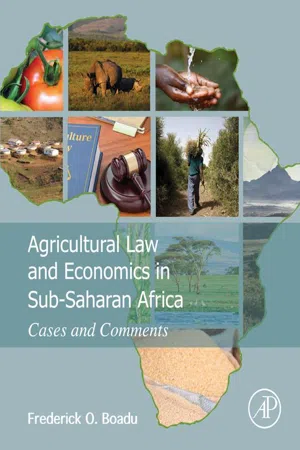
Agricultural Law and Economics in Sub-Saharan Africa
Cases and Comments
- 624 pages
- English
- ePUB (mobile friendly)
- Available on iOS & Android
eBook - ePub
About this book
Agricultural Law in Sub-Saharan Africa: Cases and Comments introduces the subject of agricultural law and economics to researchers, practitioners, and students in common law countries in Sub-Saharan Africa, and presents information from the legal system in Botswana, Gambia, Ghana, Lesotho, Malawi, Nigeria, Sierra Leone, South Africa, Swaziland, Tanzania, Zambia, and Zimbabwe. The law and economics approach entails the use of quantitative methods in research. This is consistent with the expectations in an applied economics field such as agricultural economics.
Covering the general traditional law topics in contracts, torts, and property, the book goes further to introduce cutting-edge and region-relevant topics, including contracts with illiterate parties, contract farming, climate change, and transboundary water issues. The book is supported by an extensive list of reference materials, as well as study and enrichment exercises, to deepen readers' understanding of the principles discussed in the book. It is a learning tool, first and foremost, and can be used as a stand-alone resource to teach the subject matter of agricultural law and economics to professionals new to the subject area as well as to students in law school, agricultural economics, economics, and inter-disciplinary classes.
- Offers research findings on such topics as food safety, climate change, transboundary natural resources, international sale of goods, patents, and trademarks to highlight the future sources of pressure on the agriculture industry
- Uses case-studies to provide real-world insights into the challenges and considerations of appropriate agricultural law development
- Challenges readers to carry out their own research in their areas of study, and to gain some understanding of the relationship between law, economics, and statistics
- Includes extensive resources, such as chapter summaries, study questions, and challenge questions at the end of each chapter to assist instructors and students in gaining full benefits from using the book
- Provides separate instructor and student study guides, a test bank, and test bank answers, in hardcopy and electronic formats
Information
Chapter 1
What Is Agricultural Law?
Abstract
This chapter introduces the subject matter of agricultural law and the process of seeking redress before a court in sub-Saharan Africa (SSA). The sources of laws in SSA are discussed and some of the problems facing the courts, including court costs, case delays, and access to court are also explored. The complex interaction between customary laws and the received common law from England is also discussed. The law and economics evidence is of a central concept in the dispute resolution process. Cases from several SSA countries are used to illustrate how courts have explained the role of evidence in the dispute resolution process.
Keywords
Agricultural law; sources of law in your country; common law; written law; latent market; civil action; criminal action; court delay; court costs; plaintiff; defendant; evidence; parol evidence
1.1 Introduction
Agricultural law consists of the laws, regulations, decrees, treaties, and institutions (universities, financial and marketing systems, transportation) that govern the agricultural supply chain (production, marketing, and sales). The central focus is agriculture production (Kershen, 2008; Schneider, 2009). The growth of agricultural law in the United States and Europe has been influenced by the intellectual leadership made possible by the integration of agricultural law into the traditional law school curriculum, and by the participation of a knowledgeable industry/practitioner group that strengthens the industry- and client-based applied focus of agricultural law (Schneider, 2009). Some land grant institutions in the United States teach agricultural law at the undergraduate level in the department of agricultural economics. These schools also have lawyers working with the extension services serving farmers and the food industry. There is no law school in sub-Saharan Africa (SSA) with a formal agricultural law curriculum, and only a few lawyers in Africa list their practice areas to include agricultural law.
Law schools in SSA are currently not preparing lawyers to respond adequately to the needs of farmers, agricultural input suppliers, rural and urban communities, food processors, transporters, warehouses, and environmental groups. Consequently, legal and institutional issues related to contracting in agriculture, food safety and standards, agriculture lending, trade, land use, natural resources, and the environment are not being adequately addressed. A formal agricultural law curriculum in SSA law schools, economics, and agricultural economics departments will serve as a catalyst for the growing number of practitioners willing to explore markets for legal services focusing on agriculture and the food industry.
1.2 The Law and Economics Approach
This book introduces a law and economics approach to teaching agricultural law. This is the first application of this approach and is intended to emphasize the interconnectedness of law and economics and also the fact that agricultural law is today being taught in law schools, agricultural economics, and traditional economics departments. Economic analysis of law applies the tools of microeconomic theory to the analysis of legal rules and institutions (Posner, 2007). The Coase theorem is a central concept in law and economics and has spawned an extensive literature on the relationship between law and economics (Coase, 1961).1 The theorem can be explained with a simple example.2 Consider the following:
A Fulani cattle herder is grazing cattle on open land and causing harm to five crop farmers. Each farmer suffers ₤75 worth of damage for total damage of ₤375.
The crop damage can be eliminated in one of two ways:
Install a fence that costs ₤150.
Buy each farmer a cattle trap that costs ₤50 each for a total of ₤250 (5×₤50).
Clearly the efficient solution is to install a screen for ₤150.
Consider the following two situations:
If the farmers are entitled to safe crops, the cattle herder has three choices: (1) destroy the crops and pay damages equal to ₤375; (2) install a fence at cost of ₤150; or (3) buy cattle traps for the farmers costing ₤250. The efficient solution is to install a fence costing ₤150.
If the cattle herder is entitled to graze anywhere, even if crops are destroyed in the process, the farmers have three choices: (1) suffer crop damages equal to ₤375; (2) purchase cattle traps at a cost of ₤250; or (3) install a fence for the cattle herder at a cost of ₤150. Again, the efficient solution is to install a fence costing ₤150 for the cattle herder.
The example shows that the efficient solution does not depend on the initial allocation of entitlements, that is, whether the cattle herder has a right to graze cattle anywhere or the farmers have a right to safe crops. This means, in the absence of factors that restrain the herders and the farmers from negotiating, the parties on their own would negotiate to an efficient outcome. The theory suggests that the main reason we do not observe widespread negotiations is due to the presence of transaction costs. Transaction costs consist of (1) information costs; (2) bargaining costs; and (3) policing (monitoring) costs (Johnson, 2005).3
Parties to a negotiation need information about each other and the subject matter of the negotiation. Obtaining such information could be quite costly. Bargaining is also costly, especially when one party engages in strategic behavior. For example, in a case where one party is entitled to safe crops, the party could engage in a holdout and insist that cattle herders be banned altogether even though the efficient result could be some type of compensation payment. Even after bargaining, one party may cheat. This imposes costs on the good party in terms of monitoring or policing the arrangement. What the Coase theorem teaches is that laws and regulations to promote the evolution of efficient markets should help to reduce the transaction costs so that parties on their own could negotiate to an efficient outcome in interaction with each other. As the reader goes through the decisions rendered by courts it is useful to ask how the courts are issuing decisions that promote, institution-building, justice, and efficiency to help society achieve maximum social benefits through private negotiations and interactions.
1.3 Sources of Law in SSA Common Law Countries
The sources of law in common law countries in SSA are uniformly based on a mixture of English common law and the customary law that existed in the country before of the introduction of English law. The sources of law in SSA common law countries include, the Constitution, laws passed by the legislature or Parliament of the country, customary law, and the common law.4 Countries have defined their laws to reflect their diverse historical, ethnic, and religious backgrounds and experiences. For example, the sources of law in Kenya include Indian and Muslim sources given the significant non-African and Muslim groups in the country.5 There is significant Roman-Dutch influence in the laws of Lesotho even though South African precedents are only persuasive (Dube). Nigerian sources of law also reflect the diverse cultural and religious background of the country. In addition to Islamic law, certain regions of the country also practice Sharia Law, “the principal feature being the introduction of religious based criminal offences, especially on matters of morality and the introduction of punishments sanctioned by the Koran” (Dina et al.).
The Ghana Constitution defines the common law as “the rules generally known as the common law, the rules generally known as the doctrines of equity and the rules of customary law including those determined by the Superior Court of Judicature.”6 The law did not completely replace the existing customary law and practices of the colony so long as such law or custom was not “repugnant to natural justice, equity or good conscience, nor incompatible either directly or by necessary implication with any enactment of the Colonial Legislature.”7
Common law countries in SSA are gradually evolving their own “common law.” For example, a “Ghanaian common law”8 has emerged out of Ghanaian courts’ interpretation of English law in the Ghanaian context. This trend is also observed in other SSA countries. The ability of courts to fashion a common law consistent with market-led growth raises two issues. First, jurisdictions in advanced countries that accepted the common law shared similar cultural and economic backgrounds with England. Countries in SSA, on the other hand, have a fundamentally different culture, and are only recently pursuing a market-led development approach. The customary rules under which individuals in SSA countries organized their affairs before the introduction of British rule may be inadequate to support the modernization of the country. As Professor Seidman points out, “excepting problems of land tenure, most of the claims made upon customary law are not claims of development” (Seidman, 1968). This is especially true today when the winds of globalization are moving countries towards new law and regulatory governance regimes that defy the institutional set-up of any single country.9 One example of this evolving common legal regime is the United Nations Convention on Contracts for the International Sale of Goods (CISG), which “establishes a comprehensive code of legal rules governing the formation of contracts for the international sale of goods, the obligations of the buyer and seller, remedies for breach of contract and other aspects of the contract. The Convention entered into force on 1 January 1988.”10 Buscaglia considers the globalization phenomenon as a powerful force in legal transplantation.11
1.4 Written and Unwritten Law
In the common law tradition, decisions rendered by courts become a part of the law. Thus, law in Ghana consists of those made by the Parliament and those decisions made by courts in the country. These decisions by courts are sometimes referred to as “judge-made rules of law or precedents.” These are laws because in the common law tradition, judges must follow the decisions from previous court rulings if the facts of a present case are the same as the facts that supported a previous ruling.12
1.5 Pressures on the Legal System
There is broad agreement that court costs, court delays, access, and complexity are the main challenges facing the court systems in countries in SSA.13 The World Bank group has produced research and indices that help in assessing the empirical evidence on the extent to which these challenges impact the economic development goals of countries in SSA. Countries in SSA do poorly in terms of managing court delays, costs, and access compared to other countries around the world.14
1. The Cost of Using the Legal System and Access to Courts
The cost of using the legal system may be viewed from both demand and supply perspectives. On the demand side, households and firms are unable to use the services of lawyers and the courts due to low household incomes. One legal expert has observed that, “in Ghana, there are whole regions where almost everyone qualifies for legal aid: 7 of 10, 8 of 10, and 9 of 10 in the Central and Northern Regions; the Upper East Region, and the Upper West Region re...
The cost of using the legal system may be viewed from both demand and supply perspectives. On the demand side, households and firms are unable to use the services of lawyers and the courts due to low household incomes. One legal expert has observed that, “in Ghana, there are whole regions where almost everyone qualifies for legal aid: 7 of 10, 8 of 10, and 9 of 10 in the Central and Northern Regions; the Upper East Region, and the Upper West Region re...
Table of contents
- Cover image
- Title page
- Table of Contents
- Copyright
- Table of Cases
- About the Author
- Preface
- Acknowledgments
- Chapter 1. What Is Agricultural Law?
- Chapter 2. Contracts
- Chapter 3. Contract Farming
- Chapter 4. Agricultural Production and Share Contracts
- Chapter 5. Contracts Involving Illiterate Parties
- Chapter 6. Commercial Law
- Chapter 7. Trademarks and Patents
- Chapter 8. Cooperatives in Sub-Saharan Africa
- Chapter 9. Contracts Governed by International Conventions or Treaties
- Chapter 10. Tort Law
- Chapter 11. Eminent Domain
- Chapter 12. Forest Resources
- Chapter 13. Wildlife Resources
- Chapter 14. Water Resources
- Chapter 15. Environmental Law
- Chapter 16. Transboundary Water Resources and Wetlands
- Chapter 17. Climate Change
- Chapter 18. Food Safety Regulation
- Index
Trusted by 375,005 students
Access to over 1.5 million titles for a fair monthly price.
Study more efficiently using our study tools.
Frequently asked questions
Yes, you can cancel anytime from the Subscription tab in your account settings on the Perlego website. Your subscription will stay active until the end of your current billing period. Learn how to cancel your subscription
No, books cannot be downloaded as external files, such as PDFs, for use outside of Perlego. However, you can download books within the Perlego app for offline reading on mobile or tablet. Learn how to download books offline
Perlego offers two plans: Essential and Complete
- Essential is ideal for learners and professionals who enjoy exploring a wide range of subjects. Access the Essential Library with 800,000+ trusted titles and best-sellers across business, personal growth, and the humanities. Includes unlimited reading time and Standard Read Aloud voice.
- Complete: Perfect for advanced learners and researchers needing full, unrestricted access. Unlock 1.5M+ books across hundreds of subjects, including academic and specialized titles. The Complete Plan also includes advanced features like Premium Read Aloud and Research Assistant.
We are an online textbook subscription service, where you can get access to an entire online library for less than the price of a single book per month. With over 1.5 million books across 990+ topics, we’ve got you covered! Learn about our mission
Look out for the read-aloud symbol on your next book to see if you can listen to it. The read-aloud tool reads text aloud for you, highlighting the text as it is being read. You can pause it, speed it up and slow it down. Learn more about Read Aloud
Yes! You can use the Perlego app on both iOS and Android devices to read anytime, anywhere — even offline. Perfect for commutes or when you’re on the go.
Please note we cannot support devices running on iOS 13 and Android 7 or earlier. Learn more about using the app
Please note we cannot support devices running on iOS 13 and Android 7 or earlier. Learn more about using the app
Yes, you can access Agricultural Law and Economics in Sub-Saharan Africa by Frederick Owusu Boadu in PDF and/or ePUB format, as well as other popular books in Business & Agribusiness. We have over 1.5 million books available in our catalogue for you to explore.