eBook - ePub
Lightweight Ballistic Composites
Military and Law-Enforcement Applications
- 448 pages
- English
- ePUB (mobile friendly)
- Available on iOS & Android
eBook - ePub
About this book
Ballistic composites need to be lightweight and durable as well as exhibiting high impact resistance and damage tolerance. This important book reviews these requirements, how the materials used for ballistic composites meet them and their range of applications.After an introductory chapter, Lightweight ballistic composites is split into two main sections. The first part of the book explores material requirements and testing. There are chapters on bullets and bullet fragments, material responses to ballistic impact, standards and specifications, modelling and test methods. Part Two reviews the range of materials used, production methods and applications. Topics discussed include high-performance ballistic fibres and ceramics, non-woven ballistic and prepreg composites, and their uses in body armour, vehicle and aircraft protection.This major book is the first of its kind to give a comprehensive review of the current use of lightweight ballistic composites in both military and law-enforcement applications. It is an invaluable reference for all those involved in personnel and vehicle protection in defence and police forces around the world.
- Reviews the current use of lightweight ballistic composites in both military and law-enforcement application
- An authoritative overview of the range of materials used, production methods and applications
- Explores material requirements and testing
Information
1
Introduction
L. Wanger Honeywell International Inc., USA
1.1 History
With the invention of explosive powder, the dynamics of the battlefield have changed and from the American Civil War era to the current war on terrorism, mankind has been exposed to high speed projectiles, namely bullets fired from a handgun or rifle, fragments of hardened steel from a hand grenade, or massive explosions of artillery shells or homemade bombs. During the First and Second World Wars knowledge about personnel protective gear was limited to the use of steel. However, due to the heavy weight of the steel armor and lack of flexibility, it was used only on slow moving, heavily armored vehicles. Personnel protection was completely missing.
The earliest use of a head-protecting helmet was attempted during the First World War by the French army. This helmet was a modified metal cap to protect soldiers from head-related injuries and was used by a number of armies. During the same war Germany introduced heavy breastplates, the British lighter breastplates, and Italy armored waistcoats.
For personnel protection, flak jackets were used during the Vietnam era. However, these jackets were heavy, bulky and provided limited protection from high speed projectiles.
During the last two to three decades scientists and engineers at various industries, universities, and government laboratories have conducted research work on ballistic materials and their interaction with high-speed projectiles. A majority of these detailed studies are written for an audience whose knowledge is limited. Ballistic information which reaches end-users is in the form of condensed literature from brochures, experience by users, and from standards published by military and law enforcement agencies.
It is hoped that this book will bring some of the recent advances in the area of ballistic protection to light in simplified form. The book is divided into chapters to cover lightweight high performance ballistic fibers – the backbone of an armor system – as well as ballistic woven and non-woven materials. The book has chapters on specifications of armor from around the world; subjects include details of common bullets and fragments, deformation of bullets, ballistic testing, modeling of ballistic materials, current ballistic applications related to personnel protection, armored vehicles, and, finally, a chapter covering the future of high performance, lightweight, fiber-reinforced composite armor for personnel protection. Some new lightweight ballistic materials currently in the pipeline are also highlighted in the last chapter of this book.
The chapters in this book should help readers from a wide spectrum understand current lightweight materials and the trade-off in relation to performance of protective armor, its cost and availability.
1.2 Ballistic fibers
High performance, man-made ballistic fibers have unique properties which set them apart from other man-made fibers used for industrial applications. The tensile strength and modulus of the ballistic fibers are significantly higher and fiber elongation is lower. These fibers can be woven on fabric looms more easily than brittle fibers such as fiberglass and graphite fibers. The ballistic fibers also show inherent resistance to a number of chemicals, industrial solvents and lubricants used by automotive and aerospace industries.
Each high performance ballistic fiber has a certain unique property because of the polymer used to manufacture the fiber and the unique spinning process. The tensile properties of these ballistic fibers are determined by their structural characteristics at a molecular orientation about the spinning direction, and the effective cross-section area occupied by single chain which is related to the degree of chain linearity. The manufacturing process controls both the microscopic structure and chain orientation in a ballistic fiber. However, another equally important aspect is the economy of fiber manufacturing which may or may not give the highest theoretical properties of ballistic fibers, but help manufacturers to produce large quantities of fibers at a reasonable cost structure. Balancing the two is not simple, but after running a pilot plant for a few years and selling the ballistic fiber, most manufacturing companies figure out how to sell their fibers in applications which will utilize the unique fiber properties.
Current success of the lightweight fiber-reinforced armor did not happen overnight, the development started in the early 1970s. For the first fifteen years the understanding was limited to a few fibers and a limited type of weaves which provided a decent level of ballistic protection in the vest and to a greater extent when combined with a thermoset resin and molded under heat and pressure. Since there was practically no competition, incentive for improvement was practically non-existent. As new lightweight ballistic fibers started moving out from bench scale to full-scale production, competition increased and customers started demanding lower weight and higher ballistic protection.
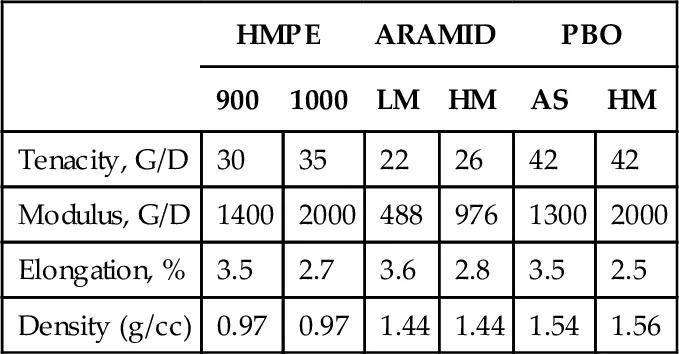
A comparison of high performance ballistic fibers is shown below in Table 1.1. The High Modulus Polyethylene (HMPE) was introduced in the mid-1980s and PBO was introduced in the late 1990s.
Table 1.1
Properties of high performance ballistic fibers
| HMPE | ARAMID | PBO | ||||
| 900 | 1000 | LM | HM | AS | HM | |
| Tenacity, G/D | 30 | 35 | 22 | 26 | 42 | 42 |
| Modulus, G/D | 1400 | 2000 | 488 | 976 | 1300 | 2000 |
| Elongation, % | 3.5 | 2.7 | 3.6 | 2.8 | 3.5 | 2.5 |
| Density (g/cc) | 0.97 | 0.97 | 1.44 | 1.44 | 1.54 | 1.56 |
Along with the new more efficient fibers other technologies were also developed. One of the most significant technologies combines new higher performance ballistic fibers into a (0, 90) network without going through the traditional fiber twist and weaving technology. This technology revolutionized the entire dynamics of lightweight armor. Soft armor became lighter and more comfortable and molded armor not only became lighter than water but could also stop rifle bullets.
Some European countries not only experimented with new materials but also adopted them, in some cases practically overnight, for peacekeeping and military missions.
Fine tuning of new armor technologies and traditional technologies continues to improve in terms of weight saving and higher performance. Due to continuous improvement in high performance fibers, weaving technology and non-woven cross-plied unidirectional technologies, weight reduction of lightweight armor is between 10 and 20% every ten years.
1.2.1 Aramid fibers
In the late 1960s a technology breakthrough occurred in the field of polymers. Dupont scientists developed a family of fibers three times as strong as nylon with a far higher modulus. The fiber was so fine that a woven fabric could be made which had flexibility and drapability. The new fiber was named as PRD-49 and then commercialized as Kevlar®29. These fibers were much tougher and lighter than fiberglass fibers and replaced nylon in flexible and rigid armor used by law enforcement agencies and the military. The helmets and flexible vests made with aramid fibers could stop fragments and bullets at a much lower weight than the nylon fibers. However, the fiber-reinforced composites could not stop all bullets fired from a rifle. With ceramic tiles and aramid composite backing, a new lightweight material was developed which could stop a rifle bullet in comparison to ceramic backed with fiberglass composites.
Law enforcement also showed interest in aramid fiber due to its protective properties against handgun bullets. The weight of an aramid vest was much lower than the nylon vest.
1.2.2 HMPE fibers
With the invention of gel-spun HMPE fiber manufacturing technology, fibers were commercialized by Honeywell (Allied Fibers) which were 10 times stronger than steel, but lighter than water and showed non-linear viscoelastic properties. Due to the chemistry of the HMPE fibers, the surface of the fiber is practically inert to a host of chemicals exposed to law enforcement agencies and also faced by military personnel on the battlefield.
Along with the HMPE fiber technology Honeywell introduced another equally important technology in the late 1990s. In this technology, fibers-to-high velocity projectiles interaction was dramatically increased by utilizing unidirectional, cross-plied non-woven technology. The technology utilizes untwisted fibers, which are spread out at macro level and held in a predetermined orientation by a binder.
A third technology, invented in the mid-1990s, was molding technology. In this technology high pressure is utilized to consolidate the fiber packing density in the molded product. With higher fiber pack density, along with the viscoelastic properties of the HMPE fiber technology, a rifle M80 ball bullet can be stopped at about 15 kg/m2 which is almost a 50% weight reduction for armor molded to stop the same bullet only a few years before. The molded products consist of 100% HMPE fiber-reinforced composite, only with no ceramic facing.
The French military was the first to use molded HMPE plate kits in Bosnia. The vest consisted of four molded plates inserted into a flexible vest covering front, back, groin and collar. Since then a number of European and Asian countries have adopted similar armor for stopping high energy bullets fired from rifles.
1.2.3 PBO fibers
PBO fibers are relatively new high performance fibers for the ballistic vest. Although these fibers are more expensive and have limited supply, the remarkable ballistic-resistant qualities of these fibers have helped to set a new level of soft armor performance. At the moment, limited long-term performance data is available. A number of vest manufacturing companies in the United States have commercialized vests using PBO woven fabric and non-woven cross-plied unidirectional ballistic materials.
1.3 Fiber-reinforced ballistic armor
Fiber-reinforced ballistic armor is the generic term for a group of related yet individual materials. Some of the groups utilize only high perfo...
Table of contents
- Cover image
- Title page
- Table of Contents
- Copyright page
- Dedication
- Contributor contact details
- 1: Introduction
- Part I: Material requirements and testing
- Part II: Types of material and their application
- Index
Trusted by 375,005 students
Access to over 1.5 million titles for a fair monthly price.
Study more efficiently using our study tools.
Frequently asked questions
Yes, you can cancel anytime from the Subscription tab in your account settings on the Perlego website. Your subscription will stay active until the end of your current billing period. Learn how to cancel your subscription
No, books cannot be downloaded as external files, such as PDFs, for use outside of Perlego. However, you can download books within the Perlego app for offline reading on mobile or tablet. Learn how to download books offline
Perlego offers two plans: Essential and Complete
- Essential is ideal for learners and professionals who enjoy exploring a wide range of subjects. Access the Essential Library with 800,000+ trusted titles and best-sellers across business, personal growth, and the humanities. Includes unlimited reading time and Standard Read Aloud voice.
- Complete: Perfect for advanced learners and researchers needing full, unrestricted access. Unlock 1.5M+ books across hundreds of subjects, including academic and specialized titles. The Complete Plan also includes advanced features like Premium Read Aloud and Research Assistant.
We are an online textbook subscription service, where you can get access to an entire online library for less than the price of a single book per month. With over 1.5 million books across 990+ topics, we’ve got you covered! Learn about our mission
Look out for the read-aloud symbol on your next book to see if you can listen to it. The read-aloud tool reads text aloud for you, highlighting the text as it is being read. You can pause it, speed it up and slow it down. Learn more about Read Aloud
Yes! You can use the Perlego app on both iOS and Android devices to read anytime, anywhere — even offline. Perfect for commutes or when you’re on the go.
Please note we cannot support devices running on iOS 13 and Android 7 or earlier. Learn more about using the app
Please note we cannot support devices running on iOS 13 and Android 7 or earlier. Learn more about using the app
Yes, you can access Lightweight Ballistic Composites by Ashok Bhatnagar in PDF and/or ePUB format, as well as other popular books in Technology & Engineering & Materials Science. We have over 1.5 million books available in our catalogue for you to explore.