eBook - ePub
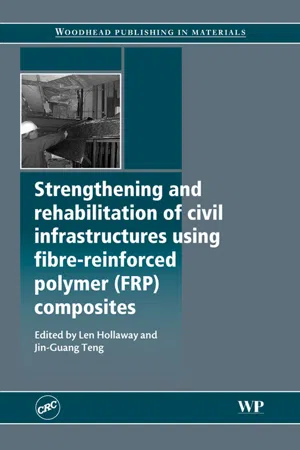
Strengthening and Rehabilitation of Civil Infrastructures Using Fibre-Reinforced Polymer (FRP) Composites
- 416 pages
- English
- ePUB (mobile friendly)
- Available on iOS & Android
eBook - ePub
Strengthening and Rehabilitation of Civil Infrastructures Using Fibre-Reinforced Polymer (FRP) Composites
About this book
The repair of deteriorated, damaged and substandard civil infrastructures has become one of the most important issues for the civil engineer worldwide. This important book discusses the use of externally-bonded fibre-reinforced polymer (FRP) composites to strengthen, rehabilitate and retrofit civil engineering structures, covering such aspects as material behaviour, structural design and quality assurance.The first three chapters of the book review structurally-deficient civil engineering infrastructure, including concrete, metallic, masonry and timber structures. FRP composites used in rehabilitation and surface preparation of the component materials are also reviewed. The next four chapters deal with the design of FRP systems for the flexural and shear strengthening of reinforced concrete (RC) beams and the strengthening of RC columns. The following two chapters examine the strengthening of metallic and masonry structures with FRP composites. The last four chapters of the book are devoted to practical considerations in the flexural strengthening of beams with unstressed and prestressed FRP plates, durability of externally bonded FRP composite systems, quality assurance and control, maintenance, repair, and case studies.With its distinguished editors and international team of contributors, Strengthening and rehabilitation of civil infrastructures using fibre-reinforced polymer (FRP) composites is a valuable reference guide for engineers, scientists and technical personnel in civil and structural engineering working on the rehabilitation and strengthening of the civil infrastructure.
- Reviews the use of fibre-reinforced polymer (FRP) composites in structurally damaged and sub-standard civil engineering structures
- Examines the role and benefits of fibre-reinforced polymer (FRP) composites in different types of structures such as masonry and metallic strengthening
- Covers practical considerations including material behaviour, structural design and quality assurance
Information
1
Structurally deficient civil engineering infrastructure: concrete, metallic, masonry and timber structures
L. DE LORENZIS, University of Salento, Italy
T.J. STRATFORD, University of Edinburgh, UK
L.C. HOLLAWAY, University of Surrey, UK
Publisher Summary
This chapter discusses the structurally deficient civil engineering infrastructure: concrete, metallic, masonry, and timber structures. The repair of deteriorated, damaged, and substandard civil infrastructure has become one of the important issues for the civil engineer worldwide. The rehabilitation of existing structures is fast growing, especially in developed countries, which completed most of their infrastructure in the middle period of the last century. The structures that were built after World War II had little attention paid to durability issues and the U.S, and Japan had inadequate knowledge of seismic design. The chapter gives an overview of the forms and properties of concrete, metallic, masonry, and timber structures that might need rehabilitation. The ways in which externally bonded FRP can be used to extend the lives of the structures are described. It describes general structural deficiencies and discusses the reasons for using FRP strengthening rather than conventional strengthening techniques.
1.1 Introduction
The repair of deteriorated, damaged and substandard civil infrastructure has become one of the important issues for the civil engineer worldwide. The rehabilitation of existing structures is fast growing, especially in developed countries, which completed most of their infrastructure in the middle period of the last century. Furthermore, structures which were built after World War II had little attention paid to durability issues, and the USA and Japan had inadequate knowledge of seismic design. In 1995, the Hyogoken–Nanbu earthquake caused a great disaster to the city of Kobe, Japan. As a result, in September 1999, the Japan Building Disaster Prevention Association (JBDPA, 1999) published the Seismic Retrofitting ‘Design and Construction Guidelines for Existing Reinforced Concrete Bridges with Fibre Reinforced Polymer Materials’. In the European Union nearly 84 000 reinforced and prestressed concrete bridges require maintenance, repair and strengthening with an annual budget of £215 M, excluding traffic management cost (Leeming and Derby, 1999). In the USA, infrastructure upgrading of structures has been estimated as $20 trillion (NSF, 1993).
Within the scope of rehabilitation of concrete structures and metallic and timber systems, it is essential to differentiate between the terms repair, strengthening and retrofitting; these terms are often erroneously interchanged, but they do refer to three different structural conditions. In ‘repairing’ a structure, the composite material is used to improve a structural or functional deficiency such as a crack or a severely degraded structural component. In contrast, the ‘strengthening’ of a structure is specific to those cases where the addition or application of the composite would enhance the existing designed performance level. The term ‘retrofit’ is specifically used to relate to the seismic upgrade of facilities, such as in the case of the use of composite jackets for the confinement of columns. Strengthening/rehabilitating/retrofitting existing structures, manufactured from the more conventional materials, by utilising advanced fibre reinforced polymer (FRP) composites is a powerful and viable alternative to the use of steel. Since the 1980s, the realisation amongst civil/structural engineers of the importance of the specific weight and stiffness, the resistance to corrosion, durability, tailorability and ease of installation is encouraging the use of FRP composites in the rehabilitation of structures throughout the world. Externally bonded FRP composite strengthening is particularly attractive where there are severe access restraints or high cost associated with installation time. In addition, the capacity of FRP composite strengthening to extend the life of historic structures with minimum disruption to users makes for genuinely sustainable engineering solutions. Furthermore, the fabrication technologies for the production of FRP composites have been revolutionised by sophisticated manufacturing techniques. These methods have enabled polymer composite materials to produce good-quality laminates with minimal voids and accurate fibre alignment.
This book will discuss the mechanical and in-service properties and the relevant manufacturing techniques and aspects related to externally bonded FRP composites to strengthen/rehabilitate/retrofit civil engineering structural materials. The book concentrates on:
1. the mechanical properties of the FRP materials used;
2. the analysis and design of strengthening/rehabilitating/retrofitting beams and columns manufactured from reinforced concrete (RC), metallic, masonry and timber materials;
3. the failure modes of strengthening systems;
4. the site preparation of the two adherend materials;
5. the durability issues;
6. the quality control, maintenance and repair of structural systems;
7. some case studies.
This chapter gives an overview of the forms and properties of concrete, metallic, masonry and timber structures that may need rehabilitation. The ways in which externally bonded FRP can be used to extend the lives of these structures are described. An introductory section describes general structural deficiencies and the closing section discusses the reasons for using FRP strengthening rather than conventional strengthening techniques. Subsequent chapters describe the use of FRP composite strengthening in more detail, including aspects of design, durability, and inspection of a strengthening scheme.
1.2 Structural deficiencies
The world’s infrastructure comprises a wide range of structures, constructed over many years and from a variety of materials. Any of these structures might be structurally deficient and in need of strengthening to allow their continued use. The reasons for structural deficiency in the civil infrastructure can be split into two broad groups:
• changes in the use of a structure, so that it needs to carry different loads from those originally specified;
• degradation of a structure, so that it cannot carry the loads for which it was originally intended.
Both of these broad classifications of structural deficiency can be addressed using FRP composites. The term ‘strengthening’ is commonly used to describe rehabilitation of a structure, even though it might not be an increase in strength that is required.
Each construction material has different properties and different strengthening requirements. Hence, structural deficiencies are discussed for each of the materials below. Some structural deficiencies, however, are common to any type of structure.
1.2.1 Changes in the use of a structure
Civil infrastructure routinely has a serviceable life in excess of 100 years. It is inevitable that the structure will be required to fulfil a role not envisaged in the original specification. The structure is often unable to meet these new requirements, and consequently needs strengthening. Changes in use of a structure include:
• Increased live load. For example, increased traffic load on a bridge; change in use of a building resulting in greater imposed loads.
• Increased dead load. For example, additional load on underground structures due to new construction above ground.
• Increased dead and live load. For example, widening a bridge to add an extra lane of traffic.
• Change in load path. For example, by making an opening in a floor slab to accept a lift shaft, staircase or service duct.
• Modern design practice. An existing structure may not satisfy modern design requirements; for example, due to development of modern design methods, or due to changes in design codes.
• New loading requirements. For example, a structure may not have originally been designed to carry blast or seismic loads.
1.2.2 Degradation of a structure
The condition of a structure deteriorates with time, due to the service conditions to which the structure is subjected. In some cases this deterioration might be slowed or rectified by maintenance (for example, periodic painting); however, if the deterioration is unchecked the structure will become unable to perform the purpose for which it was originally designed.
• Corrosion is the most common mechanism of structural degradation, particularly where a member is exposed to an aggressive environment, such as the de-icing salts used on highways. Corrosion can lead to a loss of member cross-section, and a consequent reduction in the capacity of the member.
• Fatigue is a second cause of structural degradation, which can govern a structure’s remaining life.
• Hazard events. Structural degradation can also result from hazard events, such as impact (for example, ‘bridge bashing’ by over-height vehicles), vandalism, fire, blast loading or inappropriate structural alterations during maintenance. A single event may not be structurally significant, but multiple events could cause significant cumulative degradation to a structure.
• Design or construction errors due to poor construction workmanship and management, the use of inferior materials, or inadequate design, also result in deficient struc...
Table of contents
- Cover image
- Title page
- Table of Contents
- Related titles
- Copyright
- Contributor contact details
- Preface
- Chapter 1: Structurally deficient civil engineering infrastructure: concrete, metallic, masonry and timber structures
- Chapter 2: Fibre-reinforced polymer (FRP) composites used in rehabilitation
- Chapter 3: Surface preparation of component materials
- Chapter 4: Flexural strengthening of reinforced concrete (RC) beams with fibre-reinforced polymer (FRP) composites
- Chapter 5: Shear strengthening of reinforced concrete (RC) beams with fibre-reinforced polymer (FRP) composites
- Chapter 6: Strengthening of reinforced concrete (RC) columns with fibre-reinforced polymer (FRP) composites
- Chapter 7: Design guidelines for fibre-reinforced polymer (FRP)-strengthened reinforced concrete (RC) structures
- Chapter 8: Strengthening of metallic structures with fibre-reinforced polymer (FRP) composites
- Chapter 9: Strengthening of masonry structures with fibre-reinforced polymer (FRP) composites
- Chapter 10: Flexural strengthening application of fibre-reinforced polymer (FRP) plates
- Chapter 11: Durability of externally bonded fiber-reinforced polymer (FRP) composite systems
- Chapter 12: Quality assurance/quality control, maintenance and repair
- Chapter 13: Case studies
- Index
Trusted by 375,005 students
Access to over 1.5 million titles for a fair monthly price.
Study more efficiently using our study tools.
Frequently asked questions
Yes, you can cancel anytime from the Subscription tab in your account settings on the Perlego website. Your subscription will stay active until the end of your current billing period. Learn how to cancel your subscription
No, books cannot be downloaded as external files, such as PDFs, for use outside of Perlego. However, you can download books within the Perlego app for offline reading on mobile or tablet. Learn how to download books offline
Perlego offers two plans: Essential and Complete
- Essential is ideal for learners and professionals who enjoy exploring a wide range of subjects. Access the Essential Library with 800,000+ trusted titles and best-sellers across business, personal growth, and the humanities. Includes unlimited reading time and Standard Read Aloud voice.
- Complete: Perfect for advanced learners and researchers needing full, unrestricted access. Unlock 1.5M+ books across hundreds of subjects, including academic and specialized titles. The Complete Plan also includes advanced features like Premium Read Aloud and Research Assistant.
We are an online textbook subscription service, where you can get access to an entire online library for less than the price of a single book per month. With over 1.5 million books across 990+ topics, we’ve got you covered! Learn about our mission
Look out for the read-aloud symbol on your next book to see if you can listen to it. The read-aloud tool reads text aloud for you, highlighting the text as it is being read. You can pause it, speed it up and slow it down. Learn more about Read Aloud
Yes! You can use the Perlego app on both iOS and Android devices to read anytime, anywhere — even offline. Perfect for commutes or when you’re on the go.
Please note we cannot support devices running on iOS 13 and Android 7 or earlier. Learn more about using the app
Please note we cannot support devices running on iOS 13 and Android 7 or earlier. Learn more about using the app
Yes, you can access Strengthening and Rehabilitation of Civil Infrastructures Using Fibre-Reinforced Polymer (FRP) Composites by L C Hollaway,J G Teng in PDF and/or ePUB format, as well as other popular books in Technology & Engineering & Civil Engineering. We have over 1.5 million books available in our catalogue for you to explore.