
eBook - ePub
Fluidized Bed Technologies for Near-Zero Emission Combustion and Gasification
- 1,088 pages
- English
- ePUB (mobile friendly)
- Available on iOS & Android
eBook - ePub
Fluidized Bed Technologies for Near-Zero Emission Combustion and Gasification
About this book
Fluidized bed (FB) combustion and gasification are advanced techniques for fuel flexible, high efficiency and low emission conversion. Fuels are combusted or gasified as a fluidized bed suspended by jets with sorbents that remove harmful emissions such as SOx. CO2 capture can also be incorporated. Fluidized bed technologies for near-zero emission combustion and gasification provides an overview of established FB technologies while also detailing recent developments in the field.Part one, an introductory section, reviews fluidization science and FB technologies and includes chapters on particle characterization and behaviour, properties of stationary and circulating fluidized beds, heat and mass transfer and attrition in FB combustion and gasification systems. Part two expands on this introduction to explore the fundamentals of FB combustion and gasification including the conversion of solid, liquid and gaseous fuels, pollutant emission and reactor design and scale up. Part three highlights recent advances in a variety of FB combustion and gasification technologies before part four moves on to focus on emerging CO2 capture technologies. Finally, part five explores other applications of FB technology including (FB) petroleum refining and chemical production.Fluidized bed technologies for near-zero emission combustion and gasification is a technical resource for power plant operators, industrial engineers working with fluidized bed combustion and gasification systems and researchers, scientists and academics in the field.
- Examines the fundamentals of fluidized bed (FB) technologies, including the conversion of solid, liquid and gaseous fuels
- Explores recent advances in a variety of technologies such as pressurized FB combustion, and the measurement, monitoring and control of FB combustion and gasification
- Discusses emerging technologies and examines applications of FB in other processes
Information
Part I
Introduction to fluidization science and technology
1
Overview of fluidization science and fluidized bed technologies
M. Horio, Tokyo University of Agriculture and Technology, Japan
Abstract:
Fluidization is an engineering principle in which particulate matter in a solid-like condition is brought into a fluid-like condition. It has been applied for a variety of purposes over the decades. In this overview, the interesting and important aspects of fluidization are first introduced conceptually, then defined mathematically. The different modes of fluidization, regime transition, fluid-mechanical simulation and historical developments both in industry and in science are then discussed. Stress is placed on combustion and gasification issues. By introducing the three-stage law for the progress of science and other philosophical views of the Japanese physicist Mitsuo Taketani, the 60 years of fluidization science are revisited to assess the future. There is also discussion of the importance of good industry–academia collaboration to promote innovations.
Key words
fluidization
flow regime map
phase diagram
historical development
gasification
fluid catalytic cracking
fluidized bed combustion
incineration
circulating fluidized bed
fast fluidized bed
paradigm shift
Taketani’s three-stage law
industry–academia relationship
sustainability
1.1 Introduction
Fluidization is a process by which we make a bed of solid particles ‘fluid-like’, as illustrated in Fig. 1.1. But, what does ‘fluid-like’ mean?
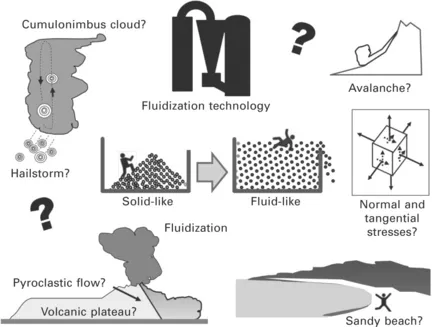
1.1 Fluidization: where and what?
First, let us take a ‘solid’ material, such as a desk or a bookshelf, and imagine the stress situations in the material by arbitrarily selecting a virtual cube inside the material and by checking both normal and tangential stresses acting on its six planes. In some parts of solid materials, the tangential stress can be non-zero and/or normal stress can be negative, i.e., tensile stress, to make them stand upright keeping their form as they are. In contrast, a fluid is a state of material in which tangential stresses are absent at rest and in which normal stresses are always ‘pressure’, i.e., not tensile stress (cf. Imai, 1974).
Particulate matter can also be either solid-like or fluid-like. In nature, some mountains, cliffs and particularly sandy beaches are made of solid-like particulate matter. It is possible to stand and walk on a sandy beach, which indicates that the mass of sand particles that it is made up of are macroscopically in the solid-like condition due to gravity and some surface forces. However, this situation can be changed to a fluid-like state by the application of counteracting forces. Suppose air or water is introduced flowing upward far below the surface of the beach. The gravitational force acting downward on the sand particles can be counter-balanced at a certain velocity by the upward fluid drag force. Then, the local particle assemblies are broken (which are rather particle shape dependent), followed by the breakage of particle-to-particle contact bridges (liquid or solid bridges), if they exist. When all static forces between the contacting particles disappear, the bed of sand particles start behaving like a fluid, at which point we could even enjoy a dusty swim. In this fluidized condition, i.e., fluid-like condition, we can put a bar or a stick into the bed of solids with little resistance and stir the solids with it. If the bar or stick is made of a material of density lighter than that of the bed, it can float upon it.
Thus, a bed of particles in such a fluid-like condition is called a ‘fluidized bed’. If not in this condition, it is called a ‘fixed bed’. If all the particles are suspended and carried by the fluid, we call the group of particles an ‘entrained bed’ by convention, even though there no longer exists any bedlike behaviour of the particles. For fine, light, dusty and sometimes fibrous particles, say less than 10 μm in diameter in an air atmosphere, such clear phase changes between fluidized bed and entrained bed modes as noted above do not exist, since their weight is so light that they can be suspended and float with only small turbulence or convective flow in the fluid.
1.1.1 Fluidization in industry and its special features
Fluidization can be said to be the most powerful method to handle a variety of solid particulate materials in industry. For decades fluidization has been a key technology in fluid catalytic cracking (FCC) to make gasoline in the petroleum industry; in catalytic processes such as partial oxidation of ammonia to acrylonitrile to prepare acrylic resin; in gas phase polymerization processes of polyethylene and polypropylene; in the chlorination process of metals such as silicon for purification in the semiconductor industry; in the granulation process for the pharmaceutical industry; in fluidized bed combustion (FBC) of solid fuels (coal, wastes and biomass) to generate steam for boilers; in waste incineration of solids and sludge; and in other simpler operations including drying, dip powder coating, thermal treatment of metals by hot or cold sands, and even a bed of seriously burnt patients in hospitals. By the 1950s fluidization had become a technical principle of a ‘domain’ of technology, using the terminology of W.B. Arthur (2009), that can be applied to any technological field.
The most important feature of gas-solid fluidized beds in industrial processes is their temperature uniformity, which is generated as a result of frequent particle collisions microscopically and of good solid mixing macroscopically by bubble motion and/or solid circulation. Temperature uniformity is a critical demand of exothermic catalytic reactions to avoid dangerous chain reactions or to avoid melting of product polymer particles in polymerization. With this temperature uniformity, ash melting and clinker formation can be avoided in fluidized bed combustion and gasification. In fluidized bed combustion, the burning fuel particles are individually surrounded by non-combustible solid particles (bed materials) and the temperature d...
Table of contents
- Cover image
- Title page
- Table of Contents
- Copyright
- Contributor contact details
- Woodhead Publishing Series in Energy
- Preface
- Part I: Introduction to fluidization science and technology
- Part II: Fundamentals of fluidized bed combustion and gasification
- Part III: Fluidized bed combustion and gasification technologies
- Part IV: Emerging CO2 capture technologies
- Part V: Other applications of fluidized bed technology
- Index
Trusted by 375,005 students
Access to over 1.5 million titles for a fair monthly price.
Study more efficiently using our study tools.
Frequently asked questions
Yes, you can cancel anytime from the Subscription tab in your account settings on the Perlego website. Your subscription will stay active until the end of your current billing period. Learn how to cancel your subscription
No, books cannot be downloaded as external files, such as PDFs, for use outside of Perlego. However, you can download books within the Perlego app for offline reading on mobile or tablet. Learn how to download books offline
Perlego offers two plans: Essential and Complete
- Essential is ideal for learners and professionals who enjoy exploring a wide range of subjects. Access the Essential Library with 800,000+ trusted titles and best-sellers across business, personal growth, and the humanities. Includes unlimited reading time and Standard Read Aloud voice.
- Complete: Perfect for advanced learners and researchers needing full, unrestricted access. Unlock 1.5M+ books across hundreds of subjects, including academic and specialized titles. The Complete Plan also includes advanced features like Premium Read Aloud and Research Assistant.
We are an online textbook subscription service, where you can get access to an entire online library for less than the price of a single book per month. With over 1.5 million books across 990+ topics, we’ve got you covered! Learn about our mission
Look out for the read-aloud symbol on your next book to see if you can listen to it. The read-aloud tool reads text aloud for you, highlighting the text as it is being read. You can pause it, speed it up and slow it down. Learn more about Read Aloud
Yes! You can use the Perlego app on both iOS and Android devices to read anytime, anywhere — even offline. Perfect for commutes or when you’re on the go.
Please note we cannot support devices running on iOS 13 and Android 7 or earlier. Learn more about using the app
Please note we cannot support devices running on iOS 13 and Android 7 or earlier. Learn more about using the app
Yes, you can access Fluidized Bed Technologies for Near-Zero Emission Combustion and Gasification by Fabrizio Scala in PDF and/or ePUB format, as well as other popular books in Technology & Engineering & Chemical & Biochemical Engineering. We have over 1.5 million books available in our catalogue for you to explore.