- 528 pages
- English
- ePUB (mobile friendly)
- Available on iOS & Android
eBook - ePub
About this book
The widely distributed American Lobster, Homarus americanus, which inhabits coastal waters from Canada to the Carolinas, is an important keystone species. A valuable source of income, its abundance or rarity often reflects the health of ecosystems occupied by these crustaceans. This comprehensive reference brings together all that is known of these fascinating animals. It will appeal to biologists, zoologists, aquaculturalists, fishery biologists, and researchers working with other lobster species, as well as neurobiologists looking for more information on the model system they so often use.
- First comprehensive book on the American lobster since Herrick's century-old monograph
- Provides crucial background for neurobiologists who use this crustacean as a model organism
- Contains a comprehensive treatment of the lobster fishery and its management
Information
Chapter 1
Introduction, Anatomy, and Life History
Jan Robert Factor Division of Natural Sciences, Purchase College, State University of New York Purchase, New York 10577
I Introduction
It has been 100 years since the publication of the first monograph on the American lobster, Homarus americanus H. Milne Edwards, 1837. In 1895,1 Francis Hobart Herrick presented the sum of knowledge that had accumulated during the 19th century (and earlier) in his monograph “The American Lobster: A Study of Its Habits and Development.” Again in 1909,2 Herrick summarized the state of contemporary understanding of this important species in “Natural History of the American Lobster.” The intense interest in the American lobster during this period was stimulated by the economic importance of the fishery, concern over the declining state of the fishery, and the potential of aquaculture, as well as by the general advance of biology, the interest in American species, and the application of contemporary techniques. These same factors continue to stimulate our interest in this important species.
In the intervening years, burgeoning fields such as ecology, population biology, physiology,and neurobiology have added to the growth of information about lobsters in general. Significant bibliographies of homarid lobsters have been produced by R. D. Lewis (1970) and W. S. W. Nowak (1972). By the late 1970s, J. Stanley Cobb and Bruce F. Phillips (1980a,b) recognized the need to review our understanding of the various clawed and spiny lobsters from around the world.
Few invertebrates have attracted as much attention for such a long period of time as Homarus americanus. The more recent explosion of information, when added to the generally superb earlier work, presents a bewildering array of research papers, facts, and opinions. This volume is intended to impose a degree of order and overview on this vast literature and to provide a modern perspective on the American lobster.
Individual chapters summarize our understanding of particular fields of research from modern viewpoint, yet with historical perspective. Bringing together such a variety of topics in one place also serves to highlight the diversity of our interests in Homarus americanus. Areas of overlap among related chapters, although generally considered from somewhat different perspectives, point out the natural interrelatedness among many topics. The liberal use of cross-referencing will guide the reader to related material found elsewhere in the volume.
It is inherently problematic to break up the naturally integrated biology of an animal into discrete subjects. From an ecological perspective, for example, it is difficult to draw the traditional line between the premetamorphic larval stages (stages I–III) and the postmetamorphic stages (beginning with the postlarva, stage IV). Rather, Ennis (Chapter 3) considers the ecology of the planktonic stages (larvae and the early, presettlement postlarva), while Lawton and Lavalli (Chapter 4) deal with the ecology of the benthic phases (beginning with the settling postlarva and continuing through the adult). Lawton and Lavalli (Chapter 4) have brought together physiology, ecology, and behavior into a coherent rationale for the terms applied to the life history phases of Homarus americanus.
The interrelationships among population biology, genetics, and fishery management are elucidated by Miller (Chapter 5) and Fogarty (Chapter 6), and the integration of fisheries with the ecology and behavior of Homarus americanus is discussed by Cobb (Chapter 7). The relationship of these fields, as well as reproductive and nutritional biology, to the longstanding interest in lobster aquaculture is made clear by Aiken and Waddy (Chapter 8).
The neurobiology of Homarus americanus is considered in three related chapters on neurobiology and neuroendocrinology (Beltz, Chapter 11), muscles and their innervation (Govind, Chapter 12), and behavior and sensory biology (Atema and Voigt, Chapter 13).
The complex processes of feeding and digestion illustrate the intimate connections among ecology (Ennis, Chapter 3, and Lawton and Lavalli, Chapter 4), sensory biology (Atema and Voigt, Chapter 13), functional morphology of appendages (Lavalli and Factor, Chapter 14), structure and organization of the digestive system (Factor, Chapter 15), and physiology of digestion and nutrition (Conklin, Chapter 16).
Additional links are also obvious, such as those between mating behavior (Atema and Voigt, Chapter 13) and the physiology of reproduction (Talbot and Helluy, Chapter 9), between the behavioral and physiological mechanisms of reproduction and the exogenous and endogenous control mechanisms of reproductive processes (Waddy, Aiken, and de Kleijn, Chapter 10), and between the nature of the circulatory system and blood cells (Martin and Hose, Chapter 17) and the integrated physiology of Homarus americanus (McMahon, Chapter 18).
This monograph is focused as tightly as possible on the American lobster, Homarus americanus. It is not intended to be a wide-ranging review of crustacean or decapod biology. Limited comparisons with closely related species, however, point out particularly interesting points of similarity or difference, or serve to fill in gaps in our understanding of H. americanus. It is not assumed that the closely related, yet distinct (Williams, Chapter 2), European lobster (H. gammarus) is identical to the American lobster (H. americanus) in any aspect of its biology, unless there is evidence to support specific instances.
When considered together, the chapters in this volume provide a level of overview and synthesis that is rarely possible in research reports or reviews of limited aspects of the literature.
II Anatomy
The segmented body of Homarus americanus is organized into three regions: head, thorax, and abdomen. Each segment bears a pair of appendages which are modified for particular functions within and among regions. The head (cephalon) bears sensory and feeding appendages, antennae and mouthparts; the thorax bears feeding and locomotory appendages, mouthparts and pereiopods (“walking legs”); and the abdomen (“tail”) bears locomotory and reproductive appendages, pleopods (“swimmerets”) and the tail fan. The head and thorax are fused into a cephalothorax, which is covered dorsally and laterally by a carapace that partially obscures the segmentation of the body. The body of a mature adult lobster is illustrated in Fig.1; although not all of the appendages are visible in this dorsal view, they are listed in Fig. 2, along with their regional and functional organization.
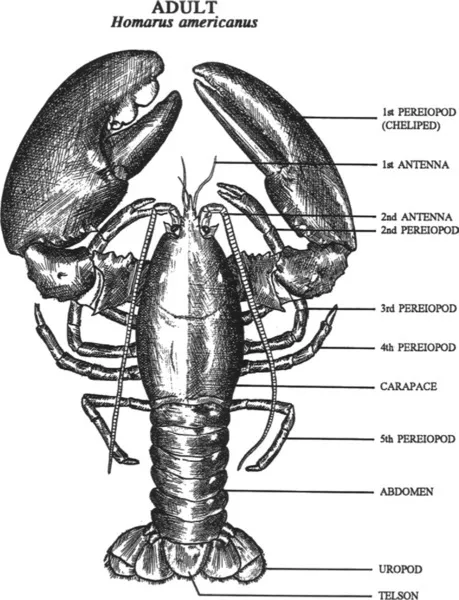
Figure 1 Adult lobster, Homarus americanus. Dorsal view. Length of specimen, 18.5 inches total length (TL); weight, 11.75 pounds; age, “probably about 16 years.” (Drawn from life by Philip B. Hadley, 1906; labels added.)
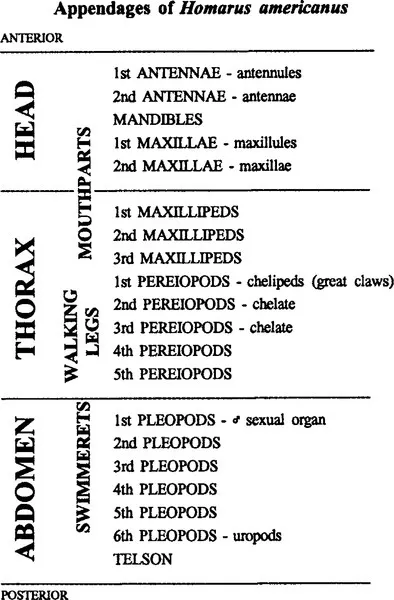
Figure 2 The appendages of Homarus americanus.
The anteriormost head appendages, the first and second antennae, serve sensory functions. The mouthparts comprise the last three appendages of the head region (mandible and first and second maxillae) and the first three thoracic appendages (first through third maxillipeds). The first pereiopods are exaggerated into the great claws (chelipeds, great chelae), and the second through fifth pereiopods serve as walking legs. In addition to the mouthparts, the pereiopods are also used in feeding, especially the ...
Table of contents
- Cover image
- Title page
- Table of Contents
- Dedication
- Copyright page
- Contributors
- Preface
- Chapter 1: Introduction, Anatomy, and Life History
- Chapter 2: Taxonomy and Evolution
- Chapter 3: Larval and Postlarval Ecology
- Chapter 4: Postlarval, Juvenile, Adolescent, and Adult Ecology
- Chapter 5: Fishery Regulations and Methods
- Chapter 6: Populations, Fisheries, and Management
- Chapter 7: Interface of Ecology, Behavior, and Fisheries
- Chapter 8: Aquaculture
- Chapter 9: Reproduction and Embryonic Development
- Chapter 10: Control of Growth and Reproduction
- Chapter 11: Neurobiology and Neuroendocrinology
- Chapter 12: Muscles and Their Innervation
- Chapter 13: Behavior and Sensory Biology
- Chapter 14: The Feeding Appendages
- Chapter 15: The Digestive System
- Chapter 16: Digestive Physiology and Nutrition
- Chapter 17: Circulation, the Blood, and Disease
- Chapter 18: The Physiology of Gas Exchange, Circulation, Ion Regulation, and Nitrogenous Excretion: An Integrative Approach
- Index
Trusted by 375,005 students
Access to over 1.5 million titles for a fair monthly price.
Study more efficiently using our study tools.
Frequently asked questions
Yes, you can cancel anytime from the Subscription tab in your account settings on the Perlego website. Your subscription will stay active until the end of your current billing period. Learn how to cancel your subscription
No, books cannot be downloaded as external files, such as PDFs, for use outside of Perlego. However, you can download books within the Perlego app for offline reading on mobile or tablet. Learn how to download books offline
Perlego offers two plans: Essential and Complete
- Essential is ideal for learners and professionals who enjoy exploring a wide range of subjects. Access the Essential Library with 800,000+ trusted titles and best-sellers across business, personal growth, and the humanities. Includes unlimited reading time and Standard Read Aloud voice.
- Complete: Perfect for advanced learners and researchers needing full, unrestricted access. Unlock 1.5M+ books across hundreds of subjects, including academic and specialized titles. The Complete Plan also includes advanced features like Premium Read Aloud and Research Assistant.
We are an online textbook subscription service, where you can get access to an entire online library for less than the price of a single book per month. With over 1.5 million books across 990+ topics, we’ve got you covered! Learn about our mission
Look out for the read-aloud symbol on your next book to see if you can listen to it. The read-aloud tool reads text aloud for you, highlighting the text as it is being read. You can pause it, speed it up and slow it down. Learn more about Read Aloud
Yes! You can use the Perlego app on both iOS and Android devices to read anytime, anywhere — even offline. Perfect for commutes or when you’re on the go.
Please note we cannot support devices running on iOS 13 and Android 7 or earlier. Learn more about using the app
Please note we cannot support devices running on iOS 13 and Android 7 or earlier. Learn more about using the app
Yes, you can access Biology of the Lobster by Jan Robert Factor in PDF and/or ePUB format, as well as other popular books in Technology & Engineering & Marine Biology. We have over 1.5 million books available in our catalogue for you to explore.