- 772 pages
- English
- ePUB (mobile friendly)
- Available on iOS & Android
eBook - ePub
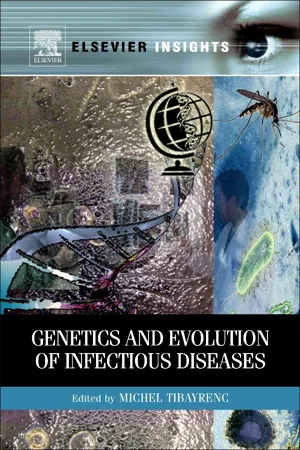
Genetics and Evolution of Infectious Diseases
About this book
Genetics and Evolution of Infectious Diseases is at the crossroads between two major scientific fields of the 21st century: evolutionary biology and infectious diseases. The genomic revolution has upset modern biology and has revolutionized our approach to ancient disciplines such as evolutionary studies. In particular, this revolution is profoundly changing our view on genetically driven human phenotypic diversity, and this is especially true in disease genetic susceptibility. Infectious diseases are indisputably the major challenge of medicine. When looking globally, they are the number one killer of humans and therefore the main selective pressure exerted on our species. Even in industrial countries, infectious diseases are now far less under control than 20 years ago. The first part of this book covers the main features and applications of modern technologies in the study of infectious diseases. The second part provides detailed information on a number of the key infectious diseases such as malaria, SARS, avian flu, HIV, tuberculosis, nosocomial infections and a few other pathogens that will be taken as examples to illustrate the power of modern technologies and the value of evolutionary approaches.
- Takes an integrated approach to infectious diseases
- Includes contributions from leading authorities
- Provides the latest developments in the field
Information
Subtopic
OncologyIndex
Biological SciencesTable of contents
- Cover Image
- Table of Contents
- Front-matter
- Copyright
- List of Contributors
- Preface
- Introduction
- 1. Virus Species
- 2. A Theory-Based Pragmatism for Discovering and Classifying Newly Divergent Bacterial Species
- 3. Population Structure of Pathogenic Bacteria
- 4. Epidemiology and Evolution of Fungal Pathogens in Plants and Animals
- 4.1. Introduction
- 4.2. Major Human and Animal Pathogenic Fungi
- 4.3. New and Emerging Mycoses
- 4.4. Plant Pathogenic Fungi
- 4.5. New and Emerging Plant Diseases
- 4.6. Modern Molecular Epidemiologic Tools for Investigating Fungal Diseases
- 4.7. Population Genetics of Pathogenic Fungi
- 4.8. Species and Speciation in Pathogenic Fungi
- 4.9. Mating and Pathogenesis
- 4.10. Genomics of Fungi: What makes a Fungus Pathogenic?
- 4.11. Conclusion
- 5. Clonal Evolution
- 6. Coevolution of Host and Pathogen
- 7. Elucidating Human Migrations by Means of their Pathogens
- 8. Phylogenetic Analysis of Pathogens
- 9. Evolutionary Responses to Infectious Disease
- 10. Infectious Disease Genomics
- 11. Proteomics and Host—Pathogen Interactions
- 12. The Evolution of Antibiotic Resistance
- 13. General Mechanisms of Antiviral Resistance
- 14. Evolution of Resistance to Insecticide in Disease Vectors
- 15. Genetics of Major Insect Vectors
- 16. Modern Morphometrics of Medically Important Insects
- 17. Multilocus Sequence Typing of Pathogens
- 18. Omics, Bioinformatics, and Infectious Disease Research
- 19. Genomics of Infectious Diseases and Private Industry
- 20. Current Progress in the Pharmacogenetics of Infectious Disease Therapy
- 21. Genetic Exchange in Trypanosomatids and Its Relevance to Epidemiology
- 22. Genomic Insights into the Past, Current and Future Evolution of Human Parasites of the Genus Plasmodium
- 23. Integrated Genetic Epidemiology of Chagas Disease
- 24. The Rise and Fall of the Mycobacterium tuberculosis Complex
- 25. The Evolution and Dynamics of Methicillin-Resistant Staphylococcus aureus
- 26. Origin and Emergence of HIV/AIDS
- 27. Evolution of SARS Coronavirus and the Relevance of Modern Molecular Epidemiology
- 28. Ecology and Evolution of Avian Influenza Viruses
Trusted by 375,005 students
Access to over 1.5 million titles for a fair monthly price.
Study more efficiently using our study tools.
Frequently asked questions
Yes, you can cancel anytime from the Subscription tab in your account settings on the Perlego website. Your subscription will stay active until the end of your current billing period. Learn how to cancel your subscription
No, books cannot be downloaded as external files, such as PDFs, for use outside of Perlego. However, you can download books within the Perlego app for offline reading on mobile or tablet. Learn how to download books offline
Perlego offers two plans: Essential and Complete
- Essential is ideal for learners and professionals who enjoy exploring a wide range of subjects. Access the Essential Library with 800,000+ trusted titles and best-sellers across business, personal growth, and the humanities. Includes unlimited reading time and Standard Read Aloud voice.
- Complete: Perfect for advanced learners and researchers needing full, unrestricted access. Unlock 1.5M+ books across hundreds of subjects, including academic and specialized titles. The Complete Plan also includes advanced features like Premium Read Aloud and Research Assistant.
We are an online textbook subscription service, where you can get access to an entire online library for less than the price of a single book per month. With over 1.5 million books across 990+ topics, we’ve got you covered! Learn about our mission
Look out for the read-aloud symbol on your next book to see if you can listen to it. The read-aloud tool reads text aloud for you, highlighting the text as it is being read. You can pause it, speed it up and slow it down. Learn more about Read Aloud
Yes! You can use the Perlego app on both iOS and Android devices to read anytime, anywhere — even offline. Perfect for commutes or when you’re on the go.
Please note we cannot support devices running on iOS 13 and Android 7 or earlier. Learn more about using the app
Please note we cannot support devices running on iOS 13 and Android 7 or earlier. Learn more about using the app
Yes, you can access Genetics and Evolution of Infectious Diseases by Michel Tibayrenc in PDF and/or ePUB format, as well as other popular books in Biological Sciences & Oncology. We have over 1.5 million books available in our catalogue for you to explore.