- 270 pages
- English
- ePUB (mobile friendly)
- Available on iOS & Android
eBook - ePub
Mechanical Testing of Orthopaedic Implants
About this book
Mechanical Testing of Orthopaedic Implants provides readers with a thorough overview of the fundamentals of orthopedic implants and various methods of mechanical testing. Historical aspects are presented, along with case studies that are particularly useful for readers.
- Presents information on a range of implants, from dental to spinal implants
- Includes case studies throughout that help the reader understand how the content of the book is applied in practice
- Provides coverage and guidance on FDA regulations and requirements
- Focuses on application of mechanical testing methods
Information
Topic
MedicinaSubtopic
Tecnología y suministros médicosPart One
Fundamentals of mechanical testing of orthopedic implants
1
Introduction to mechanical testing of orthopedic implants
E.A. Friis⁎; A.K. Tsao†; L.D. Timmie Topoleski‡; L.C. Jones§ ⁎ University of Kansas, Lawrence, KS, United States
† Mid-Atlantic Permanente Medical Group, Largo, MD, United States
‡ University of Maryland, Baltimore, MD, United States
§ The Johns Hopkins University School of Medicine, Baltimore, MD, United States
† Mid-Atlantic Permanente Medical Group, Largo, MD, United States
‡ University of Maryland, Baltimore, MD, United States
§ The Johns Hopkins University School of Medicine, Baltimore, MD, United States
Abstract
Musculoskeletal diseases and disorders, including trauma create a need for biomedical implants to reconstruct bone and its associated soft tissues. With the increased activity of an aging population, the number of orthopedic devices being implanted worldwide is continuing to climb. These orthopedic implants include devices for fracture fixation; joint replacement; tumor reconstruction; soft tissue repair; and fusion, reconstruction, or stabilization of the spine. Mechanical testing of these orthopedic implants can involve analysis of the implant rigidity, testing how many cycles it takes until it breaks, how the implant influences the rest of the body around it, or a multitude of other needs. No matter what the need or circumstance, it is important to recognize that the way in which an implant is tested should always attempt to represent the way in which it is mechanically loaded in the body in clinical use. Therefore appropriate testing of orthopedic implants must include knowledge of basic mechanical and materials concepts; the anatomy surrounding the device; and biomechanics of the implant, the body, and the interface between the body and implant. One should have insight into the design of the implant and how the implant is used clinically at all stages. This book provides the fundamentals of this necessary information for the major orthopedic implants used for joint replacement and hard tissue repair.
Keywords
Orthopedic implant; Orthopedic implant; Mechanical testing; Implant testing; Implant design; Materials; Biomaterials; Clinical use; Biomechanics
1.1 Introduction—overall philosophy of the book
Musculoskeletal diseases and disorders, including trauma, create a need for biomedical implants to reconstruct bone and its associated soft tissues. With the increased activity of an aging population, the number of orthopedic devices being implanted worldwide is continuing to climb. These orthopedic implants include devices for fracture fixation; joint replacement; tumor reconstruction; soft tissue repair; and fusion, reconstruction, or stabilization of the spine.
Mechanical testing of these orthopedic implants can involve analysis of the implant rigidity, testing how many cycles it takes until it breaks, how the implant influences the rest of the body around it, or a multitude of other needs. No matter what the need or circumstance, it is important to recognize that the way in which an implant is tested should always attempt to represent the way in which it is mechanically loaded in the body in clinical use. Therefore appropriate testing of orthopedic implants must include knowledge of basic mechanical and materials concepts; the anatomy surrounding the device; and biomechanics of the implant, the body, and the interface between the body and implant. One should have insight into the design of the implant and how the implant is used clinically at all stages. This book provides the fundamentals of this necessary information for the major orthopedic implants used for joint replacement and hard tissue repair.
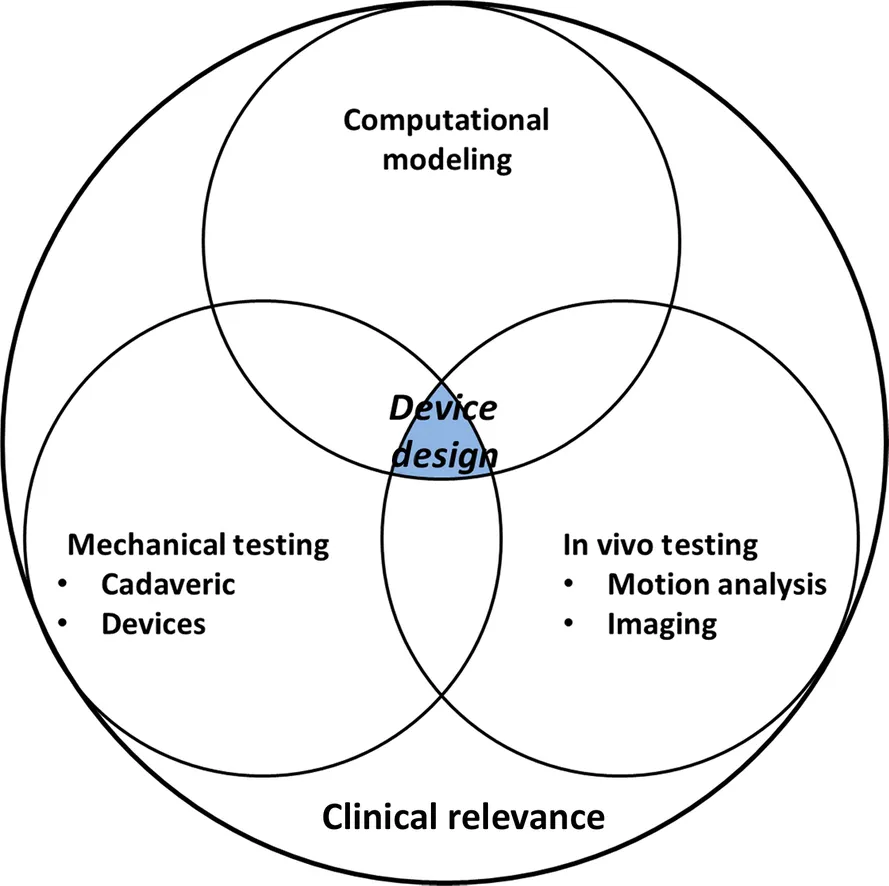
Fig. 1.1 illustrates the overall philosophy of the analysis of mechanical testing described in each chapter of this book. Mechanical testing can encompass a variety of different test modes, including traditional mechanical loading of devices in test machines or testing in situ in cadaveric models, computational modeling to help enhance understanding of implant design variations, or in vivo testing through motion analysis or imaging. Each of these approaches has a different purpose for its use in the analysis of mechanical performance of an orthopedic implant. The current use of these various analysis techniques for specific types of implants will be presented in each chapter.
1.2 Approach of this book for teaching and learning
This book is split into four main parts. Part One (this chapter and Chapters 2–4) provides the basic information related to test equipment, mechanics, materials, and how standards organizations and regulatory agencies can influence the development and use of mechanical test methods. Part Two (Chapters 5–6) covers testing concepts for the upper extremities (hands, wrists, elbows, and shoulders). Part Three focuses on implants and cadaveric testing procedures used for long bone fractures and the spine (Chapters 7–9). Finally, Part Four addresses hip, knee, ankle, and foot implant testing (Chapters 10–12). This “head-to-toe” coverage of the major orthopedic implants will provide a fundamental understanding of the considerations made in setting up a mechanical test of a specific implant.
Introduction to Mechanical Testing of Orthopedic Implants is designed to be used by anyone who wants to increase their knowledge of orthopedic implant design, testing needs, and the field in general. People who would benefit from this book include business or sales individuals who are currently in or want to transition to the orthopedic device sector, investors who want to learn more about specific areas in the orthopedic device sector, and mechanical engineers in industry who want to transition to the orthopedic device field. Residents and attending physicians in orthopedic surgery or neurosurgery who want to do engineering-type research on orthopedic devices would also benefit from reading this book. If used as a classroom textbook, an appropriate audience would be for senior or graduate courses in biomedical engineering or mechanical engineering.
To help facilitate extended learning, there is a historically based case study at the end of each chapter to provide more historical context to the topics discussed in that chapter. The case studies are not comprehensive, but do provide the reader with enough information to search for more details on the subject matter. The case study can be used to help guide further understanding of the chapter subject. Also provided at the end of each chapter are “Points for Further Discussion.” These points are provided to help guide the reader through more advanced topic in the field. If the book is used in a classroom setting, the points can be used for classroom discussion or open-ended homework activities.
1.3 Implant design
Implant design and testing require knowledge of anatomy, kinematics, biomaterials science, and biomechanics. Anatomy and kinematics are closely related and often underappreciated. For example, during the early designs of knee prostheses, it was assumed that knees acted as a hinge to extend and flex the knee; the implant design reflected this. With a better understanding of the kinematics of the knee, it is now understood that the knee has multiple degrees of freedom in addition to flexion and extension, including varus-valgus (side to side), internal and external rotation (rotation around a longitudinal axis), and anterior-posterior (front to back). In fact, it is now recognized that the knee is not a singular axis of rotation but axes of rotation that allow for rollback (the simultaneous rotation of the femoral component and front-to-back motion as the knee flexes) and even higher degrees of flexion. Current implants are more anatomic in design and provide larger ranges of motion than earlier designs. A review of some of these fundamentals is necessary.
The primary goal of orthopedic implants is to reconstruct the anatomy and restore the function of the musculoskeletal tissues they replace while relieving associated pain. Therefore it is critical to understand concepts regarding anatomy and the function of bone and joints.
1.3.1 Anatomy
The skeleton is characterized as either axial or appendicular. The axial skeleton includes the skull, vertebral column, and thoracic cage (ribs and sternum). The appendicular skeleton includes the thoracic and pelvic girdles, as well as the long bones, which are attached. Musculoskeletal tissues have diverse functions, including protection, mobility, and biology. Bones such as the cranium and the ilium are relatively large and flat to protect the organs contained within; our ribs also are protective but accomplish this using multiple bones, allowing for flexibility and movement for activity such as breathing. Our long bones and joints allow us to move in various directions by serving as sites of attachment for our muscles and allow a complex system of levers to permit movement through space. Ligaments place constraints at joints, which allows stable motions.
The forms of the hard and soft tissues of the musculoskeletal system reflect these diverse roles, ranging from the flexibility of cartilaginous tissues such as the menisci of the knee joint to the thin, rod-like extensions of our metacarpals and metatarsals. Bones contain varying amounts of cortical (also called compact) and cancellous (also called spongy) bone. The varying degrees of porosity of bone affect the strength and biological function of the structure. Consequently, the strength of cortical bone is significantly greater than that of cancellous bone but the cancellous bone contains more marrow and marrow elements (including progenitor cells). The bones themselves also play an important role in human biology by serving as a source of calcium and of progenitor cells. While not traditionally discussed in orthopedic implant design, these are characteristics that have been exploited in the development of coatings for implant fixation and in tissue engineered constructs for use as bone void fillers.
Bone formation occurs through either intramembranous or endochondral ossification. Osteogenesis by intramembranous ossification involves bone formation directly on or within a fibrous framework; the flat bones of the skull, parts of the mandible, and parts of the clavicle are formed by this mechanism. Most bones of the body are formed by endochondral ossification. This type of bone formation involves the progression of ossification by a cartilaginous framework that becomes ossified as a consequence of changes in hypoxia and modulation by various cytokines and growth factors. As development progresses and bone tissue is formed, an epiphyseal plate is created. This plate allows for lengthening of the bone until early adulthood and, thus, is also called the growth plate. It is important to understand the process of endochondral ossification because implants that interrupt the epiphyseal plate in adolescents will likely alter the growth of the affected bone.
The mechanisms involved in bone remodeling and bone healing are also important to appreciate. Bone remodeling involves an interaction between bone formation and bone resorption. Many musculoskeletal conditions affect bone re...
Table of contents
- Cover image
- Title page
- Table of Contents
- Copyright
- List of contributors
- Foreword
- Part One: Fundamentals of mechanical testing of orthopedic implants
- Part Two: Mechanical testing of orthopedic implants in the head and upper extremity
- Part Three: Mechanical testing of orthopaedic implants for fracture and in the spine
- Part Four: Mechanical testing of orthopaedic implants in the lower extremity
- Index
Trusted by 375,005 students
Access to over 1.5 million titles for a fair monthly price.
Study more efficiently using our study tools.
Frequently asked questions
Yes, you can cancel anytime from the Subscription tab in your account settings on the Perlego website. Your subscription will stay active until the end of your current billing period. Learn how to cancel your subscription
No, books cannot be downloaded as external files, such as PDFs, for use outside of Perlego. However, you can download books within the Perlego app for offline reading on mobile or tablet. Learn how to download books offline
Perlego offers two plans: Essential and Complete
- Essential is ideal for learners and professionals who enjoy exploring a wide range of subjects. Access the Essential Library with 800,000+ trusted titles and best-sellers across business, personal growth, and the humanities. Includes unlimited reading time and Standard Read Aloud voice.
- Complete: Perfect for advanced learners and researchers needing full, unrestricted access. Unlock 1.5M+ books across hundreds of subjects, including academic and specialized titles. The Complete Plan also includes advanced features like Premium Read Aloud and Research Assistant.
We are an online textbook subscription service, where you can get access to an entire online library for less than the price of a single book per month. With over 1.5 million books across 990+ topics, we’ve got you covered! Learn about our mission
Look out for the read-aloud symbol on your next book to see if you can listen to it. The read-aloud tool reads text aloud for you, highlighting the text as it is being read. You can pause it, speed it up and slow it down. Learn more about Read Aloud
Yes! You can use the Perlego app on both iOS and Android devices to read anytime, anywhere — even offline. Perfect for commutes or when you’re on the go.
Please note we cannot support devices running on iOS 13 and Android 7 or earlier. Learn more about using the app
Please note we cannot support devices running on iOS 13 and Android 7 or earlier. Learn more about using the app
Yes, you can access Mechanical Testing of Orthopaedic Implants by Elizabeth Friis in PDF and/or ePUB format, as well as other popular books in Medicina & Tecnología y suministros médicos. We have over 1.5 million books available in our catalogue for you to explore.