- 158 pages
- English
- ePUB (mobile friendly)
- Available on iOS & Android
eBook - ePub
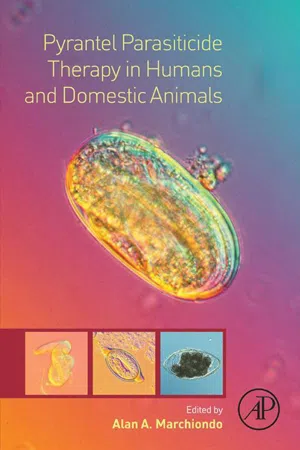
Pyrantel Parasiticide Therapy in Humans and Domestic Animals
About this book
Pyrantel Parasiticide Therapy in Humans and Domestic Animals presents a single source history and reference on the parasiticide activity and pharmacology of the tetrahydropyrimidines and their salts in humans and domestic animals, also collating evidence that resistance to pyrantel has developed in human and domestic animal nematodes.
Other books of this nature have been compiled historically for specific anthelmintic compounds, but none has been written to date for the pyrantel family of drugs. Pyrantel, a nicotinic receptor agonist, has been used in domestic animal and human medicine since the 1970's to control two important nematode groups, the hookworms and the roundworms.
Given the zoonotic potential of these parasites, pyrantel has served a dual role in helping to protect the health of both domestic animals and the public for more than 45 years.
- Easy-to-use reference guide on the anthelmintic pyrantel for clinicians, parasitologists, and researchers in human and veterinary medicine
- Addresses current issues of resistance, along with combination uses against anthelmintic resistant parasites
- Presents useful, authoritative information (chemical, pharmaceutical, clinical, etc.) for the pyrantel family of compounds
- Includes a discussion on pyrantel's potential role in combination therapies
- Provides cutting-edge material, and will be an evolving area of scientific discussion of treatment options in the future
Information
Topic
MedicineChapter 1
Discovery and Chemistry of Pyrantel, Morantel and Oxantel
D.J. Sheehan1, S.M. Sheehan1 and A.A. Marchiondo2,3, 1Zoetis, Kalamazoo, MI, United States, 2Adobe Veterinary Parasitology Consulting LLC, Santa Fe, NM, United States, 3Retired, Zoetis, Kalamazoo, MI, United States
Abstract
The discovery of the Tetrahydropyrimidines began with in vivo screening programs in the late-1950s leading to the synthesis of pyrantel, morantel, and oxantel. Each of these anthelmintics and their salts possessed anthelmintic activities that were commercially developed into veterinary and, eventually, human medicines. This chapter describes the discovery and chemistry of pyrantel, morantel, and oxantel, along with the various anthelmintic applications of the Tetrahydropyrimidines and their salts.
Keywords
Pyrantel; morantel; oxantel; discovery; chemistry; history
1.1 Introduction
The discovery of pyrantel (1), morantel (2), and oxantel (3) can only be put into context by defining the history and organization of Pfizer Central Research and the key scientists in medicinal chemistry and parasitology responsible for the research (Fig. 1.1).

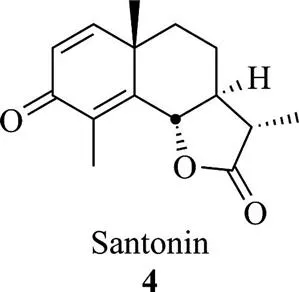
The Charles Pfizer & Company was started in 1849 in Williamsburg, Brooklyn by the partnership of the German-American cousins, Charles Pfizer, a chemist, and Charles Erhart, a confectioner, who emigrated from Ludwigsburg, Germany [1]. The company was started as a manufacturer of bulk chemicals such as iodine, boric, tartaric, and citric acids, the latter used for soft drink companies, and produced a wide range of industrial and pharmaceutical products, including the antiparasitic called Santonin (4) for the treatment of the human roundworm, Ascaris lumbricoides (Fig. 1.2).
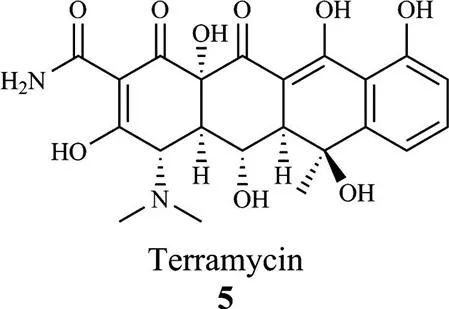
In 1919, Pfizer developed expertise in fermentation technology originally for citric acid production and then penicillin during World War II. In 1950, Pfizer discovered and commercialized Terramycin (oxytetracycline, 5) changing the company from a manufacturer of fine chemicals to a research-based pharmaceutical company with the implementation of a drug discovery program. Terramycin spurred the entry of Pfizer into the animal health industry with the formation of Pfizer’s Agricultural Division in the early 1950s and the commercialization of Terramycin-based feed supplements for swine, cattle, and chickens (Fig. 1.3).
Three Pfizer research centers were key to the discovery of pyrantel. In 1952, a 700-acre (2.8 km2) Agricultural Research Department was established at Terre Haute, Indiana, for the fermentation of streptomycin and Terramycin, along with veterinary facilities to study livestock and poultry diseases. In 1960, Pfizer moved its medical research laboratory and discovery screening out of New York City to a new facility in Groton, Connecticut. Pfizer established operations in the United Kingdom in 1954 on an 80-acre site on the outskirts of Sandwich, Kent [2]. The Agricultural Division opening at the Sandwich site in 1957 was followed by the acquisition by Pfizer of additional land adjacent to its existing site in Sandwich to yield a 390-acre research center in 1964 [3].
Chemical compounds were synthesized and screened in the mid-1960s in a research program carried out by Pfizer’s Chemotherapy Research Department and Parasitology Research Department in Sandwich, Kent in collaboration with the company’s Chemotherapy Research Department in Groton, Connecticut and Agricultural Research Department in Terre Haute. The collaborative invention and discovery of pyrantel included inventors, Lloyd Conover (who also produced the first semisynthetic tetracycline), Bill Austin, and Jim McFarland, along with parasitologists, John Lynch and Harold Howes from Groton, Rendle Cornwell and Mervyn Jones from Sandwich, and Vasillios Theodorides from Terra Haute. The collaborative medicinal chemistry and drug discovery screening was led by Lloyd Conover in Groton and Bill Austin in Sandwich with some controversy on both sides with the Groton and Sandwich research teams working as competitors to some extent [4].
1.2 Discovery of Pyrantel, Morantel, and Oxantel
During the mid to late 1950s, Pfizer researchers at Groton, Connecticut, established a screening program to find new anthelmintic agents, employing infections of the gastrointestinal nematodes Nematospiroides dubius (Heligmosomoides polygyrus bakeri) in mice and Nippostrongylus muris in rats [5]. In 1959, Lynch and Nelson [6] in Groton modified the N. dubius screen of the earlier work of Baker [7] and Hewitt and Gumble [8] by increasing the number of drug doses given prior to evaluation. In their study, mice were infected orally with 40 larvae of N. dubius and treated 15 days later with two to five oral doses of the isothiuronium salt, 2-thenylmercapto-2-imidazoline (designated Compound 1871, 6) (Fig. 1.4) at 12.5–200 mg/kg or in single doses of 12.5–300 mg/kg. All mice were euthanized 2–3 days after termination of the treatment regimen. Appropriate multiple or single doses of the drug were capable of bringing about a greater than 90% reduction in worm burden of the treated mice.
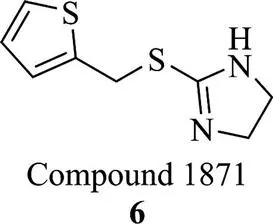
However, while the isothiuronium salt possessed anthelmintic activity against N. dubius, it showed little activity when administered orally to sheep, probably due to the high susceptibility of imidazolidines toward rapid metabolism and hydrolysis forming 2-thenylthiol (7) and 2-imidazolidone (8) (Fig. 1.5) [9,10].
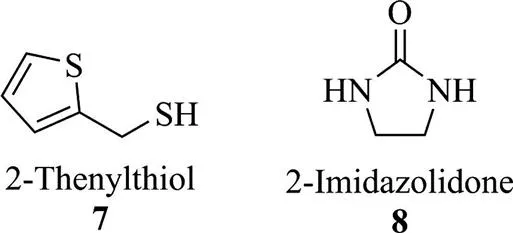
While evaluating mouse-derived anthelmintic leads against gastrointestinal nematodes of sheep, a precursor compound of pyrantel containing sulfur in a side chain was tested in Terra Haute. After it was administered to sheep, the barn, environs, field hands, and laboratory personnel became unwittingly exposed to a highly disagreeable odor. The odor was retained on clothing and even the laboratory records of the study. The synthetic chemists at Pfizer were promptly informed that such a product would not be commercially acceptable, regardless of the anthelmintic activity.
The structure of 1871, however, provided a useful lead to follow. New compounds, lacking the aliphatic sulfur (and the disagreeable odor) were prepared. In order to widen the scope of the screens and spectrum of anthelmintic activity, laboratory mice were artificially infected w...
Table of contents
- Cover image
- Title page
- Table of Contents
- Copyright
- List of Contributors
- Preface
- Introduction
- Chapter 1. Discovery and Chemistry of Pyrantel, Morantel and Oxantel
- Chapter 2. Pharmacology of Pyrantel
- Chapter 3. The Safety of Pyrantel, Oxantel, and Morantel
- Chapter 4. Formulations and Clinical Uses of Pyrimidine Compounds in Domestic Animals
- Chapter 5. Pyrantel Parasiticide Therapy in Humans
- Chapter 6. Potential Applications of Tetrahydropyrimidines to Address Unmet Needs
- Index
Trusted by 375,005 students
Access to over 1.5 million titles for a fair monthly price.
Study more efficiently using our study tools.
Frequently asked questions
Yes, you can cancel anytime from the Subscription tab in your account settings on the Perlego website. Your subscription will stay active until the end of your current billing period. Learn how to cancel your subscription
No, books cannot be downloaded as external files, such as PDFs, for use outside of Perlego. However, you can download books within the Perlego app for offline reading on mobile or tablet. Learn how to download books offline
We are an online textbook subscription service, where you can get access to an entire online library for less than the price of a single book per month. With over 1.5 million books across 990+ topics, we’ve got you covered! Learn about our mission
Look out for the read-aloud symbol on your next book to see if you can listen to it. The read-aloud tool reads text aloud for you, highlighting the text as it is being read. You can pause it, speed it up and slow it down. Learn more about Read Aloud
Yes! You can use the Perlego app on both iOS and Android devices to read anytime, anywhere — even offline. Perfect for commutes or when you’re on the go.
Please note we cannot support devices running on iOS 13 and Android 7 or earlier. Learn more about using the app
Please note we cannot support devices running on iOS 13 and Android 7 or earlier. Learn more about using the app
Yes, you can access Pyrantel Parasiticide Therapy in Humans and Domestic Animals by Alan A. Marchiondo in PDF and/or ePUB format, as well as other popular books in Medicine & Medical Microbiology & Parasitology. We have over 1.5 million books available in our catalogue for you to explore.