- 448 pages
- English
- ePUB (mobile friendly)
- Available on iOS & Android
eBook - ePub
About this book
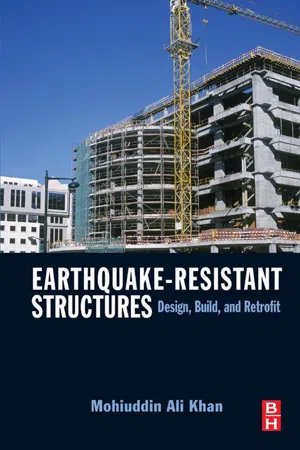
Earthquake engineering is the ultimate challenge for structural engineers. Even if natural phenomena involve great uncertainties, structural engineers need to design buildings, bridges, and dams capable of resisting the destructive forces produced by them. These disasters have created a new awareness about the disaster preparedness and mitigation. Before a building, utility system, or transportation structure is built, engineers spend a great deal of time analyzing those structures to make sure they will perform reliably under seismic and other loads. The purpose of this book is to provide structural engineers with tools and information to improve current building and bridge design and construction practices and enhance their sustainability during and after seismic events. In this book, Khan explains the latest theory, design applications and Code Provisions. Earthquake-Resistant Structures features seismic design and retrofitting techniques for low and high raise buildings, single and multi-span bridges, dams and nuclear facilities. The author also compares and contrasts various seismic resistant techniques in USA, Russia, Japan, Turkey, India, China, New Zealand, and Pakistan.
- Written by a world renowned author and educator
- Seismic design and retrofitting techniques for all structures
- Tools improve current building and bridge designs
- Latest methods for building earthquake-resistant structures
- Combines physical and geophysical science with structural engineering
Information
Subtopic
Civil EngineeringPart One
Introduction to Seismology and Seismic Engineering
Chapter One Modern Earthquake Engineering
Chapter Two Seismology and Earthquake Effects for Engineers
Chapter Three Seismic Response of Structures to Liquefaction
Chapter One
Modern Earthquake Engineering
An Overview
Chapter Outline
1.1 Introduction and Review of Literature
1.2 The Basics of Earthquakes
1.3 The Most Destructive Earthquakes on Record
1.4 Is Seismic Activity Increasing?
1.5 Some Seismological History
1.6 Measurement of Earthquake Intensity and Magnitude
1.7 Seismic Instrumentation
1.8 Comprehensive Seismic Study
1.9 Applications of Seismic Design Codes
1.10 The Role of the U.S. Geological Survey
1.11 Conclusions on the State of Art
Selected Bibliography
Come forth into the light of things Let nature be your teacher
An English Poet
1.1 Introduction and Review of Literature
Nature teaches us about the earthquake location and the zone and intensity to expect. Over the last 50 years much progress has been made in earthquake engineering that will save lives, infrastructure, and homes. As the old saying goes, “Necessity is the mother of invention.” Seismic-resistant design is not a single subject but a combination of diverse scientific disciplines, and the state of the art is advancing yearly. A book like this one is required just to broadly review new procedures and to cover the field’s salient features. These are addressed in the chapters that follow.
A review of scientific literature on the subject can be made by glancing at the research papers being published in relevant structural engineering journals, conference proceedings, text books on related subjects, university theses, students project dissertations, seismic design codes and the continued publications by the management and scientific agencies. The available technical information is generally supported by dynamic analysis theory, computer software and laboratory studies on structural components or shake tables testing of typical prototype models.
The bibliography at the end of the chapter includes important code references such as:
American Association of State Highway and Transportation Officials (AASHTO, 1991), Specifications for Highway Bridges, Division1-A (AASHTO, 1996), Standard Specifications for Highway Bridges, 16th ed.; (AASHTO, 1998), Load Resistance Factor Design Specifications for Highway Bridges (AASHTO, 2007), LRFD Specifications for the Design of Bridges. In addition, American National Standards Institute/American Institute of Steel Construction (ANSI/AISC, 2005), Seismic Provisions for Structural Steel Buildings, #341-05.
ANSI (2005), Prequalified Connections for Special and Intermediate Steel Moment Frames for Seismic Applications, #358-05. American Society of Civil Engineers (ASCE) 2010. #07-2010;
Applied Technology Council (ATC, 1996), Improved Seismic Design Criteria for California Bridges Provisional Recommendations, ATC-32.
Publications of major scientific agencies are listed in the Bibliography such as Federal Emergency Management Agency (FEMA, 2006), Designing for Earthquakes, Providing Protection to People and Buildings, A Manual for Architects, Risk Management Series #454; FEMA/National Earthquake Hazard Reduction Program (NEHRP, 2000), Recommended Provisions for Seismic Regulations for New Buildings and Other Structures, #368/369. (NEHRP) Recommended Provisions for Seismic Regulations for New Buildings and Other Structures, Part 2 Commentary, #450, 2003; (NEHRP, 2003). Recommended Provisions: Design Examples, #451;
(NEHRP). Earthquake-Resistant Design Concepts: An Introduction to the NEHRP Recommended Seismic Provisions for New Buildings and Other Structures, #P-749, 2009; Federal Highway Agency (FHWA) 1987, Seismic Design and Retrofit Manual for Highway Bridges.
Seismic Retrofitting Manual for Highway Bridges (FHWA, 2000).
National Seismological Teachers Association/FEMA 2012. Bulletin of the Seismological Society of America 102,2; National Fire Protection Association (NFPA, 2006); Building Construction and Safety Code.
Structural Engineers Association of California (SEAOC, 1999). Seismology Committee Recommended Lateral Force Requirements and Commentary.
In addition, useful newer publications by the following authors are included in the Selected Bibliography:
Agarwal and Shrikhande (2006), Berlin (1980), Coffman and von Hake (1982), Duggal (2007)
Saadeghvaziri et al. (2001), Spence, Sipkin, and Choy (1989) of U.S. Geological Survey, Stratta (1987) and Wakabayashi (1986)
References to other useful publications are addressed in the text in this chapter and in the chapters which follow.
Management agencies such as U.S. Geological Survey (USGS), the Federal Emergency Management Agency (FEMA), the Federal Highway Administration (FHWA), the National Earthquake Hazards Reduction Program (NEHRP), the American Society of Civil Engineers (ASCE), the California Transportation Agency (Caltrans), the Multidisciplinary Center for Earthquake Engineering Research (MCEER), and the Earthquake Engineering Research Institute (EERI), along with universities and individuals, play an important role in research, in developing design methods such as performance-based seismic engineering, and in developing policies for resisting earthquakes. The work and funding by these organizations and individuals have aided the development of state and regional earthquake design codes, as well as those that have been by many countries around the world. Indeed, USGS hazard maps are used on a global basis and International Building Code (IBC) and American Association of State Highway and Transportation Officials (AASHTO) design specifications are generally referred to in international publications.
In recent years, advances in seismology and soil science have influenced structural concepts and design guidelines, resulting in corresponding code changes. There have been many innovations, such as seismic hazard analysis, geotechnical site response and liquefaction, soil–structure interaction, structural response, structural design and retrofit, short- and long-ter...
Table of contents
- Cover image
- Title page
- Table of Contents
- Copyright
- Preface
- Acknowledgement
- Part One: Introduction to Seismology and Seismic Engineering
- Part Two: Earthquake Disasters: Pre- and Post-Earthquake Engineering
- Part Three: Structural Design and Retrofit
- Part Four: Solved Examples for Seismic Analysis and Design Addressed in the Text Book Chapters
- Glossary
- Index
Trusted by 375,005 students
Access to over 1.5 million titles for a fair monthly price.
Study more efficiently using our study tools.
Frequently asked questions
Yes, you can cancel anytime from the Subscription tab in your account settings on the Perlego website. Your subscription will stay active until the end of your current billing period. Learn how to cancel your subscription
No, books cannot be downloaded as external files, such as PDFs, for use outside of Perlego. However, you can download books within the Perlego app for offline reading on mobile or tablet. Learn how to download books offline
Perlego offers two plans: Essential and Complete
- Essential is ideal for learners and professionals who enjoy exploring a wide range of subjects. Access the Essential Library with 800,000+ trusted titles and best-sellers across business, personal growth, and the humanities. Includes unlimited reading time and Standard Read Aloud voice.
- Complete: Perfect for advanced learners and researchers needing full, unrestricted access. Unlock 1.5M+ books across hundreds of subjects, including academic and specialized titles. The Complete Plan also includes advanced features like Premium Read Aloud and Research Assistant.
We are an online textbook subscription service, where you can get access to an entire online library for less than the price of a single book per month. With over 1.5 million books across 990+ topics, we’ve got you covered! Learn about our mission
Look out for the read-aloud symbol on your next book to see if you can listen to it. The read-aloud tool reads text aloud for you, highlighting the text as it is being read. You can pause it, speed it up and slow it down. Learn more about Read Aloud
Yes! You can use the Perlego app on both iOS and Android devices to read anytime, anywhere — even offline. Perfect for commutes or when you’re on the go.
Please note we cannot support devices running on iOS 13 and Android 7 or earlier. Learn more about using the app
Please note we cannot support devices running on iOS 13 and Android 7 or earlier. Learn more about using the app
Yes, you can access Earthquake-Resistant Structures by Mohiuddin Ali Khan in PDF and/or ePUB format, as well as other popular books in Technology & Engineering & Civil Engineering. We have over 1.5 million books available in our catalogue for you to explore.