eBook - ePub
Membrane Contactors: Fundamentals, Applications and Potentialities
- 516 pages
- English
- ePUB (mobile friendly)
- Available on iOS & Android
eBook - ePub
Membrane Contactors: Fundamentals, Applications and Potentialities
About this book
Membrane Contactors: Fundamentals, Applications and Potentialities, Volume 11 covers new operations that could be efficiently used to improve the performance of a variety of industrial production cycles in applications ranging from biotechnology to agrofood. This book focuses on the basic "principles of work": required membrane materials and properties; major operating parameters; the importance of module configuration and design and; the performance of membrane contactors in specific processes. The authors' dynamic approach to this subject makes Membrane Contactors: Fundamentals, Applications and Potentialities, Volume 11 the most comprehensive book currently available on all aspects related to the 'membrane contactor world.* Describes new unit operations in process engineering* Covers a wide variety of industrial applications, from biotechnology to agrofood* Applicable to process intensification and sustainable growth strategies
Information
Chapter 1
Basic principles of membrane contactors
1 Generalities on membrane contactors operations
The term “membrane contactor” is used to identify membrane systems that are employed to “keep in contact” two phases. On the contrary of the more “traditional” idea of membranes as media for performing separations thanks to their selectivity, membrane contactors do not offer any selectivity for a particular species with respect to another, but simply act as a barrier between the phases involved, by allowing their contact in correspondence of a well defined interfacial area [1–9]. Being the two phases separate by the membrane, there is no mix of them and dispersion phenomena do not occur. The species are transferred from one phase to the other by only diffusion. The membranes are usually microporous and symmetric and can be both hydrophobic and hydrophilic.
In the case of hydrophobic materials, the membrane can be wetted by non polar phases (e.g., non polar organics) or filled by gas, while the aqueous/polar phase can not penetrate into the pores (see Figure 1).
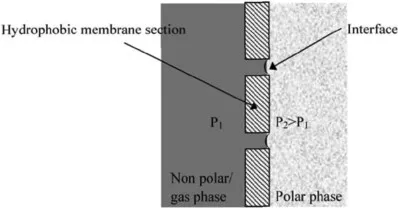
Figure 1 Interface between a non polar/gas phase and a polar phase in a hydrophobic membrane.
In this way, it is possible to define the area of contact in correspondence of the pores mouths. In order to avoid the mixing of the two phases, it is important to carefully control the operating pressures. First of all, the pressure of the aqueous/polar phase has to be equal to or higher than the pressure of the wetting/filling phase. This permits to eliminate any possibility of dispersion as drops of one phase into the other phase. Moreover, the interfacial area can be established at the pore mouth only if the penetration of the aqueous/polar phase into the membrane pores is prevented. The hydrophobicity of the material is not, in fact, a warranty for keeping the pores aqueous/polar phase-free. If a critical value of pressure, called generally breakthrough pressure, is exceed, the membrane loses its hydrophobic character and the aqueous/polar phase starts to wet it [10–12]. For a particular material the breakthrough pressure depends on the pore radius, surface/interfacial tension, contact angle between the membrane and the fluid, and can be calculated by using the Laplace’s equation (see Chapter 2). In figure 1, as well as in all the other figures, for simplicity, straight pores are considered for symmetric membranes. In practice, membrane pores have an un-defined shape, mainly related to the tortuosity of the membrane along its thickness.
With asymmetric membranes in which the pore size reduces along the thickness, it is possible to keep in non-dispersive contact the two phases also by working, at the bigger pores side, at pressures higher than the breakthrough value. In fact, being the breakthrough pressure inversely dependent on the pore size, there is a partial wetting of the membrane for the bigger pores, whereas the smaller pores continues to be aqueous/polar phase free. The interfacial area is now established within the pores (see Figure 2).
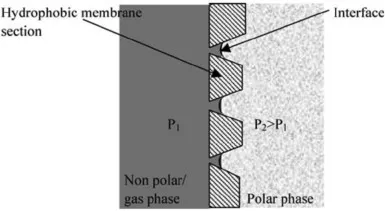
Figure 2 Interface between a non polar/gas phase and a polar phase in a partially wetted asymmetric membrane.
The hydrophobicity of the membrane can also vary because of the interactions with the phases involved that lead to changes in the membrane structure and morphology. This last aspect can be minimized by using composite membranes with a non–porous thin layer coated on the microporous surface that prevents the penetration of the aqueous/polar phase (Figure 3) [13–17].
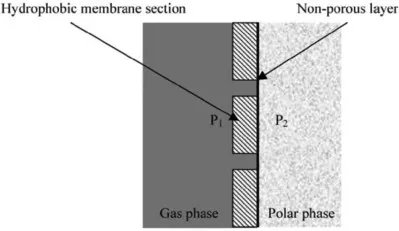
Figure 3 Composite membrane with a dense thin layer coated on the microporous surface.
The non-porous thin layer allows also to enlarge the range of the operating pressures, but, in order to do not increase too much the resistance to the mass transport, it has to be highly permeable for the trasferred species.
The membrane wetting can be partial or complete; in the first case the two phases are in contact somewhere in the membrane pores, whereas for complete wetting the two phases are mixed and the membrane contactor loses its function.
When hydrophilic materials are used, the aqueous/polar phase wets the membrane pores while the non polar/gas phase is blocked at the pore mouth. In this configuration the interface is established at the pore mouth at the non polar/gas phase side and the dispersion as drops between the phases is avoided by working with pressures of the non polar/gas phase equal to or higher than the wetting phase pressure (Figure 4).
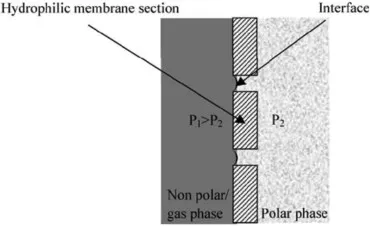
Figure 4 Interface between a non polar/gas phase and a polar phase in a hydrophilic membrane.
As for the hydrophobic membranes, the interface is kept at the pore mouth until the breakthrough press...
Table of contents
- Cover image
- Title page
- Table of Contents
- Membrane Science and Technology Series
- Front Matter
- Copyright page
- Introduction
- Chapter 1: Basic principles of membrane contactors
- Chapter 2: Membrane materials
- Chapter 3: Module configurations and design
- Chapter 4: Gas – liquid systems
- Chapter 5: Liquid – liquid extractions
- Chapter 6: Membrane Distillation and Osmotic Distillation
- Chapter 7: Membrane Crystallization
- Chapter 8: Membrane Emulsification
- Chapter 9: Supported liquid membranes
- Chapter 10: Mass transfer with chemical reaction
- Chapter 11: Relevant applications
- Nomenclature
- List of symbols
- Names list
- Topics list
Trusted by 375,005 students
Access to over 1.5 million titles for a fair monthly price.
Study more efficiently using our study tools.
Frequently asked questions
Yes, you can cancel anytime from the Subscription tab in your account settings on the Perlego website. Your subscription will stay active until the end of your current billing period. Learn how to cancel your subscription
No, books cannot be downloaded as external files, such as PDFs, for use outside of Perlego. However, you can download books within the Perlego app for offline reading on mobile or tablet. Learn how to download books offline
Perlego offers two plans: Essential and Complete
- Essential is ideal for learners and professionals who enjoy exploring a wide range of subjects. Access the Essential Library with 800,000+ trusted titles and best-sellers across business, personal growth, and the humanities. Includes unlimited reading time and Standard Read Aloud voice.
- Complete: Perfect for advanced learners and researchers needing full, unrestricted access. Unlock 1.5M+ books across hundreds of subjects, including academic and specialized titles. The Complete Plan also includes advanced features like Premium Read Aloud and Research Assistant.
We are an online textbook subscription service, where you can get access to an entire online library for less than the price of a single book per month. With over 1.5 million books across 990+ topics, we’ve got you covered! Learn about our mission
Look out for the read-aloud symbol on your next book to see if you can listen to it. The read-aloud tool reads text aloud for you, highlighting the text as it is being read. You can pause it, speed it up and slow it down. Learn more about Read Aloud
Yes! You can use the Perlego app on both iOS and Android devices to read anytime, anywhere — even offline. Perfect for commutes or when you’re on the go.
Please note we cannot support devices running on iOS 13 and Android 7 or earlier. Learn more about using the app
Please note we cannot support devices running on iOS 13 and Android 7 or earlier. Learn more about using the app
Yes, you can access Membrane Contactors: Fundamentals, Applications and Potentialities by Enrico Drioli,A. Criscuoli,E. Curcio in PDF and/or ePUB format, as well as other popular books in Technology & Engineering & Chemical & Biochemical Engineering. We have over 1.5 million books available in our catalogue for you to explore.