eBook - ePub
Knowledge Management for Sales and Marketing
A Practitioner's Guide
- 196 pages
- English
- ePUB (mobile friendly)
- Available on iOS & Android
eBook - ePub
About this book
While this book is primarily aimed at those who are involved in Knowledge Management (KM) or have recently been appointed to deliver KM in sales and marketing environments, it is also highly relevant to those engaged in the management or delivery of sales and marketing activities. This book presents models to assist the reader to understand how knowledge can be applied and reused within the sales and marketing processes, leading to an enhanced win rate.Topics covered provide managers and practitioners with the necessary principles, approaches and tools to be able to design their approach from scratch or to be able to compare their existing practices against world class examples. Several models and methodologies are explained which can be applied or replicated in a wide variety of industries. The book also features numerous case studies which illustrate the journey that various companies are taking as they implement KM within sales and marketing.
- Develops a generic model for managing knowledge in sales and marketing environments
- Provides a handbook for line managers wishing to introduce knowledge management into their sales and marketing activities
- Written by a highly knowledgeable and well-respected practitioner in the field who is mentored by an recognised sales and marketing industry expert
Information
1
Principles of knowledge management
Introduction
It is traditional to start a book of this type with the discussion of ‘what is knowledge’?, and ‘what is knowledge management’?. If you are already quite clear about the topic, then this chapter is not for you. However, there is often still some confusion over the definitions of, and fuzzy boundaries between, knowledge management, information management and data management. The two latter disciplines are well established; people know what they mean, people are trained in them, there are plenty of reference books that explain what they are and how they work. Knowledge management, on the other hand, is a relatively new term and one that requires a little bit of explanation. If you would rather jump on to the practical applications, start at Chapter 2 and come back to Chapter 1 another day.
The greater part of Chapter 1 necessarily covers much of the same ground as the corresponding sections in Milton (2004)1 and in Young (2009).2 If you own and have read these two books, you can move on to Chapter 2.
We will start by looking at ‘what is knowledge?’
What is knowledge?
Knowledge (according to Peter Senge3) is ‘the ability to take effective action’ (the Singapore Armed Forces further refine this definition as ‘the capacity to take effective action in varied and uncertain situations’). Knowledge is something that only humans can possess. People know things and can act on them; computers can’t know things and can only respond. This ability to take effective action is based on experience and it involves the application of theory or heuristics (rules of thumb) to situations – either consciously or unconsciously. Knowledge has something that data and information lack, and those extra ingredients are the experience and the heuristics (Figure 1.1).
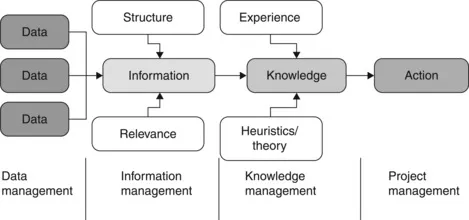
Figure 1.1 Data, information and knowledge
Knowledge is situational and what works in one situation may not work in another.
As an illustration, consider the link between data, information and knowledge as they are involved in decision-making in a marketing organisation:

The experienced marketer has ‘know-how’ – he or she knows how to interpret market research information. They can use that knowledge to take the information and decide on an effective action. Their knowhow is developed from training, from years of experience, through the acquisition of a set of heuristics and working models, and through many conference and bar-room conversations with the wider community of marketers.
Knowledge that leads to action is ‘know-how’. Your experience, and the theories and heuristics to which you have access, allow you to know what to do, and to know how to do it. In this book, you can use the terms ‘knowledge’ and ‘know-how’ interchangeably.
In large organisations, and in organisations where people work in teams and networks, knowledge and know-how are increasingly being seen as a communal possession, rather than an individual possession. In some companies it will be the communities of practice that have the collective ownership of the knowledge, while in others it will be the regional sales teams that have the collective ownership. Such knowledge is ‘common knowledge’ – the things that everybody knows. This common knowledge is based on shared experiences and on collective theory and heuristics that are defined, agreed and validated by the community.
Tacit and explicit knowledge
The terms tacit and explicit are often used when talking about knowledge. The original author, Polyani (1966),4 used these terms to define ‘unable to be expressed’ and ‘able to be expressed’ respectively. Thus, in the original usage, tacit knowledge means knowledge held instinctively, in the unconscious mind and in the muscle memory, which cannot be transferred into words. Knowledge of how to ride a bicycle, for example, is tacit knowledge, as it is almost impossible to explain verbally.
Following the seminal text by Nonaka and Takeuchi (1995)5 these original definitions have become blurred, and tacit and explicit are often used to describe ‘knowledge which has not been codified’ and ‘knowledge which has been codified’ (or ‘head knowledge’ and ‘recorded knowledge’ respectively). This latter definition is a more useful one in the context of knowledge management within organisations, as it defines knowledge based on where it exists, rather than on its intrinsic codifiability. So, knowledge that exists only in people’s heads is often termed tacit knowledge, and knowledge that has been recorded somewhere is termed explicit knowledge. Knowledge can therefore be transferred from tacit to explicit, according to Nonaka and Takeuchi.
There is a wide range of types of knowledge, from easily codifiable to completely uncodifiable. Some know-how, such as how to cook a pizza, can be codified and written down; indeed, most households contain codified cooking knowledge (cookery books). Other know-how, such as how to whistle or how to dance the tango, cannot be codified, and there would be no point in trying to teach someone to dance by giving them a book on the subject.
Sales and marketing knowledge comprises a wide range of codifiability. Some of it can never be fully written down, e.g. how to establish a lasting relationship with a client, and must be transferred through coaching and role-play, while some of it can be easily codified into company guidelines.
What is knowledge management?
If knowledge is a combination of experience, theory and heuristics, developed by an individual or a community of practice, that allows decisions to be made and correct actions to be taken, then what is knowledge management? Larry Prusak of McKinsey Consulting says, ‘It is the attempt to recognise what is essentially a human asset buried in the minds of individuals, and leverage it into a corporate asset that can be used by a broader set of individuals, on whose...
Table of contents
- Cover image
- Title page
- Table of Contents
- Copyright
- List of figures and table
- Foreword
- Preface
- Acknowledgements
- About the authors
- Chapter 1: Principles of knowledge management
- Chapter 2: The sales and marketing context
- Chapter 3: Knowledge management processes in sales, bidding and marketing
- Chapter 4: Communities in sales and marketing
- Chapter 5: Technology
- Chapter 6: Knowledge management roles
- Chapter 7: Culture and governance
- Chapter 8: Case study from British Telecom: supporting a distributed sales force
- Chapter 9: Case study from Mars, Inc.: knowledge management in sales and marketing
- Chapter 10: Case study from Ordnance Survey: social networking and the transfer of knowledge within supply chain management
- Chapter 11: Setting up a knowledge management framework for sales, marketing and bidding
- Appendix – customer buying process
- Index
Trusted by 375,005 students
Access to over 1.5 million titles for a fair monthly price.
Study more efficiently using our study tools.
Frequently asked questions
Yes, you can cancel anytime from the Subscription tab in your account settings on the Perlego website. Your subscription will stay active until the end of your current billing period. Learn how to cancel your subscription
No, books cannot be downloaded as external files, such as PDFs, for use outside of Perlego. However, you can download books within the Perlego app for offline reading on mobile or tablet. Learn how to download books offline
Perlego offers two plans: Essential and Complete
- Essential is ideal for learners and professionals who enjoy exploring a wide range of subjects. Access the Essential Library with 800,000+ trusted titles and best-sellers across business, personal growth, and the humanities. Includes unlimited reading time and Standard Read Aloud voice.
- Complete: Perfect for advanced learners and researchers needing full, unrestricted access. Unlock 1.5M+ books across hundreds of subjects, including academic and specialized titles. The Complete Plan also includes advanced features like Premium Read Aloud and Research Assistant.
We are an online textbook subscription service, where you can get access to an entire online library for less than the price of a single book per month. With over 1.5 million books across 990+ topics, we’ve got you covered! Learn about our mission
Look out for the read-aloud symbol on your next book to see if you can listen to it. The read-aloud tool reads text aloud for you, highlighting the text as it is being read. You can pause it, speed it up and slow it down. Learn more about Read Aloud
Yes! You can use the Perlego app on both iOS and Android devices to read anytime, anywhere — even offline. Perfect for commutes or when you’re on the go.
Please note we cannot support devices running on iOS 13 and Android 7 or earlier. Learn more about using the app
Please note we cannot support devices running on iOS 13 and Android 7 or earlier. Learn more about using the app
Yes, you can access Knowledge Management for Sales and Marketing by Tom Young,Nick Milton in PDF and/or ePUB format, as well as other popular books in Business & Information Management. We have over 1.5 million books available in our catalogue for you to explore.