eBook - ePub
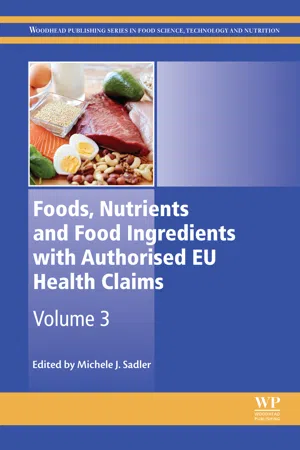
Foods, Nutrients and Food Ingredients with Authorised EU Health Claims
Volume 3
- 276 pages
- English
- ePUB (mobile friendly)
- Available on iOS & Android
eBook - ePub
About this book
Foods, Nutrients and Food Ingredients with Authorized EU Health Claims, Volume Three, provides an overview of how health claims are regulated in the European Union, along with detailed scientific and regulatory information about permitted health claims for foods and ingredients. The latest volume in this series focuses on regulatory coverage from EC 1924/2006, including the most recently authorized claims. Topics discussed include sections on the Authorized reduction of disease risk claims, including calcium, calcium with Vitamin D, Vitamin D, Folic Acid, Limicol® and MUFA and PUFA., health claims based on emerging science, recent regulatory announcements, and finally, general function claims.
The book represents the go-to resource for R&D managers and technical managers in the food and beverage and dietary supplements industry, product development managers, health professionals and academic researchers in the field.
- Provides a comprehensive overview of foods and food substances that have achieved approved health claims in Europe under Regulation EC 1924/2006
- Covers properties and applications of each ingredient, as well as evidence for the health claim and how it benefits consumers
- Outlines the importance of each claim in product development and marketing, and in regulatory issues, such as conditions of use
Information
Part One
Regulatory Background
Chapter 1: European health claims: regulatory developments
Chapter 2: Consumers and health claims
1
European health claims: regulatory developments
Michele J. Sadler Rank Nutrition Ltd, Bethersden, Kent, United Kingdom
Abstract
Recent developments, concerning the regulation of health claims in Europe have been a slowing of health-claim applications through the available application routes i.e. for reduction of disease risk claims, children’s development and health claims, and for claims based on newly developed scientific evidence and/or requesting the protection of proprietary data. There has been no further progress with setting nutrient profiles or with agreeing the status of health claims for ‘botanicals’, and these two issues are subject to a wide-ranging review. EFSA has published revised guidance to assist with health-claim applications. However, the remit of the expert panels is being revised reflecting the reduced number of health claim applications. The potential impact of Brexit on health claims is considered, as this may result in divergence in health claims regulation between the United Kingdom and the European Union depending on the final relationship that is negotiated between the UK and the EU.
Keywords
health claims
regulation
botanicals
nutrient profiles
guidance
Brexit
1.1. Introduction
This chapter discusses developments since January 2015 relating to the regulation of health claims in Europe, which is governed by the Nutrition and Health Claims Regulation (EU, 2006a). The equivalent chapter in Volume 2 (Sadler, 2015) covers regulatory developments from September 2013, while developments prior to that are covered in Volume 1 (Binns, 2014).
Recent developments of note are a slower rate of new health claim applications through the available application routes (EU, 2006a):
• Article 13.5: claims based on newly developed scientific evidence and/or requesting the protection of proprietary data.
• Article 14.1(a): reduction of disease risk claims.
• Article 14.1(b): children’s development and health claims.
Of the candidate ‘general function’ claims previously submitted by Member States (prior to 31 January 2008) under Article 13.1 (Binns, 2014), over 2000 claims for ‘botanicals’ remain on-hold, pending a wide-ranging regulatory review. The requirement in the Nutrition and Health Claims Regulation (EU, 2006a) to set nutrient profiles, such that foods not meeting certain nutritional criteria would not be able to carry health claims, is also under review. Though rules have been published to apply for generic descriptors, at the time of writing, none have as yet been approved. These issues are discussed along with other general trends, reference to new guidance documents, and possible effects of the changing political landscape, particularly in the United Kingdom in light of the decision to leave the European Union (so-called Brexit).
1.2. Health claim applications
The slower pace of new health claim applications reflects the associated difficulty, the uncertainty and the high costs of both undertaking new studies and compiling applications which have resulted in less commercial interest in winning health claim approvals in Europe. Of applications that have been made, negative EFSA opinions continue to outweigh positive ones, and the time taken to authorise claims remains variable, depending on particular issues that require discussion. The numbers of authorised and non-authorised health claims by category as of July 2017 are shown in Table 1.1.
Table 1.1
Number of authorised and non-authorised health claims by category (as of July 2017)
| Category (article) | Authorised | Non-authorised |
| 13.1 ‘General function claims’ | 229 | 1875 |
| 13.5 Claims based on newly developed scientific evidence | 6 | 108 |
| 13.5 Claims based on proprietary data | 5 | |
| 14.1(a) Reduction of disease risk claims | 14 | 24 |
| 14.1(b) Children’s development and health claims | 12 | 44 |
| Number of 13.5 and 14.1(a) and (b) health claims under discussion following receipt of the EFSA opinion is ∼50 |

1.2.1. Article 13.5 claims
1.2.1.1. Authorisations based on newly developed scientific data
Two claims were authorised in the first half of 2017, too late for inclusion in Volume 3. These were for creatine in conjunction with resistance training and ‘improvement in muscle strength’ in adults aged over 55 years, and for lactitol and ‘maintenance of normal defecation’. Lactitol has since received novel foods approval for nutritional or physiological purposes, for use in capsule or tablet forms of food supplements intended for adults at a maximum daily dose of 20 g.
Four Article 13.5 applications that are also not the subject of new chapters were for claims that had already been assessed with a favourable outcome under Article 13.1. They related to two claims: one for non-fermentable carbohydrates and ‘consumption of foods/drinks containing [name of all used non-fermentable carbohydrates] instead of fermentable carbohydrates...
Table of contents
- Cover
- Title page
- Table of Contents
- Copyright
- Dedication
- List of contributors
- Preface
- Part One: Regulatory Background
- Part Two: Authorised Reduction of Disease Risk Claims
- Part Three: Health Claims Based on Emerging Science and Proprietary Claims
- Part Four: General Function Claims
- Index
Trusted by 375,005 students
Access to over 1.5 million titles for a fair monthly price.
Study more efficiently using our study tools.
Frequently asked questions
Yes, you can cancel anytime from the Subscription tab in your account settings on the Perlego website. Your subscription will stay active until the end of your current billing period. Learn how to cancel your subscription
No, books cannot be downloaded as external files, such as PDFs, for use outside of Perlego. However, you can download books within the Perlego app for offline reading on mobile or tablet. Learn how to download books offline
Perlego offers two plans: Essential and Complete
- Essential is ideal for learners and professionals who enjoy exploring a wide range of subjects. Access the Essential Library with 800,000+ trusted titles and best-sellers across business, personal growth, and the humanities. Includes unlimited reading time and Standard Read Aloud voice.
- Complete: Perfect for advanced learners and researchers needing full, unrestricted access. Unlock 1.5M+ books across hundreds of subjects, including academic and specialized titles. The Complete Plan also includes advanced features like Premium Read Aloud and Research Assistant.
We are an online textbook subscription service, where you can get access to an entire online library for less than the price of a single book per month. With over 1.5 million books across 990+ topics, we’ve got you covered! Learn about our mission
Look out for the read-aloud symbol on your next book to see if you can listen to it. The read-aloud tool reads text aloud for you, highlighting the text as it is being read. You can pause it, speed it up and slow it down. Learn more about Read Aloud
Yes! You can use the Perlego app on both iOS and Android devices to read anytime, anywhere — even offline. Perfect for commutes or when you’re on the go.
Please note we cannot support devices running on iOS 13 and Android 7 or earlier. Learn more about using the app
Please note we cannot support devices running on iOS 13 and Android 7 or earlier. Learn more about using the app
Yes, you can access Foods, Nutrients and Food Ingredients with Authorised EU Health Claims by Michele Sadler in PDF and/or ePUB format, as well as other popular books in Law & Administrative Law. We have over 1.5 million books available in our catalogue for you to explore.