New and Future Developments in Catalysis is a package of books that compile the latest ideas concerning alternate and renewable energy sources and the role that catalysis plays in converting new renewable feedstock into biofuels and biochemicals. Both homogeneous and heterogeneous catalysts and catalytic processes will be discussed in a unified and comprehensive approach. There will be extensive cross-referencing within all volumes.This volume presents a complete picture of all carbon dioxide (CO2) sources, outlines the environmental concerns regarding CO2, and critically reviews all current CO2 activation processes. Furthermore, the volume discusses all future developments and gives a critical economic analysis of the various processes.
- Offers in-depth coverage of all catalytic topics of current interest and outlines future challenges and research areas
- A clear and visual description of all parameters and conditions, enabling the reader to draw conclusions for a particular case
- Outlines the catalytic processes applicable to energy generation and design of green processes
Narcís Homsa,b, Jamil Toyirc and Pilar Ramírez de la Piscinaa, aDepartament de Química Inorgànica and Institut de Nanociència i Nanotecnologia, Facultat de Química, Universitat de Barcelona, Martí i Franquès 1-11, 08028 Barcelona, Spain, bCatalonia Institute for Energy Research (IREC), Jardins de les Dones de Negre 1, 08930 Barcelona, Spain, cUniversité Sidi Mohamed Ben Abdellah, Faculté Polydisciplinaire, B.P 1223, Taza, Morocco
1.1 Introduction
CO2 can be considered a carbon source rather than just a greenhouse gas (GHG) that needs to be mitigated. As a result of tough policies on GHG emissions, CO2 has turned out to be a strategic carbon source, available as free or even with a financial return if adequate technology is applied for CO2 capture and recycling. From this perspective, an attractive opportunity is emerging for a new CO2-based economy. The chemical recycling of CO2 and its reuse in the production of fuels or other chemicals is attractive from both an environmental perspective and in terms of fossil source independency. CO2 is released as a by-product in the chemical and petrochemical industry and in fermentation processes and currently, new technological possibilities based on membranes and absorbents are opening up for its separation and capture. High purity CO2 is available from such sources; indeed, some such emissions are already used in the production of chemicals such as CO2 from the ammonia industry which is fed to urea plants or CO2 from fermentation which is recycled into the beverage industry after appropriate cleaning. Moreover, large-scale emissions of CO2 come from power plants fueled by natural gas and from the cement industry; in these cases undesired impurities must be taken into account before the CO2 becomes useful. However, these sources can be considered an opportunity for large-scale recycling of CO2. In what follows we will consider different options for the reuse of CO2 by means of chemical recycling.
We must bear in mind that CO2 is classified as a stable, almost inert molecule. To activateCO2, it is necessary to overcome its considerable Gibbs energy of formation:
. Nevertheless, CO2 use is thermodynamically possible via numerous reactions involving its reduction or its incorporation into other compounds.
The reduction of CO2 by the cleavage of the C
O bond(s) and the formation of new C—H or C—C bond(s) can be accomplished using a reductant. In this case, the action of an appropriate catalyst can convert CO2 into a potential energy vector. This recycling pathway requires a large input of energy and usually H2 as the reductant, and leads to fuels such as methane and methanol. In this context, two aspects must be taken into account: the production of H2 and the energy source. If the energy comes from renewable sources and the H2 does not come from fossil fuels, does the overall process merit further interest. Nowadays, we can engage optimized electrolysis of water to supply the H2, thus avoiding the fossil fuel starting material. The use of non-constant wind energy or electrical energy produced at night can be used to obtain H2, thereby matching the necessity to store such excess energy. In fact, storage of H2 itself is necessary; one nice way to accomplish this is to incorporate the hydrogen into a liquid fuel. Then, since the products obtained from the catalytic hydrogenation of CO2 can be directly used as fuels, overall this process could be seen as a means of electrical energy storage and transport. However, the recycling of CO2 to fuels implies its immediate release into the environment.
The incorporation of CO2 into chemicals as a C1 building block is the other approach to its reuse. In this case, lower energy input is required since the whole CO2 molecule is used without the need to cleave the C
O bond(s). However, to accomplish a desired reaction, the action of a catalyst is also usually necessary. In this CO2 recycling pathway, different parameters need to be taken into account to determine the viability of a proposed process. The amount of CO2 fixed and the overall energy balance of the complete chemical route, together with the value of the product produced, could indicate how feasible this process is. Large-scale production of highly valued polymers could be performed using recycled CO2, thus also diminishing the use of fossil resources. In this way, if highly stable long-life materials are produced, the CO2 storage could be very long term and therefore the release of CO2 into the environment could be very slow.
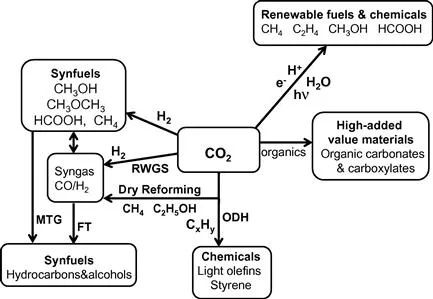
In recent years, extensive research has been carried out into these aspects of CO2 reuse and numerous publications have appeared [1–12]. This chapter therefore presents recent advances in the conversion of CO2 into fuels and desirable chemical products by using heterogeneously catalyzed processes, which are summarized in Figure 1.1.
Figure 1.1 Catalytic routes for CO2 activation in heterogeneous phase leading to fuels and chemicals.
The chapter is divided in different sections. After the Introduction, the second section is dedicated to the reactions of CO2 with hydrogen; particular attention is paid to large-scale processes that produce synfuels: methanol, dimethyl ether (DME), methane and higher hydrocarbons and alcohols. Then, CO2-reforming processes of methane and alcohols, and dehydrogenation processes using CO2 are presented in Section 1.3. Catalytic processes based on CO2 insertion into organic compounds to form carbonates or carboxylic acids are discussed in Section 1.4. In the last part, future trends in the catalytic conversion of CO2 are presented with a particular focus on processes that aim to produce strategic chemicals or fuels using renewable energy sources.
1.2 Reactions of CO2 with hydrogen
1.2.1 Hydrogenation of CO2 to Methanol
Methanol is extensively used as a starting material for the production of several bulk chemicals and liquid fuels [2]. Furthermore, the use of methanol as a medium for the storage and transportation of hydrogen and as fuel in direct methanol fuel cells (DMFC) could increase demand for it in a future.
Nowadays, methanol production uses syngas (a CO/CO2/H2 mixture) produced from fossil sources and Cu/ZnO-based catalysts. However, methanol production from CO2 and hydrogen (Eq. (1.1)) is now considered a serious alternative which could contribute to ...
Table of contents
Cover image
Title page
Table of Contents
Copyright
Introduction
Contributors
Chapter 1. Catalytic Processes for Activation of CO2
Chapter 2. Surface Science Studies of Carbon Dioxide Chemistry
Chapter 3. Mechanistic Understanding of Catalytic CO2 Activation from First Principles Theory
Chapter 4. Catalytic Activation and Conversion of Carbon Dioxide into Fuels/Value-Added Chemicals Through C—C Bond Formation
Chapter 5. Catalytic Transformation of CO2 into Value-Added Organic Chemicals
Chapter 6. Application of Carbon Dioxide in Hydrogen Storage: Homogeneous Hydrogenation of Carbon Dioxide and Dehydrogenation of Formic Acid
Chapter 7. Recent Advances on the Catalysts for Activation of CO2 in Several Typical Processes
Chapter 8. Catalytic Synthesis of CO Free Hydrogen
Chapter 9. Transition-Metal-Catalyzed C—C Bond Forming Reactions with Carbon Dioxide
Chapter 10. Electro-Catalytic Reduction of Carbon Dioxide
Chapter 11. Carbon Dioxide Reforming of Methane to Syngas over Mesoporous Material Supported Nickel Catalysts
Chapter 12. Chemical Functions of Dense Phase CO2 as Accelerator/Modifier in Organic Synthetic Reactions
Chapter 13. Synthesis of Cyclic Carbonates from Carbon Dioxide and Epoxides
Chapter 14. Environmental Concerns Regarding CO2
Chapter 15. Catalyst Development for CO2 Activation to Produce Syn-Gas through CO2 Reforming of CH4: Mitigation of Carbon Formation on Ni-Based Catalysts
Chapter 16. Carbon Dioxide as Soft Oxidant and Promoter in Oxidation Catalysis
Chapter 17. Biomimetic Approaches to Reversible CO2 Capture from Air. N-Methylcarbaminic Acid Formation in Rubisco-Inspired Models
Chapter 18. CO2 Adsorption in Porous Materials
Chapter 19. Carbon Dioxide Activation and Conversion
Chapter 20. Photocatalytic Conversion of Carbon Dioxide into Fuels Using Layered Double Hydroxides Coupled with Hydrogen or Water
Chapter 21. CO2 Capture by CaO-Based Sorbents and Sorption Enhanced Reaction Systems
Index
Trusted by 375,005 students
Access to over 1.5 million titles for a fair monthly price.
Study more efficiently using our study tools.
Frequently asked questions
Yes, you can cancel anytime from the Subscription tab in your account settings on the Perlego website. Your subscription will stay active until the end of your current billing period. Learn how to cancel your subscription
No, books cannot be downloaded as external files, such as PDFs, for use outside of Perlego. However, you can download books within the Perlego app for offline reading on mobile or tablet. Learn how to download books offline
Perlego offers two plans: Essential and Complete
Essential is ideal for learners and professionals who enjoy exploring a wide range of subjects. Access the Essential Library with 800,000+ trusted titles and best-sellers across business, personal growth, and the humanities. Includes unlimited reading time and Standard Read Aloud voice.
Complete: Perfect for advanced learners and researchers needing full, unrestricted access. Unlock 1.5M+ books across hundreds of subjects, including academic and specialized titles. The Complete Plan also includes advanced features like Premium Read Aloud and Research Assistant.
Both plans are available with monthly, semester, or annual billing cycles.
We are an online textbook subscription service, where you can get access to an entire online library for less than the price of a single book per month. With over 1.5 million books across 990+ topics, we’ve got you covered! Learn about our mission
Look out for the read-aloud symbol on your next book to see if you can listen to it. The read-aloud tool reads text aloud for you, highlighting the text as it is being read. You can pause it, speed it up and slow it down. Learn more about Read Aloud
Yes! You can use the Perlego app on both iOS and Android devices to read anytime, anywhere — even offline. Perfect for commutes or when you’re on the go. Please note we cannot support devices running on iOS 13 and Android 7 or earlier. Learn more about using the app
Yes, you can access New and Future Developments in Catalysis by Steven L Suib in PDF and/or ePUB format, as well as other popular books in Technology & Engineering & Chemical & Biochemical Engineering. We have over 1.5 million books available in our catalogue for you to explore.