eBook - ePub
Advanced Gear Manufacturing and Finishing
Classical and Modern Processes
- 240 pages
- English
- ePUB (mobile friendly)
- Available on iOS & Android
eBook - ePub
Advanced Gear Manufacturing and Finishing
Classical and Modern Processes
About this book
Advanced Gear Manufacturing and Finishing offers detailed coverage of advanced manufacturing technologies used in the production of gears, including new methods such as spark erosion machining, abrasive water jet machining, additive layer manufacturing, laser shaping, and sustainable manufacturing of gears.
The industry in this area is constantly producing new settings where gears must endure ever increasing stresses, strains, and temperatures. Advanced methods in manufacturing, finishing, and surface property enhancement have emerged in recent years to meet these challenges.
This unique book takes a critical look at the state-of-the-art research into these new methods, and the latest improvements to classic technologies in both gear manufacturing and finishing. This book is essential reading for researchers and engineers working in the fields of powertrain manufacturing, gear technology, and advanced manufacturing technologies.
- Describes the machining systems, main components, and working procedures with the help of diagrams and photos.
- Demonstrates the mechanisms and capabilities of new methods.
- Shows improvements to a range of gear manufacturing and finishing technologies.
- Provides a critical review of recent research in a range of fields relevant to gear manufacturing technologies.
Information
Chapter 1
Introduction to Gear Engineering
Abstract
Gears are basic mechanical components used to transmit motion and/or power and are responsible for the smooth functioning of a significant number of machines, instruments, and equipments employed in most major industrial, scientific, and domestic applications. The purpose of this chapter is to present a basic introduction to gears, their use, and manufacture. The chapter commences with an introduction to gears along with a brief history. A classification scheme is then presented based on the gear-shaft axis orientation and corresponding gear types with their unique features and applications. The applicable gear terminology and nomenclature along with the most important gear materials, their properties, and application areas are presented next. The chapter is concluded with a brief introduction into gear manufacture comprising both conventional and advanced types along with the relevant finishing processes.
Keywords
Bevel gear; involute; gear hobbing; noncircular gear; spline; spur gear; worm wheel
1.1 Introduction and History of Gears
1.1.1 Introduction
A gear is basically a toothed wheel that works in tandem with another gear (or gears) to transmit power and/or motion to change speed and/or direction of motion. Dudley defined a gear as “a geometric shape that has teeth uniformly spaced around the circumference and is made to mesh its teeth with another gear” [1]. Slipping is a major problem during transmission of motion and power between two shafts by rope or belt drive and consequently may affect the precision and efficiency of the system adversely. This slipping phenomenon is largely avoided by means of gear drives. The compact layout, flexibility, high efficiency, and reliability are the most important features that make gears and gear drives the first choice in many applications. Gear sizes range from nanometers (nanogears) to meters (macrogears) with corresponding application areas from nanoelectromechanical systems (NEMS) to large mills and wind turbines. A wide range of materials ranging from plastics and ceramics to ultrahigh strength steels are used in gear manufacture.
Gears and subsequently the gear manufacturing industry plays an integral role in many industrial sectors as it is one of the basic mechanical components used for transmission of motion and/or power in equipment, machines, and instruments. Several conventional and advanced methods of gear manufacture are available for use in specialized applications to produce gears that are fit for purpose. Technological advancements in gear engineering over the last few decades have enabled the gear industry to produce near-net shaped and high-quality gears by short process chains and a lower environmental footprint.
1.1.2 History
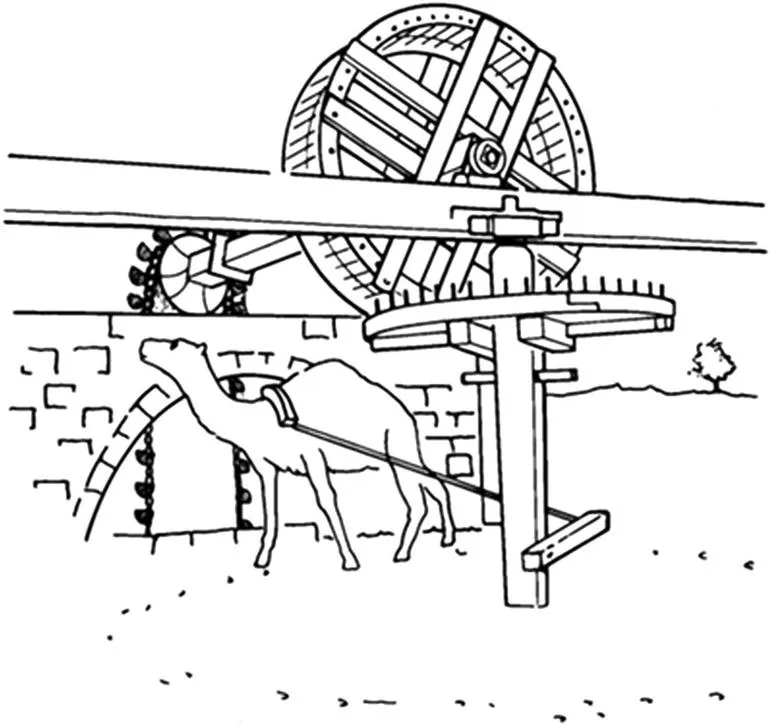
The writings of Aristotle (4th century B.C.) reflect some of the earliest reference to gears and their use [2]. He specifically noted that the direction of rotation is reversed when one gear wheel drives another. Water-lifting devices, in the form of ‘Persian wheels’, were used in the 3rd century B.C. Animals such as camels, bullocks, and buffaloes were used to drive these devices that were typically associated with open wells. In this arrangement, an animal driven horizontal toothed wheel was meshed into a vertical toothed wheel that was then used to lift water containers that were attached to another geared mechanism (Fig. 1.1). Later on, this method was successfully adopted for use in water-driven grain mills and other devices. During the 3rd century, Archimedes also developed a device (Antikythera mechanism) that was equipped with numerous gears to simulate positions of astronomical bodies [3]. The sketchbooks of Leonardo da Vinci, dating to the mid 1400s, depict various unique gear mechanisms. Initially, wood was the material of choice for gear manufacture until it was subsequently replaced by cast iron.
A more advanced approach to gear engineering came into being at around 1400 with more comprehensive use of science and mathematics in gear design and the associated mechanisms. The first major investigation into gear design as regards to proving the benefits of the involute curve over a cycloidal was conducted by Philip de la Hire in France and later confirmed by a Swiss mathematician Leonard Euler who was responsible for the law of conjugate action [1]. The industrial revolution in England during the 18th century led to the use of cycloidal gears for clocks, irrigation devices, water mills, and powered machines. Further uses were rapidly developed and explored with the invention of the locomotive, vehicles, and other machines. Gear hobbing and shaping technologies were developed in the early 19th century providing the foundation for fabrication of better quality commercial gears. Various new gear types, materials, and surface treatment techniques were introduced during the 19th century. Further advancement in gear manufacturing, measurement techniques, and testing technologies during the late 19th and in early 20th centuries led the way for significant growth in its application in industry.
1.2 Classification and Gear Types
A wide range of gear types exist to fulfill various different application requirements. Gears and gear systems are usually classified according to the orientation/arrangement of its associated rotational axes. Gears are therefore classified as parallel-shaft gears, intersecting-shaft gears and nonparallel nonintersecting-shaft gears (refer Table 1.1). The details regarding these three categories and the corresponding gear types are discussed in detail in the following subsections.
Table 1.1
The Three Major Categories of Gear Classification and Corresponding Gear Types
| Categories of Gears (Based on the Orientation of Gear Shafts) | Types of Gears | Representation | Features, Applications and Methods of Manufacture |
Parallel-shaft gears 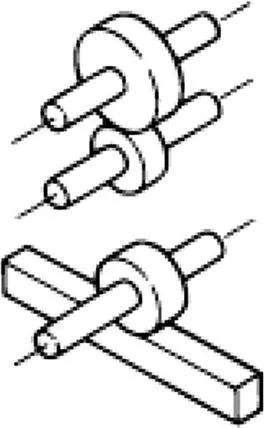 | Spur gears | 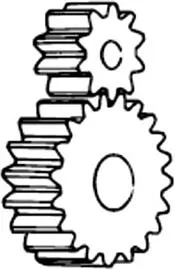 | Features: Simple to design and manufacture, highest efficiency, easy to assemble, offer excellent precision, high wear and noisy operation |
| Applications: Automotive transmission; Industrial drives; Machine tools; Motors and pumps; Agriculture equipment; Scientific instruments; Electronic devices; Large mills | |||
| Methods of Manufacture: Hobbing, shaping, milling, broaching, casting, extrusion, stamping, powder metallurgy, ... |
Table of contents
- Cover image
- Title page
- Table of Contents
- Copyright
- Preface
- Chapter 1. Introduction to Gear Engineering
- Chapter 2. Conventional Manufacturing of Cylindrical Gears
- Chapter 3. Manufacturing of Conical and Noncircular Gears
- Chapter 4. Advances in Gear Manufacturing
- Chapter 5. Conventional and Advanced Finishing of Gears
- Chapter 6. Surface Property Enhancement of Gears
- Chapter 7. Measurement of Gear Accuracy
- Index
Trusted by 375,005 students
Access to over 1.5 million titles for a fair monthly price.
Study more efficiently using our study tools.
Frequently asked questions
Yes, you can cancel anytime from the Subscription tab in your account settings on the Perlego website. Your subscription will stay active until the end of your current billing period. Learn how to cancel your subscription
No, books cannot be downloaded as external files, such as PDFs, for use outside of Perlego. However, you can download books within the Perlego app for offline reading on mobile or tablet. Learn how to download books offline
Perlego offers two plans: Essential and Complete
- Essential is ideal for learners and professionals who enjoy exploring a wide range of subjects. Access the Essential Library with 800,000+ trusted titles and best-sellers across business, personal growth, and the humanities. Includes unlimited reading time and Standard Read Aloud voice.
- Complete: Perfect for advanced learners and researchers needing full, unrestricted access. Unlock 1.5M+ books across hundreds of subjects, including academic and specialized titles. The Complete Plan also includes advanced features like Premium Read Aloud and Research Assistant.
We are an online textbook subscription service, where you can get access to an entire online library for less than the price of a single book per month. With over 1.5 million books across 990+ topics, we’ve got you covered! Learn about our mission
Look out for the read-aloud symbol on your next book to see if you can listen to it. The read-aloud tool reads text aloud for you, highlighting the text as it is being read. You can pause it, speed it up and slow it down. Learn more about Read Aloud
Yes! You can use the Perlego app on both iOS and Android devices to read anytime, anywhere — even offline. Perfect for commutes or when you’re on the go.
Please note we cannot support devices running on iOS 13 and Android 7 or earlier. Learn more about using the app
Please note we cannot support devices running on iOS 13 and Android 7 or earlier. Learn more about using the app
Yes, you can access Advanced Gear Manufacturing and Finishing by Kapil Gupta,Neelesh Kumar Jain,Rolf Laubscher in PDF and/or ePUB format, as well as other popular books in Technology & Engineering & Mechanical Engineering. We have over 1.5 million books available in our catalogue for you to explore.