- 176 pages
- English
- ePUB (mobile friendly)
- Available on iOS & Android
eBook - ePub
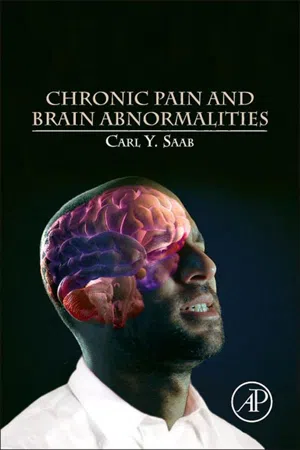
Chronic Pain and Brain Abnormalities
About this book
It is only natural for someone in pain to attend to the body part that hurts. Yet this book tells the story of persistent pain having negative effects on brain function. The contributors, all leading experts in their respective fields of pain electrophysiology, brain imaging, and animal models of pain, strive to synthesize compelling and, in some ways, connected hypotheses with regard to pain-related changes in the brain. Together, they contribute their clinical, academic, and theoretical expertise in a comprehensive overview that attempts to define the broader philosophical context of pain (disentangling sensical from nonsensical claims), list the changes known to take place in the brains of individuals with chronic pain and animal models of pain, address the possible causes and mechanisms underlying these changes, and detail the techniques and analytical methods at our disposal to "visualize" and study these changes.
- Philosophical and social concepts of pain; testimonials of chronic-pain patients
- Clinical data from pain patients' brains
- Advances in noninvasive brain imaging for pain patients
- Combining theoretical and empirical approaches to the analysis of pain-related brain function
- Manipulation of brain function in animal models
- Emerging neurotechnology principles for pain diagnostics and therapeutics
Information
Chapter 1
Introduction
Carl Y. Saab, Brown University, Providence, RI, USA
“We are all bitched from the start and you especially have to be hurt like hell before you can write seriously. But when you get the damned hurt use it—don’t cheat with it. Be as faithful to it as a scientist.”
Ernest Hemingway to F. Scott Fitzgerald.
“Pain is the question mark turned like a fishhook in the human heart.”
Peter De Vries.
Rationale and Scope of this Book
This book focuses on the neurophysiological mechanisms of pain in the brain, in particular chronic pain conditions. Chronic pain is broadly defined as a myriad of long-lasting, poignantly unpleasant sensations, in addition to a host of cognitive, behavioral and emotional comorbidities that are not alleviated by standard pharmacotherapy. It is a state of consciousness that deviates from common painful experiences in ways that profoundly threaten the patient’s wellbeing and quality of life. A more elaborate definition of chronic pain is discussed below, and the authors have each attempted to articulate the specific chronic pain condition in question, as there are many that manifest with different etiologies, symptomatology and, arguably, physiological mechanisms.
Certain forms of chronic pain such as neuropathic pain, are classified as neurological disorders, begging the question “where in the nervous system is the pathology?” Can one speak of pathogenesis and etiology of chronic pain in classical terms such as the pathogenesis of cancer or the etiology of cystic fibrosis? Restricted lesions in the brain have been known to lead to central pain, for example thalamic pain syndrome due to a stroke in the thalamus. However, the authors of this book do not wish to generalize that the brain is the target organ of pathology in patients suffering from all sorts of chronic pain, the same way for example that joint pathology is the ubiquitous cause for arthritis. Rather, we endorse the view that brain mechanisms associated with chronic pain could provide valuable clues to the underlying neural circuitry that is required for the pain experience. This perspective should not be construed as pointing fingers at “pain centers” in the brain that set off a host of feelings and emotions intimately entwined with pain.
Accordingly, my main goal as Editor was to engage leading clinicians and scientists in the pain field to reconcile the wealth of clinical and laboratory data in one book, to place these data within a coherent hypothetical framework, and to discuss up-to-date therapeutic options that target the brain exclusively. In my opinion, the authors have done an excellent job in identifying a set of measurable neurophysiological phenomena that are highly correlated with the pain experience (i.e. predictive of pain), and phenomena whose modulation could alter the pain experience (i.e. of potential therapeutic value).
With these disclaimers in mind, it would be presumptuous (even non-sensical) to claim that, one day, given the right technology, we’ll be able to visualize what pain looks like in the brain. What we are prepared to say, instead, is that we are now closer to predicting pain in others with a high degree of confidence based on empirical measures. Moreover, we hope that similar approaches might, at the very least, help guide future diagnostics, and also, in the best case scenario, inform novel therapies.
What is Pain?
Can pain be accurately defined? Several authoritative books on pain have only partially succeeded in defining the pain experience in a fully comprehensive manner.1–7 Even one of the most widely-used definitions of pain among medical and academic professionals (which was formulated by the International Association for the Study of Pain, IASP8) falls short of grasping the pain experience in its entirety from the genealogy, etiology, epistemology and phenomenology perspectives* (see below). It is not surprising that linguists and philosophers across ages have been fascinated with the human experience of pain as a subject of study. Unless the reader is born with a genetic predisposition for pain insensitivity,9 they will unequivocally understand what pain means without further elaboration. This concept of perfectly understanding (or relating to) a phenomenon, yet not being able to reach universal agreement over its definition using communicable language, is not unique to pain. Consider for example the word “game.” Try as you may to reach a consensus on a definition of what game is (or what it is not), even among your closest friends, game will still mean different things to different people. Yet, call on someone to “play a game,” the person would likely engage in that specific activity (knowing the rules governing that game) without invoking a philosophical conundrum. It is argued that terms such as “game,” “love” and “pain” are understood because of community agreement about what these terms refer to, irrespective of our inability to confine them within the boundaries of common language. Therefore they are said to be representations of knowledge only partially anchored in language, and can only be conveyed most sincerely and gracefully by “showing” rather than by “saying”: “There are, indeed, things that cannot be put into words. They make themselves manifest. They are what is mystical”10 (p. 89); “What we cannot speak about we must pass over in silence”10(p. 89*). This is why, it is assumed, when two individuals communicate their pain experiences to one another, they can be said to play a language game whose rules follow popular votes far from being rigid (see “Private Language and Rule-Following Arguments”).11 Accordingly, one expects the qualifiers of the human pain experience to change dramatically with time and across cultures. Indeed, chilling accounts of pain insensitivity based on race portray a disturbing cultural bias and a racial rapport to pain (“Negresses will bear cutting with nearly, if not quite, as much impunity as dogs and rabbits”5, p. 40). Furthermore, the rising epidemic of pain hints at a possible shift in the collective pain barometer in modern days. Compare our daily moaning and groaning about back pain and joint pain with anecdotal accounts of Greek and Trojan wartime injuries, which are described with anatomical precision in The Iliad, however, with no hint of suffering or agony that live up to the traumatic atrocities they endured.5 It seems that the boundary of language cowers to pain, and one is inclined, thereof, to accept Wittgenstein’s position, that the genuine definition of a word lies in its use (“Don’t Think but Look!” aphorism 6612).
Pain in Animals
The difficulty in communicating one’s own pain experience is even more compounded when trying to appreciate someone else’s pain, or pain in other species. However, after years of working with animal models of pain, there is no doubt in my mind that animals feel pain and suffer from it. With the absence of an algesiometer with which one could measure pain quantitatively and empirically, confirmation of pain in others (be it human, rat or fish) remains completely subjective and arbitrary. Perhaps the Wittgensteinian dictum “What we cannot speak about we must pass over in silence” applies aptly in the case of animals, whereby pain-like behavior is our best (or at least most reliable) indicator of their general state of physical suffering, for even “if a lion could speak, we wouldn’t understand him”12aphorism 223). What’s left for an observer looking for clues about the sensory and emotional states of the wounded animal is a set of typical behaviors the observer can relate to, such as guarding the affected limb, vocalization, or alienation from its social milieu. However, the overwhelming majority of laboratory pain tests are based on so-called evoked responses to noxious stimuli, which involve recording the time it takes for an injured animal to withdraw the affected limb being stimulated with a moderately noxious heat stimulus, or in response to a moderately noxious mechanical stimulus. Some advances in the development of novel testing paradigms, such as place preference13 and coding of facial grimaces,14 have offered interesting alternatives to the traditional withdrawal reflex-based behavior. These inherent pitfalls associated with the use of behavior (reflexive and/or operant) as surrogate for predicting pain in animals have served as the platform for mounting serious criticism against the translational value of animal models. Regardless, pre-clinical animal models of pain have played—and continue to play—a key role in basic laboratory pain research.
Pain We Need
Evading hurt and suffering, or quickly eliminating either when they happen, is a guiding principle for many of us. Avoiding pain and discomfort may be the single most important factor influencing our day-to-day decisions, whereby “the right to a pain-free life” has attained an almost human right status. However, one must not confuse this tenet with striving to be pain-insensitive. This nuance is critical for the understanding of the value of pain, which serves primarily as a protective function that’s essential for survival. It is one thing to plan ahead to try to dodge as many painful stimuli as possible, and quite another to go through life without fear of harmful events, not knowing what pain is or what it means. For example, the fear of bee stings might prohibit a pain-sensitive person from reaching for honey from a beehive without the protective gear, whereas a pain-insensitive person with disregard for the bees warning signals might rush to the beehive with bare hands; the punishing experience of pain is just not there. In fact, congenital insensitivity to pain (CIP), a form of the rare hereditary sensory and autonomic neuropathies, is characterized from birth with a host of sensory deficits including mainly loss of pain and temperature (heat/cold) sensations, sleep disturbance and mental retardation (thought to be the result of the inability for thermoregulation during childhood in the case of CIP with anhydrosis).9 Though not directly fatal, the life expectancy of people with CIP is less than 25 years, which is mainly attributed to unattended severe traumatic injuries or infections. Other clinical conditions associated with partial pain insensitivity in the distal limbs include leprosy, leading to tissue wasting and amputation. Interestingly, the challenge for leprosy patients presenting with distal neuropathy is restoring their ability to feel pain in the affected limbs, or at least train them to better protect and safeguard their limbs, which has proven to be a difficult, if not impossible, task.15 In fact, Paul Brand, a pioneer in leprosy treatment, went on to develop a “prosthetic pain system,” using mechanical sensors in gloves and socks that deliver electric shock to a sensitive part of the body (armpit). However, Dr. Brand relinquished his pursuit saying:
In the end we had to abandon the entire scheme. Most important, we found no way around the fundamental weakness in our system: it remained under the patient’s control. If the patient did not want to heed the warnings from our sensory [prosthetic], he could always find a way to bypass the whole system. Why must pain be unpleasant? Why must pain persist? Our system failed for the precise reason that we could not effectively duplicate those two qualities of pain.
Brand16 (p. 195).
Nevertheless, he continued to expand on the techniques for protecting the insensitive foot and hand in novel ways, noting that:
Pain is the most valuable sensation we have. Never minimize its value. Never suppress pain unless you know its cause and have dealt with the root of the problem. Work with the sensations of pain, not against them. Pain is the way your own cells talk to you; listen and obey. When you value your own sensations, give special care to those who suffer from having no pain.
One wonders whether the paraphernalia of current over-the-counter pain medication might be, in some way, counteracting our natural pain system and helping us sustain unhealthy behaviors by ignoring warning signals such as headache and joint pain.
Pain We Don’t Need
Having argued that pain is a blessing, it must be said that this is mostly true in the case of normal pain. But is there such a thing as abnormal pain? As the total absence of pain can be detrimental to the few hundred documented cases of CIP, awkward and/or exaggerated and long-lasting pain seriously threatens the wellbeing of millions around the world. When the degree and quality of pain are uncoupled from apparent bodily injury, and if this pain persists for more than six months, is described in vague or unusual terms such as “electric-like” and/or evoked by gentle touch, it is mostly referred to as pathological chronic pain. Perhaps the best description of chronic pain comes from personal accounts of patients suffering from unremitting pain.
Real Faces of Pain: Case Illustrations
As discussed earlier regarding the difficulty of defining the word pain, and the highly idiosyncratic nature of chronic pain, it is helpful perhaps to use vivid illustrations of what chronic pain ought to look like in human subjects, thereby portraying a certain profile of the common chronic pain patient. Indeed, providing intimate descriptions of real case studies is important in going beyond the strict clinical jargon of medical charts and straight into the core issues of the pain patient’s feelings. Profound feelings of helplessness and anxiety (more so than depression), sadness, and a general sense of grief or loss tend to be common among those that experience severe pain that goes unabated for more than a straight three or six months period (p. 33). To a busy clinician, this added “baggage of feelings” amounts to nothing but a nuisance and a waste of time during consultation, whereas to an astute pain specialist they represent valuable signs that reinforce the medical diagnosis and, in some cases, mitigate suspicions of malingering (an important medico-legal issue beyond the scope of this book, p. 9).
Other common denominators of the chronic pain patient include a set of social or behavioral attributes such as difficulty in coping with daily activities, heavy use of heath care services (often in a futile quest of finding an elusive “cure”), as well as clear evidence of hightened psychological disturbances (though not necessarily psychiatric illnesses per se). In brief, reciprocal interactions between the patient and their s...
Table of contents
- Cover image
- Title page
- Table of Contents
- Copyright
- Dedication
- Preface
- List of Contributors
- List of Figures
- Chapter 1. Introduction
- Chapter 2. Morphological Brain Changes in Chronic Pain: Mystery and Meaning
- Chapter 3. Thalamic Burst Firing in Response to Experimental Pain Stimuli and in Patients with Chronic Neuropathic Pain may be a Carrier for Pain-Related Signals
- Chapter 4. Central Pain: A Thalamic Deafferentation Generating Thalamocortical Dysrhythmia
- Chapter 5. Surgical Interventions for Pain
- Chapter 6. Thalamocortical Abnormalities in Spinal Cord Injury Pain
- Chapter 7. Discussion
- Index
Trusted by 375,005 students
Access to over 1.5 million titles for a fair monthly price.
Study more efficiently using our study tools.
Frequently asked questions
Yes, you can cancel anytime from the Subscription tab in your account settings on the Perlego website. Your subscription will stay active until the end of your current billing period. Learn how to cancel your subscription
No, books cannot be downloaded as external files, such as PDFs, for use outside of Perlego. However, you can download books within the Perlego app for offline reading on mobile or tablet. Learn how to download books offline
Perlego offers two plans: Essential and Complete
- Essential is ideal for learners and professionals who enjoy exploring a wide range of subjects. Access the Essential Library with 800,000+ trusted titles and best-sellers across business, personal growth, and the humanities. Includes unlimited reading time and Standard Read Aloud voice.
- Complete: Perfect for advanced learners and researchers needing full, unrestricted access. Unlock 1.5M+ books across hundreds of subjects, including academic and specialized titles. The Complete Plan also includes advanced features like Premium Read Aloud and Research Assistant.
We are an online textbook subscription service, where you can get access to an entire online library for less than the price of a single book per month. With over 1.5 million books across 990+ topics, we’ve got you covered! Learn about our mission
Look out for the read-aloud symbol on your next book to see if you can listen to it. The read-aloud tool reads text aloud for you, highlighting the text as it is being read. You can pause it, speed it up and slow it down. Learn more about Read Aloud
Yes! You can use the Perlego app on both iOS and Android devices to read anytime, anywhere — even offline. Perfect for commutes or when you’re on the go.
Please note we cannot support devices running on iOS 13 and Android 7 or earlier. Learn more about using the app
Please note we cannot support devices running on iOS 13 and Android 7 or earlier. Learn more about using the app
Yes, you can access Chronic Pain and Brain Abnormalities by Carl Y. Saab in PDF and/or ePUB format, as well as other popular books in Medicine & Neurology. We have over 1.5 million books available in our catalogue for you to explore.