eBook - ePub
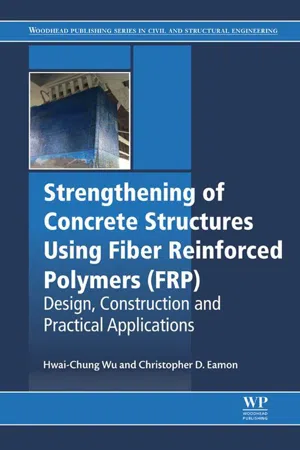
Strengthening of Concrete Structures Using Fiber Reinforced Polymers (FRP)
Design, Construction and Practical Applications
- 340 pages
- English
- ePUB (mobile friendly)
- Available on iOS & Android
eBook - ePub
Strengthening of Concrete Structures Using Fiber Reinforced Polymers (FRP)
Design, Construction and Practical Applications
About this book
Strengthening of Concrete Structures Using Fiber Reinforced Polymers (FRP): Design, Construction and Practical Applications presents a best practice guide on the structural design and strengthening of bridge structures using advanced Fiber Reinforced Polymer (FRP) composites. The book briefly covers the basic concepts of FRP materials and composite mechanics, while focusing on practical design and construction issues, including inspection and quality control, paying special attention to the differences in various design codes (US, Japan, and Europe) and recommendations.
At present, several design guides from the US, Japan, and Europe are available. These guidelines are often inconsistent and do not cover all necessary design and inspection issues to the same degree of detail. This book provides a critical review and comparison of these guidelines, and then puts forward best practice recommendations, filling a significant gap in the literature, and serving as an important resource for engineers, architects, academics, and students interested in FRP materials and their structural applications. Written from a practitioner's point-of-view, it is a valuable design book for structural engineers all over the world.
- Includes a large quantity of design examples and structural software to facilitate learning and help readers perform routine design
- Provides recommendations for best practices in design and construction for the strengthening of bridge structures using advanced fiber-reinforced polymer (FRP) composites
- Presents comprehensive guidelines on design, inspection, and quality control, including laboratory and field testing information
Information
1
Introduction
Abstract
This chapter introduces the current problems of infrastructural systems. It starts by briefly reviewing the causes of deterioration of conventional concrete and steel, and then go on to reveal the financial consequences of deteriorating infrastructures. Following this discussion, an analysis of fiber-reinforced polymer (FRP) and its available systems for strengthening will be presented. Finally, a full discussion of various strengthening schemes, design guidelines, and installation precautions for FRP is included at the conclusion of the chapter.
Keywords
Fiber-reinforced polymer (FRP); infrastructural problems; strengthening of structures; FRP installation; design guides
1.1 Overview
Various causes contribute to the deterioration of the civil infrastructure. Although bridges are generally expected to have a service life of 50–100 years, many are showing signs of distress much earlier. Extreme temperatures in the summer and winter, including many cycles of freeze thaw, and the use of deicing salts, are significant factors that contribute to the progressive damage of bridge structural members (Staton and Knauff, 2007). Other factors include heavy traffic loading, lack of adequate maintenance, and collision damage.
In the United States, State Departments of Transportation (DOT) conduct regular inspections of transportation structures such as bridges. Bridge inspection and reporting by DOTs are part of the larger, federally mandated National Bridge Inspection Standards (NBIS) administered by the Department of Transportation (USDOT) Federal Highway Administration (FHWA) (USDOT-FHWA, 2004). According to FHWA data, in 2009, 5% of bridges on the National Highway System were structurally deficient, 17% were functionally obsolete, and about 35% had superstructures rated less than in “good” condition. Unsurprisingly, older bridges are more likely to have problems. Considering all bridges, for example, the proportion of structurally deficient and functionally obsolete bridges exceeds 40% for structures 51–75 years old, and from 54 to 65% of the structures older than 75 years are deficient or obsolete (FHWA, 2010).
Depending on the nature and severity of the deficiency, different corrective actions may be required. Traditional methods of strengthening and rehabilitating steel bridges include the replacement of damaged structural members, repair of corroded beam ends, addition of stiffeners, and application of protective coatings (Wipf et al., 2003). For concrete bridges, traditional rehabilitation measures may include sealing hairline cracks using epoxy injection, spot-patching damaged areas, waterproofing, jacketing structural members to restore or increase their load carrying capacity, and cathodic protection against reinforcement corrosion. However, traditional methods have inherent limitations. For example, spot-patching methods can mend corrosion-induced spalls, but typically do not retard chloride-induced corrosion; corrosion rates have been observed to be higher at the perimeter of a patch and are independent of the type of patch material used (Tabatabai et al., 2005). Moreover, these traditional repairs are often expensive and disruptive to traffic, particularly for bridges. As such, an alternative that is growing in popularity is to utilize fiber-reinforced polymer (FRP) composite materials.
FRP has been used for strengthening applications in various industries. However, common applications for bridge components involve externally bonded (EB) composite fabrics or jackets on beams, columns, and bridge decks, where significant improvements in compressive, shear, and flexural performance has been obtained (Nanni et al., 1992; Karbhari et al., 1993; Saadatmanesh et al., 1994; Chajes et al., 1995; Labossiere et al., 1995; Seible et al., 1997; Nanni, 2000; Mo et al., 2004; Nanni, 2004; Ludovico et al., 2005; Walker and Karbhari, 2006; Mertz and Gillespie, 1996; Miller et al., 2001; Tavakko...
Table of contents
- Cover image
- Title page
- Table of Contents
- Copyright
- Preface
- 1. Introduction
- 2. Fiber-reinforced polymer composites
- 3. Composite mechanics
- 4. Design provisions
- 5. Provisions for installation, quality control, and maintenance
- 6. Laboratory testing
- 7. Field testing
- 8. Recommendations
- 9. Design examples
- Appendix A. Nomenclature
- Appendix B. Inspection checklist
- References
- Index
Trusted by 375,005 students
Access to over 1.5 million titles for a fair monthly price.
Study more efficiently using our study tools.
Frequently asked questions
Yes, you can cancel anytime from the Subscription tab in your account settings on the Perlego website. Your subscription will stay active until the end of your current billing period. Learn how to cancel your subscription
No, books cannot be downloaded as external files, such as PDFs, for use outside of Perlego. However, you can download books within the Perlego app for offline reading on mobile or tablet. Learn how to download books offline
Perlego offers two plans: Essential and Complete
- Essential is ideal for learners and professionals who enjoy exploring a wide range of subjects. Access the Essential Library with 800,000+ trusted titles and best-sellers across business, personal growth, and the humanities. Includes unlimited reading time and Standard Read Aloud voice.
- Complete: Perfect for advanced learners and researchers needing full, unrestricted access. Unlock 1.5M+ books across hundreds of subjects, including academic and specialized titles. The Complete Plan also includes advanced features like Premium Read Aloud and Research Assistant.
We are an online textbook subscription service, where you can get access to an entire online library for less than the price of a single book per month. With over 1.5 million books across 990+ topics, we’ve got you covered! Learn about our mission
Look out for the read-aloud symbol on your next book to see if you can listen to it. The read-aloud tool reads text aloud for you, highlighting the text as it is being read. You can pause it, speed it up and slow it down. Learn more about Read Aloud
Yes! You can use the Perlego app on both iOS and Android devices to read anytime, anywhere — even offline. Perfect for commutes or when you’re on the go.
Please note we cannot support devices running on iOS 13 and Android 7 or earlier. Learn more about using the app
Please note we cannot support devices running on iOS 13 and Android 7 or earlier. Learn more about using the app
Yes, you can access Strengthening of Concrete Structures Using Fiber Reinforced Polymers (FRP) by Hwai-Chung Wu,Christopher D Eamon in PDF and/or ePUB format, as well as other popular books in Technology & Engineering & Civil Engineering. We have over 1.5 million books available in our catalogue for you to explore.