eBook - ePub
Handbook of Green Building Design and Construction
LEED, BREEAM, and Green Globes
- 832 pages
- English
- ePUB (mobile friendly)
- Available on iOS & Android
eBook - ePub
About this book
Packed with conceptual sketches and photos, real world case studies and green construction details, Handbook of Green Building Design and Construction provides a wealth of practical guidelines and essential insights that will facilitate the design of green buildings. Written in an easy to understand style, the Handbook draws on over 35 years of personal experience across the world, offering vital information and penetrating insights into two major building rating systems such as LEED and BREEAM both used extensively in the United States, Europe, Asia and the Middle East.
- Develop a project schedule that allows for systems testing and commissioning
- Create contract plans and specifications to ensure building performance
- A step-by-step approach for integrating technologies into the different stages of design and execution
Information
Subtopic
Environmental ScienceChapter 1
Green Concepts and Vocabulary
1.1 The green building movement today
The construction industry and the architectural/engineering professions have witnessed fundamental changes over recent years in the promotion of environmentally responsible buildings. Since the 1973 oil crisis, the green building movement has continued to gain momentum across all sectors of industry and “green” construction has become the norm on many new construction projects. Architects, designers, builders, and building owners are increasingly jumping on the green building bandwagon. National and local programs advancing green building principles are flourishing throughout the nation as well as globally.
Indeed, the green movement has penetrated most areas of our society, including the construction and home-building industries. Still, according to Achim Steiner, executive director of the United Nations Environment Programme (UNEP), “If targets for greenhouse gas (GHG) emissions reduction are to be met, decision-makers must unlock the potential of the building sector with much greater seriousness and vigor than they have to date and make mitigation of building-related emissions a cornerstone of every national climate change strategy.” Steiner goes on to say:
Public policy is vital in triggering investment in energy efficient building stock, achieving energy and cost savings, reducing emissions, and creating millions of quality jobs. In developing countries where more than 50 percent of households (up to 80 percent in rural Africa) have no access to electricity, affordable, energy efficient, low-carbon housing helps address energy poverty.
Green construction remains in its relative infancy and is continuously developing. Moreover, although the practices and technologies used in green building construction continue to evolve and develop, and vary from region to region and from one country to the next, there remain certain fundamental principles that apply to all green projects: siting, structure design efficiency, energy efficiency, water efficiency, materials selection, indoor environmental quality (IEQ) operations and maintenance, and waste and toxics reduction. In today’s world, national and global economic conditions, political pressure, and good environmental stewardship dictate that our built environment be sustainable. At local and state levels, government is increasingly mandating that projects be built to green standards of construction, and this is driving our industry toward making sustainable projects for our clients and communities a priority.
With respect to building green and sustainability, architects and project teams should concentrate on designing and erecting buildings that are energy efficient, that use natural or reclaimed materials in their construction, and that are in tune with the environments in which they exist. Building green means being more efficient in the use of valuable resources such as energy, water, materials, and land than conventional building that simply adheres to code, which is why green buildings are more sympathetic to the environment and provide indoor spaces that occupants typically find to be healthier, more comfortable, and more productive. This is supported by a recent CoStar Group study finding that sustainable “green” buildings outperform their peer non-green assets in the key areas of occupancy, sale price, and rental rates, sometimes by wide margins.
Studies clearly show that buildings are primary contributors to environmental impacts—both during the Construction Phase and through their operation—which is why they have become a focus of green investment dollars. Studies also show that buildings are the world’s prime consumers of natural resources, which is why today we see a flurry of architects, engineers, contractors, and builders reevaluating how residential and commercial buildings are being built. Additionally, we now see various incentive programs around the country and internationally to encourage and sometimes stipulate that developers and federal agencies go green. It should be noted, however, that while sustainable or green building is basically a strategy for creating healthier and more energy-efficient buildings—that is, environmentally optimal buildings—it has been found that buildings designed and operated with their life-cycle impacts taken into consideration provide significantly greater environmental, economic, and social benefits.
Moreover, the incorporation of green strategies and materials during the early Design Phase is the ideal approach to increase a project’s potential market value. Sustainable buildings amass a vast array of practices and techniques to reduce and ultimately eliminate their negative impacts on the environment and on human health. For example, the EPA states that as many as 500 out of the 4100 or so commercial buildings that have earned the federal government’s ENERGY STAR® rating use a full 50% less energy than average buildings. And many of those efficiency practices, such as upgrading light bulbs or office equipment, pay for themselves in energy cost savings.
Most green building programs typically focus on a number of environmentally related categories that emphasize taking advantage of renewable resources, such as natural daylight and sunlight, through active and passive solar as well as photovoltaic techniques and the innovative use of plants to produce green roofs and reduce rainwater runoff. But, as mentioned earlier, sustainability is best achieved when an integrated team approach is used in the building design and construction process. In fact, in today’s high-tech world an integrated team approach to green building has become pivotal to a project’s success; this means that all aspects of a project, from site selection to the structure, to interior finishes, are carefully considered from the outset.
Architects and property developers have come to realize that focusing on only one aspect of a building can have a severe negative impact on the project as a whole. For example, the design and construction of an inefficient building envelope can adversely affect indoor environmental quality in addition to increasing energy costs, whereas a proper sustainable envelope can help lower operating costs over the life of a building by increasing productivity and utilizing less energy and water. As mentioned earlier, sustainable developments can also provide tenants and occupants with a healthier and more productive working environment as a result of improved indoor air quality. This means that exposure to materials such as asbestos, lead, and formaldehydes, which may contain high volatile organic compound (VOC) emissions, are less likely in a green building and so potential health problems such as “sick building syndrome” (SBS) are avoided.
The main objective of most designers who engage in green building is to achieve both ecological and aesthetic harmony between a structure and its surrounding environment. Helen Brown, former board director of the U.S. Green Building Council (USGBC®) and a fellow of the Post Carbon Institute, echoes the sentiment of many green proponents:
Viewed through a green building lens, conventionally built buildings are rather poor performers. They generate enormous material and water waste as well as indoor and outdoor air pollution. As large containers and collection points of human activity, buildings are especially prodigious consumers of energy. They depend on both electricity and on-site fossil fuel use to support myriad transactions: transporting and exchanging water, air, heat, material, people, and information.
Brown also believes that the green building movement, which is now in its second decade, reduces (and eventually eliminates) the negative impacts buildings have on local and global ecosystems.
According to Rob Watson, author of the “Green Building Impact Report” issued in November 2008:
The construction and operation of buildings require more energy than any other human activity. The International Energy Agency (IEA) estimated in 2006 that buildings used 40 percent of primary energy consumed globally, accounting for roughly a quarter of the world’s greenhouse gas emissions [Figure 1.1]. Commercial buildings comprise one-third of this total. Urbanization trends in developing countries are accelerating the growth of the commercial building sector relative to residential buildings, according to the World Business Council on Sustainable Development (WBCSD).
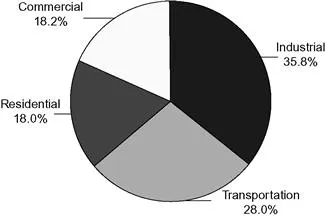
Figure 1.1 U.S. total greenhouse gas emissions in 2005. The Energy Information Administration (EIA) typically breaks down U.S. energy consumption into four end-use categories: industry, transportation, residential, and commercial. Almost all residential greenhouse emissions are CO2, and are strongly related to energy consumption.
Source: Adapted from Paul Emrath and Helen Fei Liu, the National Association of Home–Builders, Special Studies, Residential Greenhouse Gas Emissions, April 30, 2007.
Additionally, it is estimated that buildings account for about 71% of all electricity consumed in America and 40% of global carbon dioxide emissions.
The impact of building on the U.S. economy is clearly evident from the use of construction materials. For example, it is estimated that infrastructure supplies, building construction, and road building make up about 60% of the total flow of materials (excluding fuel) through the U.S. economy. Likewise, studies show that building construction and demolition waste accounts for roughly 60% of all nonindustrial waste. As for water usage, it is estimated that building occupants consume about 50 billion gallons per day (i.e., more than 12% of U.S. potable water consumption). This amount of water consumption is mainly to support municipal, agricultural, and industrial activities, which have more than tripled since 1950. Construction also impacts the indoor levels of air pollutants and VOCs in buildings, which can be two to five times higher than outdoor levels.
For all of these reasons, sustainable/green building strategies and best practices present a unique opportunity to create environmentally sound and resource-efficient buildings. By applying an integrated design approach from the beginning, this can be achieved especially by having the stakeholders—architects, engineers, land planners, and building owners and operators, as well as members of the construction industry—work together as a team to design a project. Indeed, architects and urban engineers around the world are building cities designed to cope with a future of growing populations, increasingly scarce resources, and the need to reduce carbon emissions. We see examples of future cities debuting in Great Britain, China, and the United Arab Emirates.
At the forefront of the U.S. green building offensive is the federal government, the nation’s largest landlord. The General Services Administration (GSA) was one of the first adopters of LEED for New Construction (LEED-NC)—to be discussed momentarily—and is committed to incorporating principles of sustainable design and energy efficiency into all of its building projects. It is the GSA’s intent to integrate sustainable design as effortlessly as possible into existing design and construction processes. In this regard it recently announced that it will apply more stringent green building standards to its $12 billion construction portfolio, which presently includes more than 361 million square feet of space in 9600 federally owned and leased facilities occupied by more than 1.2 million federal employees. This portfolio consists of post offices, courthouses, border stations, and other buildings.
The GSA decided to use the USGBC’s Leadership in Energy and Environmental Design (LEED) Green Building Rating System as its tool for evaluating and measuring achievements in its sustainable design programs. In keeping with the spirit of sustainability, the GSA recently increased its minimum standard requirement for new construction and substantial renovation of federally owned facilities by adopting the LEED Gold standard, which is the second highest level of certification (just below Platinum). Until recently, the GSA had only required a LEED Silver certification. In justifying this move, Robert Peck, former GSA commissioner of public buildings, stated, “Sustainable, better-performing federal buildings can significantly contribute to reducing the government’s environmental footprint” and “this new requirement is just one of the many ways we’re greening the federal real estate inventory to help deliver on President Obama’s commitment to increase sustainability and energy efficiency across government.”
CEO and founding chairman of the USGBC, Richard Fedrizzi, echoed the federal government’s lead in adopting green building practices when he said: “The Federal government has been at the forefront of the sustainable building movement since its inception, providing resources, pioneering best practices and engaging multiple Federal agencies in the mission of transforming the built environment.” A first ever White House Summit on Federal Sustainable Buildings held in January 2006 attracted over 150 federal facility managers and decision makers in addition to 21 government agencies, coming together to formulate and witness the signing of the “Federal Leadership in High Performance and Sustainable Buildings Memorandum of Understanding (MOU).” Signatories to this MOU committed to federal leadership in the design, construction, and operation of high-performance and sustainable buildings. The MOU highlights the sense of urgency felt by green building proponents and represents a significant accomplishment by the federal government through its collective effort to define common strategies and guiding principles. The signatory agencies now need to work with others in the private and public sectors to consolidate these goals.
The initiatives just described are clear indications that the gap between green and conventional construction is narrowing, and they signal that green construction has come of age, especially when we learn that there are more than 80 green building programs operating in the United States alone, and even more in numerous other countries such as Canada, Japan, China, India, Australia, and the United Kingdom. A measure of the growth of green building programs and their success is reflected by the number of cities that have established or adopted them. For example, the American Institute of Architects reports that by 2008 92 cities with populations greater than 50,000 had established green building programs—up from 22 in 2004—which represents a 318% increase.
Many programs in the United States are city, county, or state operated; there are also three that are national in scope: USGBC’s LEED program, the Green Globes program of the Green Building Institute (GBI)—designed by the U.K. Building Research Establishment—and the National Green Building Standard of the National Assoc...
Table of contents
- Cover image
- Title page
- Table of Contents
- Copyright
- Dedication
- Foreword
- Acknowledgments
- Introduction: The Green Movement—Myths, History, and Overview
- Chapter 1. Green Concepts and Vocabulary
- Chapter 2. Components of Sustainable Design and Construction
- Chapter 3. Green Design and the Construction Process
- Chapter 4. Green Project Cost Monitoring and Closeout
- Chapter 5. Building Information Modeling
- Chapter 6. Green Building Materials and Products
- Chapter 7. Indoor Environmental Quality
- Chapter 8. Water Efficiency and Sanitary Waste
- Chapter 9. Impact of Energy and Atmosphere
- Chapter 10. Green Design and Building Economics
- Chapter 11. Green Project Commissioning
- Chapter 12. Project Cost Analysis
- Chapter 13. Green Specifications and Documentation
- Chapter 14. Types of Building Contract Agreements
- Chapter 15. Green Business Development
- Chapter 16. Building Green Litigation and Liability Issues
- APPENDIX A. Acronyms and Abbreviations
- Appendix B. Glossary
- Bibliography
- Index
Trusted by 375,005 students
Access to over 1.5 million titles for a fair monthly price.
Study more efficiently using our study tools.
Frequently asked questions
Yes, you can cancel anytime from the Subscription tab in your account settings on the Perlego website. Your subscription will stay active until the end of your current billing period. Learn how to cancel your subscription
No, books cannot be downloaded as external files, such as PDFs, for use outside of Perlego. However, you can download books within the Perlego app for offline reading on mobile or tablet. Learn how to download books offline
Perlego offers two plans: Essential and Complete
- Essential is ideal for learners and professionals who enjoy exploring a wide range of subjects. Access the Essential Library with 800,000+ trusted titles and best-sellers across business, personal growth, and the humanities. Includes unlimited reading time and Standard Read Aloud voice.
- Complete: Perfect for advanced learners and researchers needing full, unrestricted access. Unlock 1.5M+ books across hundreds of subjects, including academic and specialized titles. The Complete Plan also includes advanced features like Premium Read Aloud and Research Assistant.
We are an online textbook subscription service, where you can get access to an entire online library for less than the price of a single book per month. With over 1.5 million books across 990+ topics, we’ve got you covered! Learn about our mission
Look out for the read-aloud symbol on your next book to see if you can listen to it. The read-aloud tool reads text aloud for you, highlighting the text as it is being read. You can pause it, speed it up and slow it down. Learn more about Read Aloud
Yes! You can use the Perlego app on both iOS and Android devices to read anytime, anywhere — even offline. Perfect for commutes or when you’re on the go.
Please note we cannot support devices running on iOS 13 and Android 7 or earlier. Learn more about using the app
Please note we cannot support devices running on iOS 13 and Android 7 or earlier. Learn more about using the app
Yes, you can access Handbook of Green Building Design and Construction by Sam Kubba in PDF and/or ePUB format, as well as other popular books in Technology & Engineering & Environmental Science. We have over 1.5 million books available in our catalogue for you to explore.