- 480 pages
- English
- ePUB (mobile friendly)
- Available on iOS & Android
eBook - ePub
The Effect of Sterilization on Plastics and Elastomers
About this book
This reference guide brings together a wide range of essential data on the sterilization of plastics and elastomers, enabling engineers to make optimal material choices and design decisions. The data tables in this book enable engineers and scientists to select the right materials, and right sterilization method for a given product or application.
The third edition includes new text chapters that provide the underpinning knowledge required to make best use of the data. Larry McKeen has also added detailed descriptions of sterilization methods for most common polymer classes such as polyolefins, polyamides, polyesters, elastomers, fluoropolymers, biodegradable plastics. Data has been updated throughout, with expanded information on newer classes of polymer utilized in medical devices and sterile packaging, such as UHMWPE, high temperature plastics (PEEK, PES, PPS, etc.), PBT, PETG, etc. The resulting Handbook is an essential reference for Plastics Engineers, Materials Scientists and Chemists working in contexts where sterilization is required, such as food packaging, pharmaceutical packaging and medical devices.
- Essential data and practical guidance for engineers and scientists working with plastics in applications that require sterile packaging and equipment.
- 3rd edition includes new introductory chapters on sterilization processes and polymer chemistry, providing the underpinning knowledge required to utilize the data.
- Provides essential information and guidance for FDA submissions required for new Medical Devices.
Information
1
Introduction to Food Irradiation and Medical Sterilization
This first chapter primarily focuses on the processes used to destroy microbiological life. Microbiological life, microbes, or pathogens in food contribute to food spoilage, disease, illness, and even death. Similarly, microbes in a health care environment may cause disease, infections, sickness, illness, and death. The elimination, killing, or control of microbes is therefore critically important. The processes used for microbe control can affect the properties of materials, especially plastics. That effect is the subject of the bulk of this book. This introductory chapter will be split up into three parts. First will be background on the biology and types of microbes. Then the processes used to control microbial life in the food supply are discussed. That is followed by the control of microbes in the health care environment.
1.1 Pathogens
Sterilization processes are intended to deal with contamination of food, surfaces, or equipment by potentially harmful life forms. These life forms are primarily bacteria, viruses, and endospores, but could also include parasites, prions, molds, fungi, yeasts, protozoa, etc. Organisms that cause disease are called pathogens. This section briefly summarizes what these life forms are, which leads to a better understanding of how sterilization processes kill or control them.
1.1.1 Bacteria
Bacteria consist of only a single cell. Bacteria fall into a category of life called the prokaryotes. Prokaryotes’ genetic material, or DNA, is not enclosed in a cellular compartment called a nucleus as it is in eukaryotes. Not all bacteria are harmful. However, the subject of this book implies the killing of harmful bacteria. Most people know harmful bacteria best because of the diseases they cause. Some of these diseases are produced when bacteria attack directly the tissues of a plant or animal. For example, fruits and vegetables that become discolored as they are growing may be under attack by bacteria, though discoloration may also be the result of oxidation.
Bacteria also attack cells by releasing chemicals that are poisonous to plants and animals. Such poisons are known as toxins. As an example, Clostridium botulinum releases a toxin that causes the most severe form of food poisoning, botulism.
Some forms of dangerous bacteria live on the human skin, but cause no harm unless they are able to enter the body. Among these bacteria is Staphylococcus, responsible for the potentially fatal toxic shock syndrome and gastroenteritis. The bacteria may enter the bloodstream through a break in the skin or the digestive tract through contaminated food. And although Escherichia coli is helpful within the digestive system, if it is ingested it may cause cramping and diarrhea. If it enters the bloodstream, it causes fever, hypotension, altered mental status, and possibly death.
A diagram of a typical bacterium is shown in Fig. 1.1 and a micrograph of cholera bacteria is shown in Fig. 1.2. Bacteria can be of many other shapes, however, some of which are shown in Fig. 1.3.
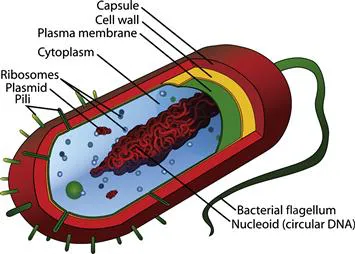
Figure 1.1 Diagram of a typical bacterium.1 For color version of this figure, the reader is referred to the online version of this book.
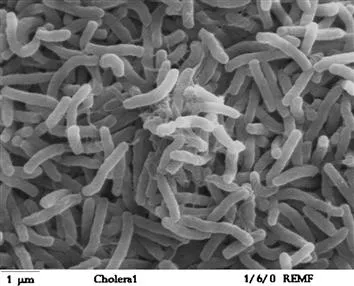
Figure 1.2 Scanning electron micrograph of cholera bacteria.1
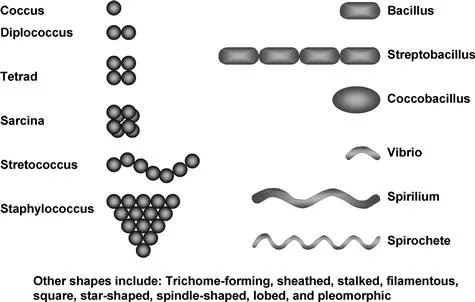
Figure 1.3 Common bacterial morphologies.
Bacteria are often classified as Gram positive and Gram negative. The main difference between the two forms of bacteria is the composition and structure of the cell walls of the two, as shown in Fig. 1.4. Referring to the figure:
• Peptidoglycan, also known as murein, is a polymer consisting of sugars and amino acids that forms a mesh-like layer outside the plasma membrane of bacteria forming the cell wall.
• The periplasm is a space bordered by the two selective permeable biological membranes, which are the inner plasma membrane and the outer membrane in Gram-negative bacteria.
• There is no periplasmic space in Gram-positive bacteria because there is only one biological membrane, but a region called inner wall zone has been observed between the cytoplasmic membrane and the bacterial cell wall.
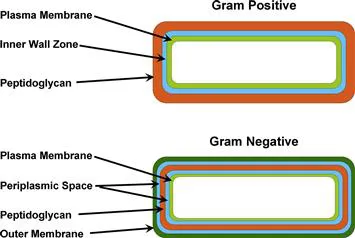
Figure 1.4 The structural difference of the bacterial cell walls of Gram-positive and Gram-negative bacteria.1 For color version of this figure, the reader is referred to the online version of this book.
The two types of bacteria may respond differently to sterilization processes. Sterilization processes that kill bacteria usually do so by:
• Causing damage to the physical structure, particularly rupture of the cell walls
• Altering the membrane permeability
• Damaging the proteins within the cells
• Damaging the nucleic acids in the DNA or RNA.
1.1.2 Viruses
A virus is a small infectious agent that can replicate only inside the living cells of organisms. They are too small to be seen with a light microscope. Viruses are not plants, animals, or bacteria, but they are more like parasites. They are parasites because without a host cell, they cannot carry out their life-sustaining functions or reproduce. Although they may seem like living organisms because of their reproductive abilities, viruses are not living.
The average virus is about one-hundredth the size of the average bacterium. All viruses contain nucleic acid, either DNA or RNA (but not both), and a protein coat, which encases the nucleic acid. Viruses come in a wide diversity of shapes and sizes called morphologies.2 Viruses are inactive when outside of a living cell, but their nucleic acid once entering the cell can take over the cells’ activities, which is primarily to reproduce and break out of the cell to infect other cells. Figure 1.5 shows electron micrographs of two different viruses. The micrograph of the virus on the right side clearly shows the DNA and cell wall structure.
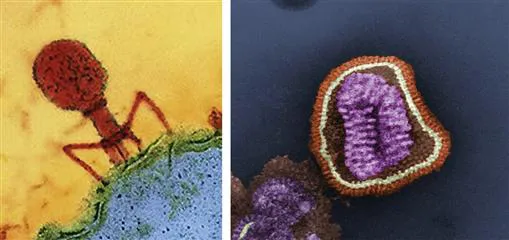
Figure 1.5 Electron micrographs of two viruses, a bacteriophage on the left and an influenza virus on the right.3 For color version of this figure, the reader is referred to the online version of this book.
1.1.3 Endospores
An endospore is a dormant, tough, and temporarily nonreproductive structure produced by certain bacteria. It is a stripped-down, dormant form to which the bacterium can reduce itself when conditions are not right for the bacterium to thrive. It is very resistant to harsh environments and can remain viable for very long periods of time, only to spring back to life when conditions are right.
The structure and a micrograph of an endospore are shown in Fig. 1.6. The endospore consists of the bacterium’s DNA and part of its cytoplasm, surrounded by a very tough outer coating. The coating consists of multiple layers. The outermost layer is the exosporium, which is a thin protein covering. The next layer is the spore coat which is co...
Table of contents
- Cover image
- Title page
- Table of Contents
- PDL Handbook Series
- Copyright
- Preface
- 1. Introduction to Food Irradiation and Medical Sterilization
- 2. Introduction to Plastics and Polymers
- 3. Introduction to the Physical, Mechanical, and Thermal Properties of Plastics and Elastomers
- 4. Styrenic Plastics
- 5. Polyesters
- 6. Polyimides
- 7. Polyamides (Nylons)
- 8. Polyolefins
- 9. Polyvinyls and Acrylics
- 10. Fluoropolymers
- 11. High-Temperature/High-Performance Polymers
- 12. Renewable Resource and Biodegradable Polymers
- 13. Elastomers
- Index
Trusted by 375,005 students
Access to over 1.5 million titles for a fair monthly price.
Study more efficiently using our study tools.
Frequently asked questions
Yes, you can cancel anytime from the Subscription tab in your account settings on the Perlego website. Your subscription will stay active until the end of your current billing period. Learn how to cancel your subscription
No, books cannot be downloaded as external files, such as PDFs, for use outside of Perlego. However, you can download books within the Perlego app for offline reading on mobile or tablet. Learn how to download books offline
Perlego offers two plans: Essential and Complete
- Essential is ideal for learners and professionals who enjoy exploring a wide range of subjects. Access the Essential Library with 800,000+ trusted titles and best-sellers across business, personal growth, and the humanities. Includes unlimited reading time and Standard Read Aloud voice.
- Complete: Perfect for advanced learners and researchers needing full, unrestricted access. Unlock 1.5M+ books across hundreds of subjects, including academic and specialized titles. The Complete Plan also includes advanced features like Premium Read Aloud and Research Assistant.
We are an online textbook subscription service, where you can get access to an entire online library for less than the price of a single book per month. With over 1.5 million books across 990+ topics, we’ve got you covered! Learn about our mission
Look out for the read-aloud symbol on your next book to see if you can listen to it. The read-aloud tool reads text aloud for you, highlighting the text as it is being read. You can pause it, speed it up and slow it down. Learn more about Read Aloud
Yes! You can use the Perlego app on both iOS and Android devices to read anytime, anywhere — even offline. Perfect for commutes or when you’re on the go.
Please note we cannot support devices running on iOS 13 and Android 7 or earlier. Learn more about using the app
Please note we cannot support devices running on iOS 13 and Android 7 or earlier. Learn more about using the app
Yes, you can access The Effect of Sterilization on Plastics and Elastomers by Laurence W. McKeen in PDF and/or ePUB format, as well as other popular books in Technology & Engineering & Chemical & Biochemical Engineering. We have over 1.5 million books available in our catalogue for you to explore.