
eBook - ePub
The Biology of the Laboratory Rabbit
- 483 pages
- English
- ePUB (mobile friendly)
- Available on iOS & Android
eBook - ePub
The Biology of the Laboratory Rabbit
About this book
After nearly 20 years, the publication of this Second Edition of The Biology of the Laboratory Rabbit attests to its popularity within the scientific community as well as to the need to update an expanding database on the rabbit as a major species in laboratory investigation. The principal aim of this text is to provide a comprehensive and authoritative source of scientifically based information on a major laboratory animal species. The text continues to emphasize the normal biology as well as diseases of the European (domestic) rabbit, Orytolagus cuniculus, especially the New Zealand White breed, with occasional reference to other rabbit species (Sylvilagus sp.) and hares (Lepus sp.). New topics have been added to this second edition in response to changing trends in biomedical research and product testing as well as to suggestions from readers.New chapters included on:
- Anesthesia and analgesia
- Models in infectious disease research
- Models in ophthalmology and vision research
- Polyclonal antibody production
- Toxicity and safety testing
- Drug doses and clinical reference data
Information
CHAPTER 1
Taxonomy and Genetics*
Richard R. Fox
Publisher Summary
Laboratory rabbits, descendents of the European wild rabbit, Oryctolagus cuniculus, along with other rabbits, hares, and pikas, are classified as the members of the order Rodentia or rodents. However, instead of the four incisor or chisel teeth characteristic of rodents, rabbits have six. The additional pair is reduced in size and placed directly behind the large pair in the upper jaw. These little teeth are rounded and lack a cutting edge. The order Lagomorpha comprises two major families, the Ochotonidae and Leporidae, with many genera and species native to all parts of the world. The pikas, sometimes called rock rabbits or mouse hares, are small, tailless members with short, broad, rounded ears, chunky bodies, and short legs. The front pair of legs is a little shorter than the rear pair. This chapter discusses the genetic features of rabbits. Rabbits could produce hemolysins and agglutinins against red blood cells of other rabbits. On the basis of this work, rabbits are classified into four blood types. Rabbits may be inbred by a number of different breeding systems; the simplest is the brother–sister inbreeding. In this system, it is possible to intersperse father–daughter or mother–son matings with no change in the theoretical rate of inbreeding provided that no one animal is used more than two generations and that these generations are consecutive. Animals may be inbred by half sib mating, although the rate of change is somewhat slower.
I. Taxonomy and Geographical Distribution
A. Taxonomy
B. Geographical Distribution
II. Origin and Domestication
A. Historical Considerations
B. Domestication
C. Breed Formation
III. Genetics
A. Size Inheritance
B. Embryological Variants
C. Growth and Morphology
D. Pathology
E. Immunology
F. Inbreeding
G. Research Stocks
H. Mutations
I. Linkage
J. Chromosomes: Numbers and Morphology
K. Techniques for Karyotyping
L. Transgenic Rabbits
IV. Inbred Strains
References
I TAXONOMY AND GEOGRAPHICAL DISTRIBUTION
The European rabbit (Oryctolagus cuniculus) occurs on the European continent in three forms: wild, feral, and domestic. In North America, however, only the domestic and the feral forms exist. The wild or ancestral type probably evolved in the Iberian Peninsula and spread to other regions of the Mediterranean. The familiar domestic form is typified by a great variety of breeds and strains which are used for meat as well as fancy and laboratory animal production. The feral rabbit is a reversion from the domestic to the wild type, and examples may be found on the Farallon Islands off the coast of San Francisco, the San Juan Islands in the Juan de Fuca Straits in Washington, the Channel Islands off Santa Barbara, California, and Isla del Flores near Montevideo, Uruguay. The only population of wild Oryctolagus in the Americas has spread from the island of Tierra del Fuego, Chile, northward into the mainland several hundred miles north of Santiago.
A Taxonomy
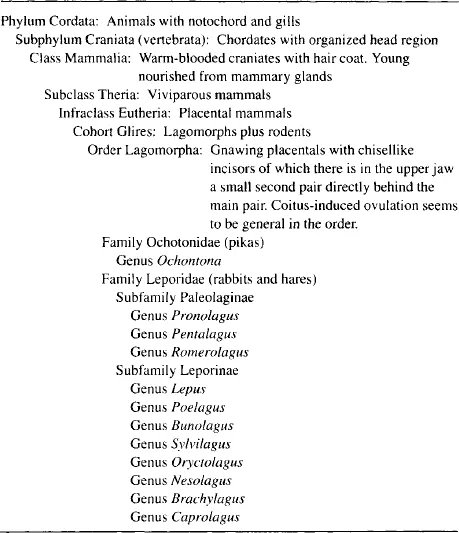
Laboratory rabbits, descendents of the European wild rabbit, Oryctolagus cuniculus, along with other rabbits, hares, and pikas, were originally classified as members of the order Rodentia, or rodents. However, instead of the four incisor or chisel teeth characteristic of rodents, rabbits have six. The additional pair is reduced in size and placed directly behind the large pair in the upper jaw. These little teeth are rounded and lack a cutting edge. They are only moderately useful and cannot be seen without opening the mouth and looking in back of the large upper incisor teeth. However, they constitute the scientific basis for placing the animals in a separate order, the Lagomorpha (58). The zoological position of the lagomorphs (58, 267) can best be seen in outline form (Table I).
TABLE I
Taxonomic Outline of the Genus Oryctolagusa
aReferences 58, 198a, 224, 267.
B Geographical Distribution
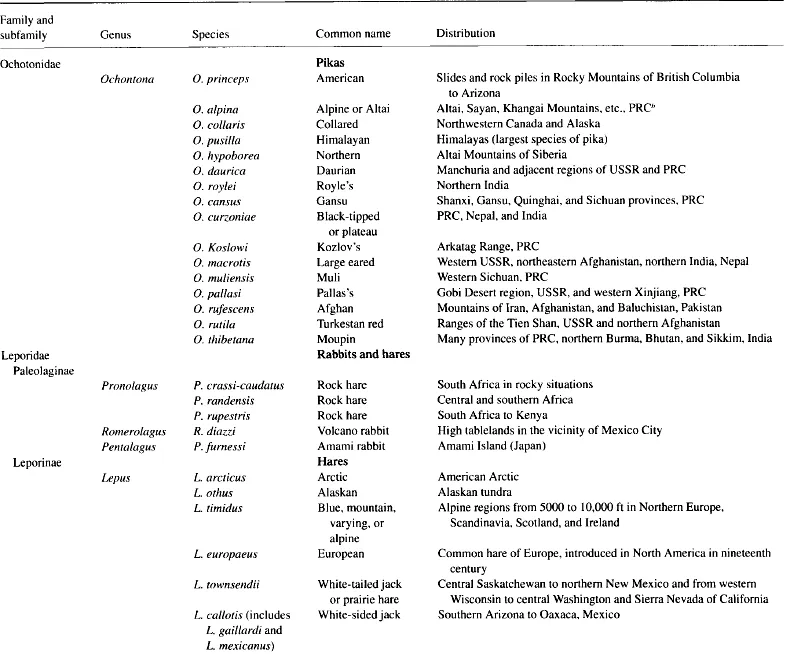
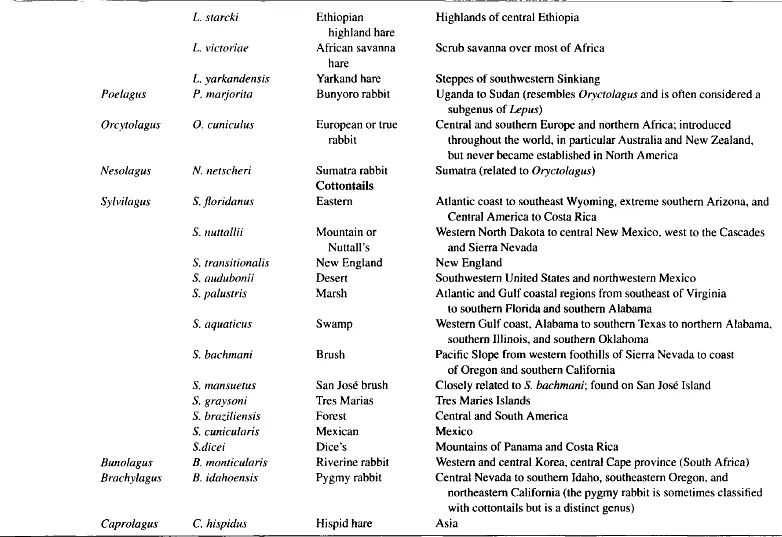
The order Lagomorpha comprises two major families, the Ochotonidae (pikas) and Leporidae (rabbits and hares), with many genera and species native to all parts of the world (6, 7, 15, 130, 136, 158, 209, 216, 224, 267). The pikas, sometimes called rock rabbits or mouse hares, are small, tailless members with short, broad, rounded ears, chunky bodies, and short legs. The front pair of legs is but little shorter than the rear pair. This is in contrast to the usually larger rabbits and hares, which have long ears and relatively long hind limbs. Major genera of the Leporidae include Lepus (hares), Oryctolagus (true rabbits), and Sylvilagus (cottontail rabbits). The Idaho pygmy rabbit, Brachylagus, is the smallest rabbit, not only in the Americas but in the world. The Mexican pygmy rabbit, Romerolagus, is slightly larger and actually more like a pika than a rabbit. Examples of some of the current major species in each genus, including natural distributions, may be seen in Table II.
TABLE II
GEOGRAPHICAL DISTRIBUTION OF MEMBERS OF THE ORDER LAGOMORPHAa

aReferences 6, ...
Table of contents
- Cover image
- Title page
- Table of Contents
- AMERICAN COLLEGE OF LABORATORY ANIMAL MEDICINE SERIES
- Copyright
- List of Contributors
- Preface
- List of Reviewers for Chapters in This Volume
- Chapter 1: Taxonomy and Genetics
- Chapter 2: Colony Husbandry
- Chapter 3: Anatomy
- Chapter 4: Physiology
- Chapter 5: Basic Biomethodology
- Chapter 6: Anesthesia and Analgesia
- Chapter 7: Clinical Biochemistry and Hematology
- Chapter 8: Bacterial Diseases
- Chapter 9: Viral Diseases
- Chapter 10: Protozoal Diseases
- Chapter 11: Arthropod and Helminth Parasites
- Chapter 12: Neoplastic Diseases
- Chapter 13: Inherited Diseases and Variations
- Chapter 14: Nutrition and Nutritional Diseases
- Chapter 15: Metabolic, Traumatic, Mycotic, and Miscellaneous Diseases
- Chapter 16: Zoonoses and Occupational Health Considerations
- Chapter 17: Atherosclerosis Research
- Chapter 18: Models in Infectious Disease Research
- Chapter 19: Models in Ophthalmology and Vision Research
- Chapter 20: Polyclonal Antibody Production
- Chapter 21: Toxicity and Safety Testing
- Selected Drug Dosages and Clinical Reference Data
- Index
Trusted by 375,005 students
Access to over 1.5 million titles for a fair monthly price.
Study more efficiently using our study tools.
Frequently asked questions
Yes, you can cancel anytime from the Subscription tab in your account settings on the Perlego website. Your subscription will stay active until the end of your current billing period. Learn how to cancel your subscription
No, books cannot be downloaded as external files, such as PDFs, for use outside of Perlego. However, you can download books within the Perlego app for offline reading on mobile or tablet. Learn how to download books offline
Perlego offers two plans: Essential and Complete
- Essential is ideal for learners and professionals who enjoy exploring a wide range of subjects. Access the Essential Library with 800,000+ trusted titles and best-sellers across business, personal growth, and the humanities. Includes unlimited reading time and Standard Read Aloud voice.
- Complete: Perfect for advanced learners and researchers needing full, unrestricted access. Unlock 1.5M+ books across hundreds of subjects, including academic and specialized titles. The Complete Plan also includes advanced features like Premium Read Aloud and Research Assistant.
We are an online textbook subscription service, where you can get access to an entire online library for less than the price of a single book per month. With over 1.5 million books across 990+ topics, we’ve got you covered! Learn about our mission
Look out for the read-aloud symbol on your next book to see if you can listen to it. The read-aloud tool reads text aloud for you, highlighting the text as it is being read. You can pause it, speed it up and slow it down. Learn more about Read Aloud
Yes! You can use the Perlego app on both iOS and Android devices to read anytime, anywhere — even offline. Perfect for commutes or when you’re on the go.
Please note we cannot support devices running on iOS 13 and Android 7 or earlier. Learn more about using the app
Please note we cannot support devices running on iOS 13 and Android 7 or earlier. Learn more about using the app
Yes, you can access The Biology of the Laboratory Rabbit by Patrick J. Manning, Daniel H. Ringler,Christian E. Newcomer in PDF and/or ePUB format, as well as other popular books in Biological Sciences & Zoology. We have over 1.5 million books available in our catalogue for you to explore.