The corresponding-states principle helps the understanding and calculating of thermodynamic, transport, and surface properties of substances in various states, required by our modern lifestyle. The Corresponding-States Principle and its Practice: Thermodynamic, Transport and Surface Properties of Fluids describes the origins and applications of the principle from a universal point of view with comparisons to experimental data where possible. It uses the universal theory to explain present theories. Emphasis is on the properties of pure systems, and the corresponding-states theory can also be extended to mixtures, which are treated as pure systems. Furthermore, the author discusses current progress, and shows technicians how to derive practical equations from molecular modeling. The Corresponding-States Principle and its Practice: Thermodynamic, Transport and Surface Properties of Fluids is the ideal handbook for those in chemical science and engineering related to energy, environment, natural gas, and petroleum.* Describes the origins and applications from a universal viewpoint* Includes experimental data for comparisons * Suitable for researchers, applied engineers, and those interested in the corresponding states theory
1.1 Overview of the Corresponding-States Principle
1.1.1 The Corresponding-States Theory of Monatomic Molecules
As the properties of substances are determined by the behavior of the molecules in these substances, the behavior of the molecules must be understood to know the properties of substances. Many molecular theories have been proposed to describe the properties of substances. One of these, the corresponding-states theory, is especially useful. For more than one hundred years, the corresponding-states principle has been used as the most useful, most reliable and most universal theory.
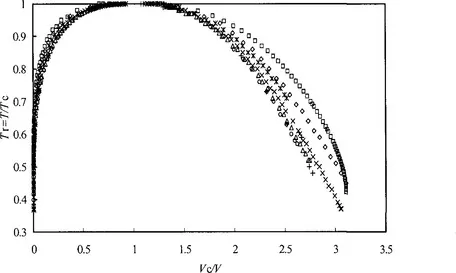
Proposed by Van der Waals in 1880, the corresponding-states theory for monatomic molecules expresses the generalization that properties that depend on intermolecular forces are related to the critical properties in a universal way. The corresponding-states principle provides the most important basis for the development of correlations and estimation methods for properties. The relation of the intermolecular potentials of monatomic and symmetrical atomic molecules to the corresponding-states properties shows that spherical molecules conform well to the substance similarity principle, upon which the macroscopic laws of the corresponding-states principle and statistical mechanics were established. Van der Waals showed the corresponding-states principle to be theoretically valid for all pure substances whose pressure-volume-temperature properties may be expressed by a two-parameter equation of state. For example, Figure 1.1 illustrates the corresponding-states form of the vapor-liquid coexistence curve of some typical substances for different classes of molecules, where Tr = T/Tc is the reduced temperature, Tc is the critical temperature, Vr= V/Vc is the reduced volume and Vc is the critical volume. However, the two-parameter corresponding-states theory proposed by Van der Waals can not exactly represent the behavior of other classes of molecules that are not spherical.
Fig. 1.1 Vapor-liquid coexistence curves of classes of typical substances (
The successful application of the corresponding-states principle to property correlations has led to similar correlations for properties that depend primarily on intermolecular forces that are invaluable in practical applications. The corresponding-states principle was originally macroscopic; however, its modern form has a molecular basis. As verified by Pitzer in 1939, it is similarly valid if the intermolecular potential function requires only two characteristic parameters.
1.1.2 The Corresponding-States Theory of Weakly Nonspherical Molecules
The corresponding-states principle can be derived from statistical thermodynamics when severe simplifications are introduced into the partition function. Other useful results can be obtained by introducing less severe simplifications into the statistical thermodynamic equations so as to provide a framework for developing estimation methods. The fundamental equations describing various thermodynamic and transport properties can be derived provided that an expression is available for the potential energy function for the molecular interactions. Such a function may be, at least in part, empirical; however, the fundamental equations for properties are often insensitive to the details in the potential function from which they stem, and two-parameter potential functions usually work remarkably well for various systems.
Spherically symmetric molecules conform to a two-parameter corresponding-states principle very well; while weakly nonpolar and weakly polar molecules, the so-called normal fluids defined by Pitzer et al., have deviations are often large enough to require another third parameter in correlations. Pitzer et al. proposed the acentric factor to represent the deviation of the vapor pressure-temperature relation from which might be expected for a similar substance consisting of spherically symmetric molecules. The three-parameter corresponding-states correlation of Pitzer et al., when expressed in terms of dimensionless properties, works very well for nonpolar molecules. As a result, good correlations exist for the properties of nonpolar small molecules from the corresponding-states theory of Pitzer et al., which was derived from macroscopic properties but with a molecular basis, correlates the properties of weakly nonspherical molecules with an accuracy that is about one order of magnitude better than that of the Van der Waals corresponding-states theory, however it can not be applied to describe the properties of highly nonspherical molecules.
1.1.3 The Corresponding-States Theory of Highly Nonspherical Molecules
The three-parameter corresponding-states theory for weakly nonspherical molecules cannot describe properties of highly nonspherical polar molecules. The generalized corresponding-states theory described in this book is an important contribution to the completion of the corresponding-states principle, in which the corresponding-states theory of Pitzer et al. for normal fluids is extended to highly nonspherical complex systems of polar, associating and hydrogen-bonding molecules. The extended corresponding-states parameter in this theory has been defined in terms of the deviation of the critical state of a molecule from that of spherical molecules and may physically describe the effects of differences between the structure of nonspherical molecules and that of spherical molecules. The extended corresponding-states parameter is not derived from experimental data for a specific property, so it may be universally used to represent the properties of simple, nonpolar, polar, hydrogen-bonding, and associating molecules. The extended corresponding-states theory provides a new approach to elucidate the physical behavior of nonspherical molecules. The extended corresponding-states theory is generally applicable to all classes of substances of various chemical structures and is a universal theory applicable to all physical properties which provides a reliable basis for the studies of molecular thermodynamics and other related sciences.
1.2 Properties of Substances
1.2.1 Importance of Properties of Substances
Substances are important in all aspects of our lives and for social progress. Substances also play an important role in various industries, production, and operations in our modern lives. Some substances that are of great significance to industrial processes are water, carbon dioxide, air, and liquid and gaseous fuels. In engineering practice, the properties of substances are the basis for analysis and design in many industries, such as energy, power, petrochemical, metallurgy, refrigeration, and heating.
The use of existing substances and of new substances requires reference data for the properties of those substances. As a result, these properties must be understood. Even theoretical physicists need to know the properties of substances to verify their theories by comparison with experimental results. An enormous amount of data has been collected and correlated over the years, but the rapid advance of technology into new fields always seems to maintain a significant gap between the demand and the availability of property data due to our limited understanding of properties of substances. Consequently, proper understanding of the properties of substances is extremely important for the practical applications.
1.2.2 Necessity of the Prediction of Properties
Practical applications frequently require properties of substances that have not been measured or cannot be calculated from existing theories. Reliable methods are needed to predict the properties of these substances. Many handbooks provide data sources, and more and more journals have been devoting to the compilation and critical review of property data. Furthermore, computational databases have become a routine part of computer-aided process design. However, the number of interesting compounds is very large and that of mixtures formed by these compounds is much larger in practical applications. It has been reported that there are more than 50 million different chemical substances, 20 millions of which are often used. However, only a few dozen substances have relatively complete experimental data. In other cases, the required data cannot be obtained from just experimental measurements. Measurement of the properties of all substances for all conditions is absolutely impossible. Moreover, the increasing need for accurate data has ever further outstupped the accumulation of new data, especially for the data of multi-component mixtures. Even if it is possible to obtain the desired properties from new experimental measurements, the measurements are often not practicable because these are expensive and time-consuming. The labor and expense of experimental measurements is almost always reduced by the ability to predict the required properties. The more applicable equations are more able to reflect the natural behavior and more able to help us understanding the properties of substances that are not yet available. Thus, the need is for better tools to better predict the required properties of substances from the limited available data. Such tools require a universal theory with a theoretical basis that is simple and general in form reliably predict physical properties.
1.3 Organization of the Book
This book is partitioned into two parts: the Corresponding-States Principle and the Corresponding-States Practice. Chapter 2 introduces Van der Waals’ corresponding-states theory as related to the continuity of the gas and liquid states and Van der Waals’ equation of state. The theoretical basis of the corresponding-states principle including the assumptions, derivation, and the expressions for the corresponding states for spherical and nonspherical molecules are described in Chapter 3. The parameters in the corresponding-states principle, i.e. the critical parameters, the acentric factor, and the aspherical factor, and the basic form of the corresponding-states properties are explained in Chapter 4 to complete the presentation of the corresponding-states principle. In the second part, the corresponding-states principle is applied to the thermodynamic properties in Chapter 5. The equations for the virial coefficients, compressibility factor, enthalpy, entr...
Table of contents
Cover image
Title page
Table of Contents
Copyright
Inside Front Cover
Dedication
Presentation Speech at the Ceremony of the Nobel Prize to Johannes Diderik van der Waals
Comment on the Importance of the Corresponding-States Principle
Comments on the Extended Corresponding-States Theory of Highly Nonspherical Molecules, on which this book focuses
Preface
Chapter 1: Introduction
Corresponding-States Principle
The Corresponding-States Practice
Index
Trusted by 375,005 students
Access to over 1.5 million titles for a fair monthly price.
Study more efficiently using our study tools.
Frequently asked questions
Yes, you can cancel anytime from the Subscription tab in your account settings on the Perlego website. Your subscription will stay active until the end of your current billing period. Learn how to cancel your subscription
No, books cannot be downloaded as external files, such as PDFs, for use outside of Perlego. However, you can download books within the Perlego app for offline reading on mobile or tablet. Learn how to download books offline
Perlego offers two plans: Essential and Complete
Essential is ideal for learners and professionals who enjoy exploring a wide range of subjects. Access the Essential Library with 800,000+ trusted titles and best-sellers across business, personal growth, and the humanities. Includes unlimited reading time and Standard Read Aloud voice.
Complete: Perfect for advanced learners and researchers needing full, unrestricted access. Unlock 1.5M+ books across hundreds of subjects, including academic and specialized titles. The Complete Plan also includes advanced features like Premium Read Aloud and Research Assistant.
Both plans are available with monthly, semester, or annual billing cycles.
We are an online textbook subscription service, where you can get access to an entire online library for less than the price of a single book per month. With over 1.5 million books across 990+ topics, we’ve got you covered! Learn about our mission
Look out for the read-aloud symbol on your next book to see if you can listen to it. The read-aloud tool reads text aloud for you, highlighting the text as it is being read. You can pause it, speed it up and slow it down. Learn more about Read Aloud
Yes! You can use the Perlego app on both iOS and Android devices to read anytime, anywhere — even offline. Perfect for commutes or when you’re on the go. Please note we cannot support devices running on iOS 13 and Android 7 or earlier. Learn more about using the app
Yes, you can access The Corresponding-States Principle and its Practice by Hong Wei Xiang in PDF and/or ePUB format, as well as other popular books in Physical Sciences & Fluid Mechanics. We have over 1.5 million books available in our catalogue for you to explore.