eBook - ePub
Handbook of the Economics of Education
- 708 pages
- English
- ePUB (mobile friendly)
- Available on iOS & Android
eBook - ePub
Handbook of the Economics of Education
About this book
What is the value of an education? Volume 4 of the Handbooks in the Economics of Education combines recent data with new methodologies to examine this and related questions from diverse perspectives. School choice and school competition, educator incentives, the college premium, and other considerations help make sense of the investments and returns associated with education. Volume editors Eric A. Hanushek (Stanford), Stephen Machin (University College London) and Ludger Woessmann (Ifo Institute for Economic Research, Munich) draw clear lines between newly emerging research on the economics of education and prior work. In conjunction with Volume 3, they measure our current understanding of educational acquisition and its economic and social effects.
- Winner of a 2011 PROSE Award Honorable Mention in Economics from the Association of American Publishers
- Demonstrates how new methodologies are yielding fresh perspectives in education economics
- Presents topics and authors whose data and conclusions attest to the globalization of research
- Complements the policy and social outcomes themes of volume 3
Information
Topic
EducationSubtopic
Business EducationHandbook of the Economics of Education, Vol. 4, No. Suppl C, 2011
ISSN: 1574-0692
doi: 10.1016/B978-0-444-53444-6.00001-8
Chapter 1 Personality Psychology and Economics1
Abstract
This chapter explores the power of personality traits both as predictors and as causes of academic and economic success, health, and criminal activity. Measured personality is interpreted as a construct derived from an economic model of preferences, constraints, and information. Evidence is reviewed about the “situational specificity” of personality traits and preferences. An extreme version of the situationist view claims that there are no stable personality traits or preference parameters that persons carry across different situations. Those who hold this view claim that personality psychology has little relevance for economics.
The biological and evolutionary origins of personality traits are explored. Personality measurement systems and relationships among the measures used by psychologists are examined. The predictive power of personality measures is compared with the predictive power of measures of cognition captured by IQ and achievement tests. For many outcomes, personality measures are just as predictive as cognitive measures, even after controlling for family background and cognition. Moreover, standard measures of cognition are heavily influenced by personality traits and incentives.
Measured personality traits are positively correlated over the life cycle. However, they are not fixed and can be altered by experience and investment. Intervention studies, along with studies in biology and neuroscience, establish a causal basis for the observed effect of personality traits on economic and social outcomes. Personality traits are more malleable over the life cycle compared with cognition, which becomes highly rank stable around age 10. Interventions that change personality are promising avenues for addressing poverty and disadvantage.
Keywords
• Personality • Behavioral Economics • Cognitive Traits • Wages • Economic Success • Human Development • Person-situation Debate
1 Introduction
The power of cognitive ability in predicting social and economic success is well documented.2 Economists, psychologists, and sociologists now actively examine determinants of social and economic success beyond those captured by cognitive ability.3 However, a substantial imbalance remains in the scholarly and policy literatures in the emphasis placed on cognitive ability compared to other traits. This chapter aims to correct this imbalance. It considers how personality psychology informs economics and how economics can inform personality psychology.
A recent analysis of the Perry Preschool Program shows that traits other than those measured by IQ and achievement tests causally determine life outcomes.4 This experimental intervention enriched the early social and emotional environments of disadvantaged children of ages 3 and 4 with subnormal IQs. It primarily focused on fostering the ability of participants to plan tasks, execute their plans, and review their work in social groups.5 In addition, it taught reading and math skills, although this was not its main focus. Both treatment and control group members were followed into their 40s.6
Figure 1.1 shows that, by age 10, the mean IQs of the treatment group and the control group were the same. Many critics of early childhood programs seize on this and related evidence to dismiss the value of early intervention studies.7 Yet on a variety of measures of socioeconomic achievement, the treatment group was far more successful than the control group.8 The annual rate of return to the Perry Program was in the range 6–10% for boys and girls separately.9 These rates of return are statistically significant and above the returns to the US stock market over the postwar period.10 The intervention changed something other than IQ, which produced strong treatment effects. Heckman, Malofeeva, Pinto, and Savelyev (first draft 2008, revised 2011) show that the personality traits of the participants were beneficially improved in a lasting way.11 This chapter is about those traits.
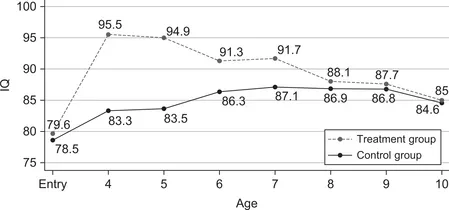
Figure 1.1 Perry Preschool Program: IQ, by Age and Treatment Group.
Notes: IQ measured on the Stanford–Binet Intelligence Scale (Terman and Merrill, 1960). The test was administered at program entry and at each of the ages indicated.
Source: Cunha, Heckman, Lochner, and Masterov (2006) and Heckman and Masterov (2007) based on data provided by the High Scope Foundation.
Personality psychologists mainly focus on empirical associations between their measures of personality traits and a variety of life outcomes. Yet for policy purposes, it is important to know mechanisms of causation to explore the viability of alternative policies.12 We use economic theory to formalize the insights of personality psychology and to craft models that are useful for exploring the causal mechanisms that are needed for policy analysis.
We interpret personality as a strategy function for responding to life situations. Personality traits, along with other influences, produce measured personality as the output of personality strategy functions. We discuss how psychologists use measurements of the performance of persons on tasks or in taking actions to identify personality traits and cognitive traits. We discuss fundamental identification problems that arise in applying their procedures to infer traits.
Many economists, especially behavioral economists, are not convinced about the predictive validity, stability, or causal status of economic preference parameters or personality traits. They believe, instead, that the constraints and incentives in situations almost entirely determine behavior.13 This once popular, extreme situationist view is no longer generally accepted in psychology. Most psychologists now accept the notion of a stable personality as defined in this chapter.14 Measured personality exhibits both stability and variation across situations.15
Although personality traits are not merely situation-driven ephemera, they are also not set in stone. We present evidence that both cognitive and personality traits evolve over the life cycle, but at different rates at different stages. Recently developed economic models of parental and envir...
Table of contents
- Cover
- Title Page
- Contents
- INTRODUCTION TO THE SERIES
- Copyright
- CONTRIBUTORS
- REFLECTIONS ON THE ECONOMICS OF EDUCATION
- INTRODUCTION TO HANDBOOK
- Chapter 1: Personality Psychology and Economics
- Chapter 2: Nonproduction Benefits of Education
- Chapter 3: Overeducation and Mismatch in the Labor Market
- Chapter 4: Migration and Education
- Chapter 5: Inequality, Human Capital Formation, and the Process of Development
- Chapter 6: The Design of Performance Pay in Education
- Chapter 7: Educational Vouchers in International Contexts
- Chapter 8: Dropouts and Diplomas
- Chapter 9: The Political Economy of Education Funding
- Index
Trusted by 375,005 students
Access to over 1.5 million titles for a fair monthly price.
Study more efficiently using our study tools.
Frequently asked questions
Yes, you can cancel anytime from the Subscription tab in your account settings on the Perlego website. Your subscription will stay active until the end of your current billing period. Learn how to cancel your subscription
No, books cannot be downloaded as external files, such as PDFs, for use outside of Perlego. However, you can download books within the Perlego app for offline reading on mobile or tablet. Learn how to download books offline
Perlego offers two plans: Essential and Complete
- Essential is ideal for learners and professionals who enjoy exploring a wide range of subjects. Access the Essential Library with 800,000+ trusted titles and best-sellers across business, personal growth, and the humanities. Includes unlimited reading time and Standard Read Aloud voice.
- Complete: Perfect for advanced learners and researchers needing full, unrestricted access. Unlock 1.5M+ books across hundreds of subjects, including academic and specialized titles. The Complete Plan also includes advanced features like Premium Read Aloud and Research Assistant.
We are an online textbook subscription service, where you can get access to an entire online library for less than the price of a single book per month. With over 1.5 million books across 990+ topics, we’ve got you covered! Learn about our mission
Look out for the read-aloud symbol on your next book to see if you can listen to it. The read-aloud tool reads text aloud for you, highlighting the text as it is being read. You can pause it, speed it up and slow it down. Learn more about Read Aloud
Yes! You can use the Perlego app on both iOS and Android devices to read anytime, anywhere — even offline. Perfect for commutes or when you’re on the go.
Please note we cannot support devices running on iOS 13 and Android 7 or earlier. Learn more about using the app
Please note we cannot support devices running on iOS 13 and Android 7 or earlier. Learn more about using the app
Yes, you can access Handbook of the Economics of Education by Eric A. Hanushek,Stephen J. Machin,Ludger Woessmann,Eric A Hanushek in PDF and/or ePUB format, as well as other popular books in Education & Business Education. We have over 1.5 million books available in our catalogue for you to explore.