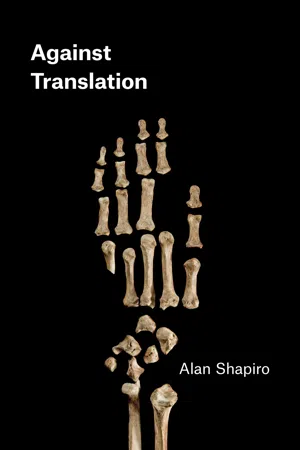
We often ask ourselves what gets lost in translation—not just between languages, but in the everyday trade-offs between what we experience and what we are able to say about it. But the visionary poems of this collection invite us to consider: what is loss, in translation? Writing at the limits of language—where "the signs loosen, fray, and drift"—Alan Shapiro probes the startling complexity of how we confront absence and the ephemeral, the heartbreak of what once wasn't yet and now is no longer, of what (like racial prejudice and historical atrocity) is omnipresent and elusive. Through poems that are fine-grained and often quiet, Shapiro tells of subtle bereavements: a young boy is shamed for the first time for looking "girly"; an ailing old man struggles to visit his wife in a nursing home; or a woman dying of cancer watches her friends enjoy themselves in her absence. Throughout, this collection traverses rather than condemns the imperfect language of loss—moving against the current in the direction of the utterly ineffable.
eBook - ePub
Against Translation
About this book
Information
Three
Oracles
Black boom box of the town loner, one hand propping it on his shoulder, pressing it against his ear, as it blasted a force field of electric outrage all around him as he walked the streets, in his own parade of being no one anybody knew, in black boots, black pants and shirt, neck shackled with austere chains, while a heavy key chain clanged from his belt. Mute but for the blasted sound, the indecipherable screeching, he passed by too quickly to be hassled, to care if he was jeered at or merely seen and then forgotten, just part of the scenery, part of the background, the background’s angry edge of caring not at all about him, appearing in our lives the way a stranger might appear by accident in a photograph taken by a loved one of a loved one—a wandering oracle, but of what? What didn’t register? What mattered little then, and less now, or mattered, we were certain, unforgettably until it didn’t, remembered if at all as just a black blur in a torn-off corner of an absent photograph he’s stepping out of, into where for him we all along had been, and for each other soon would be?
First Love
Before he happened the body was to me
like weather in a place where weather changed
so little it never needed to be noticed,
a sleepwalk through long spells of fog
effusing inside out and outside in
until one day the feeling for him in my body
made of my body the isolated site
that seeing him could only happen from.
His presence fell impartially as sunlight,
indifferent, needless, blindingly unaware
that I was brightening alone below it,
like Blake’s sunflower, fixed, drawn, leaning up toward
the golden clime whose going left so fresh
a dark around me I was grateful for it.
Grateful because so long as it was dark
the wanting could be imageless and placeless,
not a being with of bodies but an in-
between so dense with wanting to be filled
that wanting to fill it was itself the force
that held me at the edge of having what
the wanting somehow wouldn’t let me have.
Was he my otherwise? Or was I his
the day he leaned across the front seat to
unlock the door for me the way he had
for others so we could go somewhere the smiling
promised would be mine alone, or ours,
long hair the sheen of corn silk, hand on mine
that on its own refused to pull away
the more I tried to pull it, pulling me after
even while I withdrew, like the sun caught
between collapsing and exploding, which meant
I wanted to and couldn’t while I did,
both drawn in and withdrawn held down
and hovering galaxies away above
the small boy looking up from where the wanting
wouldn’t let me enter, or escape.
How I grew up is how a black hole shrinks
by sucking into its event horizon
all of the emptiness around it, which
it squeezes to a dot that keeps contracting,
sucking until the space increasing in
the shrinking speck has grown too vast to cross.
Mirrors
The amusement park of my childhood was called Paragon. Paragon Park. And in it was a “ride” that wasn’t a ride at all but a crooked hall you walked through called the Crooked Hall that was in fact a crooked hall made entirely of funhouse mirrors, not just on either side but floor and ceiling too. I pretended to love it because everyone else did or seemed to. Maybe we all pretended to love it, anxious to show the world how confident we were, how free of vanity, that we could laugh in clinical fluorescence at the monsters we became inside it, on one side the body pulled like agonized taffy to a barely human smear, while on the other it swallowed itself up into a paramecium blur, a fat puddle. Jeered at by our bodies warped and morphing all around us, we didn’t laugh, or I didn’t, not really. The mirror did the laughing for me. It was like being caught inside a nightmare particle accelerator—in which the images I presented to the world were all exploded down into some grotesque confessional essence, the Higgs boson of a self-contempt I hid even from myself, except in dreams, or in sudden eruptions out of nowhere of disgust that had no aim or object, that, not to feel myself, I would have to train on others, usually the weakest ones I knew. Getting older, at least, changed that. Getting older is a new park; it’s still called Paragon, though no one goes there for amusement. Yet stuck inside it we still joke a lot, we say things like all mirrors laugh now when we are in them, but while the mirror on one side is a young self laughing at an old self in the facing mirror laughing back, we ourselves don’t laugh; we are where the laughs collide and shatter.
Grasshopper
to the little ant that was me,
intrepid Stevie, pretty
Stevie for whom the future
was a foreign movie
without subtitles,
bad boy of the moment
of the high school
parking lot, the hallways
and classrooms too,
flask peeking out
from shirt pocket,
always a little drunk,
or high, a different girl
or boy clinging to his arm,
envy of girl and boy
alike, by me especially despite
my ant ways, my little
drone ambition, glanced
at and envied not
so much for the beauty
as the beauty’s fuck-it-
all serenity, magnetic
pull of couldn’t-give-a-shit,
the you-know-I’m-me face, bright shock
of blond hair, body tall
and slender flexed
with having, taking,
giving, body both
a shameless dare
and warning, and warned
and dared was how I
ant-like, drone-like,
navigated, tray in hand,
the hormonal roar and milky
sourness of the lunchroom,
the sticky linoleum hubbub
each step had to be un-
stuck from as I searched
for a seat at any table
but his, but never too
far from his, and always
near enough ...
Table of contents
- Cover
- Title Page
- Copyright Page
- Contents
- Acknowledgments
- one
- two
- three
- four
- Notes
Trusted by 375,005 students
Access to over 1.5 million titles for a fair monthly price.
Study more efficiently using our study tools.
Frequently asked questions
Yes, you can cancel anytime from the Subscription tab in your account settings on the Perlego website. Your subscription will stay active until the end of your current billing period. Learn how to cancel your subscription
No, books cannot be downloaded as external files, such as PDFs, for use outside of Perlego. However, you can download books within the Perlego app for offline reading on mobile or tablet. Learn how to download books offline
Perlego offers two plans: Essential and Complete
- Essential is ideal for learners and professionals who enjoy exploring a wide range of subjects. Access the Essential Library with 800,000+ trusted titles and best-sellers across business, personal growth, and the humanities. Includes unlimited reading time and Standard Read Aloud voice.
- Complete: Perfect for advanced learners and researchers needing full, unrestricted access. Unlock 1.5M+ books across hundreds of subjects, including academic and specialized titles. The Complete Plan also includes advanced features like Premium Read Aloud and Research Assistant.
We are an online textbook subscription service, where you can get access to an entire online library for less than the price of a single book per month. With over 1.5 million books across 990+ topics, we’ve got you covered! Learn about our mission
Look out for the read-aloud symbol on your next book to see if you can listen to it. The read-aloud tool reads text aloud for you, highlighting the text as it is being read. You can pause it, speed it up and slow it down. Learn more about Read Aloud
Yes! You can use the Perlego app on both iOS and Android devices to read anytime, anywhere — even offline. Perfect for commutes or when you’re on the go.
Please note we cannot support devices running on iOS 13 and Android 7 or earlier. Learn more about using the app
Please note we cannot support devices running on iOS 13 and Android 7 or earlier. Learn more about using the app
Yes, you can access Against Translation by Alan Shapiro in PDF and/or ePUB format, as well as other popular books in Literature & American Poetry. We have over 1.5 million books available in our catalogue for you to explore.