- 458 pages
- English
- ePUB (mobile friendly)
- Available on iOS & Android
eBook - ePub
Nanocomposite Structures and Dispersions
About this book
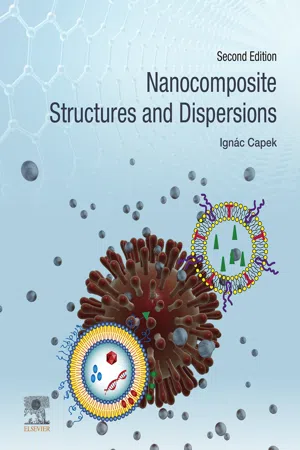
Nanocomposite Structures and Dispersions deals with the preparation of gelled, branched and crosslinked nanostructured polymers in the solution free radical polymerization and controlled/living radical polymerization and polymer and composite nanoparticles and nanostructures in disperse systems, the kinetics of direct and inverse disperse polymerizations (microemulsion, miniemulsion, emulsion, dispersion and suspension polymerization), the bottom-up approach building of functionalized nanoparticles, modelling of radical microemulsion polymerization, the characterization of traditional and non-traditional polymer dispersions, the collective properties of nanomaterials and their (bio)applications.This book is designed to bridge that gap and offers several unique features. First, it is written as an introduction to and survey of nanomaterials with a careful balance between basics and advanced topics. Thus, it is suitable for both beginners and experts, including graduate and upper-level undergraduate students. Second, it strives to balance the colloidal aspects of nanomaterials with physical principles. Third, the book highlights nanomaterial based architectures including composite or hybrid conjugates rather than only isolated nanoparticles. A number of ligands have been utilized to biodecorate the polymer and composite nanocarriers. Finally, the book provides an in depth discussion of important examples of reaction mechanisms of bottom-up building of functionalized nanoparticles, or potential applications of nanoarchitectures, ranging from physical to chemical and biological systems.
- Free radical (controlled) polymerization, branching, crosslinking and gelling
- Kinetics and mechanism of polymer nanoparticles formation
- Modelling of radical polymerization in disperse systems
- Polymer, composite and metal nanoparticles, nanostructures and nanomaterials
- Smart nanostructures, biodecorated particles, nanocarriers and therapeutics
Information
Topic
Physical SciencesSubtopic
Physical & Theoretical Chemistry1
Nanotechnology and nanomaterials
Abstract
Nanoscience and nanotechnology belong to the broad interdisciplinary area comprising polymer and metal particles, nanoelectrics, supramolecular and colloid chemistry, nanostructured materials, biochemistry and biology. Nanomaterials are implicated in several domains such as chemistry, electronics, high-density magnetic recording media, sensors, biotechnology, etc. Due to their extremely small size and large specific surface area, nanomaterials usually exhibit unusual physical and chemical properties compared to that of bulk materials. The “top-down approach miniaturization” is based on a progressive reduction of dimensions. The “bottom-up approach” on the contrary relies on the atom per atom, or molecule per molecule building of functionalized elements and their self-organization.
Nanotechnology is a multidisciplinary field bringing together chemists, physicists, biologists, pharmacologists, physicians, clinicians, veterinarians and many other specialists. In chemistry, the range of sizes from a few nanometers to much less than 100 nm has historically been associated with colloids, micelles, polymer molecules, phase-separated regions in block copolymers, and similar structures—typically, very large molecules, or aggregates of many molecules. In physics and electrical engineering, nanoscience is most often associated with quantum behavior, and the behavior of electrons and photons in nanoscale structures. Biology and biochemistry also have a deep interest in nanostructures as components of the cell; many of the most interesting structures in biology—from DNA and viruses to subcellular organelles and gap junctions—can be considered as nanostructures.
The composition of nanomaterials may be of biologic or chemical origin. Biologic materials include DNA, phospholipids, lipids, lactic acid, dextran, chitosan, and albumin. Nanoscale devices and machines are either present in nature or must be synthesized starting from more simple components. In the nanoscale area, each device is made of a countable number of atoms (molecules). The miniaturization of components for the construction of useful nanodevices and nanomachines can be pursued by the top-down and bottom-up approaches. A particularly exciting class of such hybrid devices utilizes biomolecular motors, which can add active, chemically powered force generation and movement to the functionality of the device. Applications of nanodevices based on biomolecular motors have been explored for nanoscale transport systems (molecular shuttles), surface imaging, force measurements, single molecule manipulation, and lab-on-a-chip systems.
An alternative strategy for the formation of ordered nanomaterial arrays is the self-organization method based on biomolecular templates by direct or synergistic templating techniques. Another strategy is to utilize the advantages of self-organization processes by means of noncovalent interactions. Surface properties may be imparted to nanoparticles by coating them with various substances. Moreover, coating with polymers or antibodies, which bind specifically to a particular cell, can help to better achieve targeted drug delivery.
Keywords
Nanoscience; Nanotechnology; Nanomaterials; Polymer; Composite and metal nanoparticles
Abbreviations
1D one dimensional
2D two dimensional
3D three dimensional
AFAM atomic force acoustic microscopy
AFM atomic force microscopes
AgNP silver nanoparticle
API active pharmaceutical ingredient
AuNP gold nanoparticle
BME biomolecular electronics
CFM chemical force microscopy
CMC critical micelle concentration
CNS central nervous system
CpG oligodeoxynucleotides
CS-AFM current sensing atomic force microscopy
DNA deoxyribonucleic acid
DPN din-pen nanolithography
dsDNA double-stranded DNA
E. coli Escherichia coli
E-beam electron beam
EFM electrical force microscopy
EM electromagnetic
EPR enhanced permeation and retention
EVOH ethylene-vinyl alcohol copolymer
Fab’ antibody fragment
FET field effect transistor
FFM friction force microscopy
FIA fluorescent immunoassays
FIB focused ion beam
FITC fluorescein isothiocyanate
GOx glucose oxidase
HRP horseradish peroxidase
HTL hole-transporting layer
IBD inflammatory bowel disease
IETS inelastic electron tunneling spectroscopy
ITO indium tin oxide
LB Langmuir-Blodgett
LCD liquid-crystal display
LEC light-emitting electrochemical cell
LED light-emitting diode
LFM lateral force microscopy
LSP localized surface plasmons
MEMS micro-electrical-mechanical systems
MFM magnetic force microscopy
MF-STM magnetic force scanning tunneling
MiP microparticle
miRNA microRNA
MNP metal nanoparticle
MPC monolayer protected cluster
MPEG methoxy PEG
MRI magnetic resonance imaging
MST microsystems technologies, as known in Europe
MTs microtubules
NAD+ nicotinamide adenine dinucleotide
nDSs nanochannel delivery systems
NEMS nanoelectromechanical system
NF-κB nuclear factor-κB
NIL nanoimprint-based lithography
NP nanoparticle
OLED organic light-emitting diode
PBG produce photonic bandgap
PCR polymerase chain reaction
PDMS poly(dimethylsiloxane)
PEDOT poly(3,4-ethylenedioxythiophene)
PEG poly(ethylene glycol)
PLA polylactide
PLED polymer-based LED
PLGA poly(lactic-co-glycolic acid)
PMMA poly(methyl methacrylate)
PNP polymer NP
PSMA prostate-specific membrane antigen as a targeting agent
PSt polystyrene
PStS poly(styrene sullonate)
PU poly(urethane)
PUM polyurethane micelles
PVA polyvinyl alcohol
QD quantum dots
R&D research and development
RNA ribonucleic acid
RNAi RNA interference
RTG radioisotope thermoelectric generators
SAM self-assembled monolayer
SEM scanning electron microscopy
SERS surface-enhanced Raman scattering
SFM shear force microscopy
SiNP silica NP
siRNA small (or short) interfering RNA
SMOLED small-molecule OLED
SMS single-molecule spectroscopy
SNOM scanning near-field optical microscopy
SNP single-nucleotide polymorphism
SPIO superparamagnetic iron oxide
SPL scanning probe lithography
SPM scanning probe microscopy
SP-STM spin-polarized scanning tunneling microscopy
SSIL step-and-stamp imprint lithography
STM scanning tunneling microscopes
STS scanning tunneling spectroscopy
TEM transmission electron microscopy
TEs thermoelectrics
TM-AFM tapping mode atomic force microscopy
TNBS trinitrobenzene sulfonic acid
TNF antitumor necrosis factor
TPA two-photon absorption
UHV ultra-high vacuum
VEGF vascular endothelial growth factor
w/o water-in-oil
1.1 Introduction
During the past decade, due to the emergence of a new generation of high-technology materials, the number of research groups involved in nanomaterials has increased exponentially. Nanomaterials are implicated in several domains such as chemistry, electronics, high-density magnetic recording media, sensors, biotechnology, etc. Nano-sized materials have now emerged as one of the focal points of modern research. We are achieving an uncanny ability to design, synthesize, and manipulate structures at the nanoscale. Nanomaterials are expected to be used in various applications based on their excellent and unique optical, electrical, magnetic, catalytic, biological, or mechanical properties. Such properties originate from their finely tuned nanoarchitectures and nanostructures. However, the fabrication and analysis of nanomaterials remains challenging and, therefore, considerable and continuous efforts have been made to explore novel synthetic and analytical methods for nanoarchitectures and nanostructures by many researchers all over the world. The fascinating world of these nanomaterials and their manifold applications becomes part of our life.
Several important events have marked the nanotechnology story. At the beginning of the 1980s, scanning tunneling microscopes (STM) and atomic force microscopes (AFM) were invented providing thus the “experimental techniques, methods and approaches” required for nanostructure measurement and manipulation. Scanning probe microscopy (SPM) has opened up the new world of nanotechnology for observing and manipulating individual atoms and molecules on solid surfaces. Other techniques such as beam-probe techniques, mechanical-probe techniques and particle-trapping techniques were introduced to atom manipulation with wider controllability. In a parallel development, expansion of computational capability enabled sophisticated simulations of material behavior at the nanoscale. They stimulated the research with the vision of exciting new discoveries if one could fabricate materials and devices at the atomic/molecular scale. The starting research pointed out that a new class of miniaturized instrumentation would be needed to manipulate and measure the properties of these small “nano” structures. There is also the possibility that the unique properties of nanostructures will result in novel applications and devices. Another reason for the great popularity of this field is that phenomena occurring on this length scale are of interest to physicists, chemists, biologists, electrical and mechanical engineers, and computer scientists. A motivation in nanoscience is also to try to understand how materials behave when sample sizes are close to atomic dimensions [1].
Making and manipulating matter on the sub-100 nm length scale is a grand challenge for both scientists and engineers. From an engineering standpoint, the sub-100 nm scale is extraordinarily small, and many of the tools that are used routinely to do microfabrication cannot be used for nanofabrication. However, from the chemist's point of view, this length scale, especially above 10 nm, is extraordinarily large. Chemists are really “Angstrom-technologists,” not nanotechnologists. Even when they wo...
Table of contents
- Cover image
- Title page
- Table of Contents
- Copyright
- Preface
- 1: Nanotechnology and nanomaterials
- 2: Solution radical polymerization
- 3: Preparation of polymer-based nanomaterials
- 4: Oil-in-water microemulsion polymerization
- 5: Modeling of MEP
- Index
Trusted by 375,005 students
Access to over 1.5 million titles for a fair monthly price.
Study more efficiently using our study tools.
Frequently asked questions
Yes, you can cancel anytime from the Subscription tab in your account settings on the Perlego website. Your subscription will stay active until the end of your current billing period. Learn how to cancel your subscription
No, books cannot be downloaded as external files, such as PDFs, for use outside of Perlego. However, you can download books within the Perlego app for offline reading on mobile or tablet. Learn how to download books offline
Perlego offers two plans: Essential and Complete
- Essential is ideal for learners and professionals who enjoy exploring a wide range of subjects. Access the Essential Library with 800,000+ trusted titles and best-sellers across business, personal growth, and the humanities. Includes unlimited reading time and Standard Read Aloud voice.
- Complete: Perfect for advanced learners and researchers needing full, unrestricted access. Unlock 1.5M+ books across hundreds of subjects, including academic and specialized titles. The Complete Plan also includes advanced features like Premium Read Aloud and Research Assistant.
We are an online textbook subscription service, where you can get access to an entire online library for less than the price of a single book per month. With over 1.5 million books across 990+ topics, we’ve got you covered! Learn about our mission
Look out for the read-aloud symbol on your next book to see if you can listen to it. The read-aloud tool reads text aloud for you, highlighting the text as it is being read. You can pause it, speed it up and slow it down. Learn more about Read Aloud
Yes! You can use the Perlego app on both iOS and Android devices to read anytime, anywhere — even offline. Perfect for commutes or when you’re on the go.
Please note we cannot support devices running on iOS 13 and Android 7 or earlier. Learn more about using the app
Please note we cannot support devices running on iOS 13 and Android 7 or earlier. Learn more about using the app
Yes, you can access Nanocomposite Structures and Dispersions by Ignac Capek in PDF and/or ePUB format, as well as other popular books in Physical Sciences & Physical & Theoretical Chemistry. We have over 1.5 million books available in our catalogue for you to explore.