- 372 pages
- English
- ePUB (mobile friendly)
- Available on iOS & Android
eBook - ePub
About this book
Globally, mineral exploration has grown significantly in recent years, driven by the rapid acceleration in prices for gold and diamonds since 2004 and the emergence of a middle class in both China and India—aggressively increased demand. Despite this resurgence, no single book has been published that takes an interdisciplinary approach in addressing the full scope of mineral exploration—from mining and extraction to economic evaluation, policies, sustainability, and environmental impacts. Mineral Exploration: Principles and Applications accomplishes this by presenting each topic with theoretical approaches first followed by specific applications that can be immediately implemented in the field.
- Presents 16 case studies that allow readers to quickly apply exploration concepts to real-life scenarios in the field
- Includes more than 200 illustrations and full-color photographs that aid the reader in retaining key procedures and applications
- Each chapter is structured so that its topic is discussed theoretically first followed by specific applications
- Combines both theory and application in a multidisciplinary reference that thoroughly addresses the full scope of mineral exploration
- Authored by an instructor with more than 30 years of experience in the field and a decade as a consultant for commercial mining companies
Information
Topic
Physical SciencesSubtopic
Geology & Earth SciencesChapter 1
Mineral Exploration
Good exploration planning and decision making – measure risk and reward; persist where the geology is encouraging and where the rewards will be large; recognize when you have failed.
—Cameron R. Allen, Cominco Ltd.
Chapter Outline
1.1 Introduction
1.1.1 Why Mineral Exploration?
1.2 Definition
1.2.1 Mineral and Rock
1.2.2 Ore
1.2.3 Ore Deposit
1.2.4 Prime Commodity, Associated Commodity and Trace Element
1.2.5 Protore
1.2.6 Gangue Minerals and Tailing
1.2.7 Deleterious Substances
1.3 Exploration
1.3.1 Discovery Type
1.3.1.1 Greenfield Discovery
1.3.1.2 Brownfield Discovery
1.3.2 Stages of Exploration
1.3.2.1 Reconnaissance
1.3.2.2 Large Area Prospecting
1.3.2.3 Prospecting
1.3.2.4 General Exploration
1.3.2.5 Detail Exploration
1.3.2.6 Ongoing Exploration
1.3.2.7 Exploration Scheme
1.4 Mineral Policy and Act
1.4.1 Australia
1.4.2 Canada
1.4.3 Chile
1.4.4 India
1.4.5 Portugal
1.4.6 South Africa
1.4.7 Tunisia
1.4.8 Royalties and Taxation
1.4.9 Lease Application
1.5 Mineral to Metal—A Full Circle
Further Reading
1.1 Introduction
Minerals and metals are one of the essential components for the growth of human society. Needs of survival taught the prehistoric Paleolithic men the uses of stones as tools even before 20,000 years ago. The discovery of minerals, its exploitation and uses became many folds with the advent of civilization and is continuing till date.
A mineral deposit, more meaningfully concentration of specific mineral, is too small a size in comparison to the Earth’s crust. Deposits near the surface had been discovered over the centuries, mined out and metals extracted. Future searches will be aimed at naturally occurring concealed types. It may rarely show surface signatures like weathered outcrop and are covered under transported soil. The new discovery will not be easy. It will require state-of-the-art exploration techniques, trained man power, scientific knowledge, ample experience, high-end data processing system and interpretation skill. The total procedure would be achieved step by step in a dynamic and logical sequence.
1.1.1 Why Mineral Exploration?
The mineral reserves and resources, annual production vs. consumption and index of per capita spending of any commodity are the measures that rank the status of a country as developed, developing or underdeveloped. The per capita consumption of zinc in India during 2008 was very low at 0.43 kg against a world average of 4.3 kg. The higher consumption during the same period was shared between Australia (12.7 kg), South Korea (11.3 kg), Canada (5.6 kg), Japan (5 kg), USA (4.1 kg) and China (2.7 kg). The policy makers in the Government and Private Sectors allocate funds for long- and short-term exploration plan programs guided by the demand-supply trend of all commodities as a whole. The fund allocation has special significance for strategic and deficient minerals. The annual percent satisfaction between consumption and indigenous production of zinc metal between 1992-1993 and 2009-2010 at an annual growth rate of 8-10% has been depicted in Fig. 1.1.
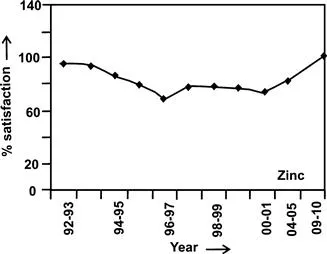
FIGURE 1.1 Satisfaction (%) of demand and supply of zinc metal between 1992-1993 and 2009-2010 in India.
The existing demand-supply disparity can be reduced by expanding the mining and smelting capacity with the on hand ore reserves as short-term ad hoc measure. The ultimate way out for long-term standpoint would be continuous efforts to enhance reserve and resource base. This is possible by new search, discovery and adequate exploration of mineral deposits, economic mining and smelting. The rate of reserve augmentation must commensurate with annual growth of the particular commodity (Fig. 1.2). The working group of sustainable mineral resource development program plans on the same analogy for future exploration investment in the country.
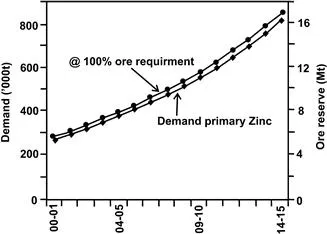
FIGURE 1.2 Projected reserve requirement of zinc at an annual growth rate of 8-10% up to 2015 at 90% mining-smelting capacity in India.
The process of mineral discovery and its development to a target production center takes a long gestation period of about 5-20 years. In terms of business requirements, this translates to a very high-risk tolerance at all levels, extensive period of time and rich pockets for a sustained cash flow. A small business unit in this field may often end its brief tenure with a total loss, in case of failure to make an economic return. Indeed, many of the discoveries are not viable at current market prices. Prima facie, the facts might indicate that investment in these ventures is a waste. However, one discovery out of 100 or even 1000 attempts may pay back the entire efforts. The task of policy maker is to plan timely allocation of funds for exploration and technology research of various mineral types, predicated on long-term demand and supply scenarios. Therefore, an investment-friendly environment, transparency and will of the Federal and the State Government and exploration companies and the political commitment of the regime are essential for mineral development in any country.
Some of the common basic terminologies that would be referred frequently in the subsequent chapters are defined here after.
1.2 Definition
1.2.1 Mineral and Rock
“Mineral” is a homogeneous inorganic substance that occurs naturally, usually in crystalline form with a definite chemical composition. It is generally in solid form, the exceptions being mercury, natural water and fossil fuel. The common rock-forming minerals (RFM) are quartz (SiO2), orthoclase feldspar (KAlSi3O8), plagioclase feldspar (CaNaAlSi3O8), albite (NaAlSi3O8), mica group such as muscovite (H2KAL3 (SiO4)3) and biotite (H2K(MgFe)3Al (SiO4)3). The common ore-forming minerals (OFM) are hematite (Fe2O3), cassiterite (SnO2), chalcopyrite (CuFeS2), sphalerite (ZnS), galena (PbS), baryte (BaSO4 2H2O), gypsum (CaSO4), apatite (Ca5(PO4)3 (F,Cl,OH)), etc.
“Rock” is an assemblage of mineral(s) formed under natural process of igneous, sedimentary and metamorphic origin. The common rocks are basalt, granite, quartzite, sandstone, limestone, marble and mica-schist.
1.2.2 Ore
In the past, the word “ore” was restricted exclusively to naturally occurring material from which one or more types of metal could be mined and extracted at a profit. The economic deposits comprising of industrial minerals, rocks, bulk materials, gemstones and fossil fuel were excluded from ore. The concept has undergone radical changes over the years. The Institution of Mining and Metallurgy, UK, currently defines “Ore as a solid naturally occurring mineral aggregate of economic interest from which one or more valuable constituents may be recovered by treatment”. Therefore, ore and orebody include metallic deposits, noble metals, industrial minerals, rocks, bulk or aggregate materials, gravel, sand, gemstones, natural water, poly-metallic nodules and mineral fuel from land and ocean bed (Fig. 1.3A-X). All ores are minerals or its aggregate, but the reverse is not true. The ore can be broadly classified as:
Metallic: Native-Pt, -Au, -Ag, -Cu, chalcopyrite, sphalerite, galena, hematite, magnetite, pyrite, pyrrhotite, bauxite.
Noble: Gold, silver, platinum, palladium.
Industrial: Quartz, garnet, phosphate, asbestos, barite.
Gemstones: Amethyst, aquamarine, diamond, emerald, garnet, opal, ruby, sapphire, topaz, zircon.
Rock: Granite, marble, limestone, rock salt.
Bulk/aggregate: Sand, gravel.
Mineral fuel: Coal, crude oil, gas.
Strategic: Uraninite, pitchblende, thorianite, wolframite.
Life essential: Natural water.
Rare earth: Lanthanum (La), cerium (Ce), neodyminum (Nd), promethium (Pm).
Ocean: Poly-metallic nodules, coral, common salt, potassium.
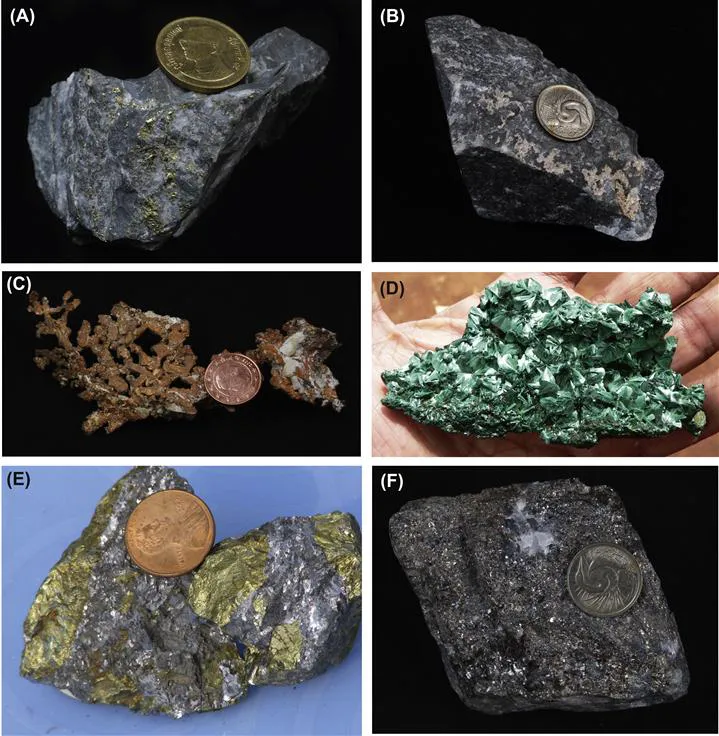
FIGURE 1.3 A-F Common ore minerals: (A) naive gold (Saudi Arabia), (B) native silver (Zawar mine), (C) native copper (Neves Corvo, Portugal), (D) malachite (credit: Prof. R. V. Karanth), (E) chalcopyrite (golden) and galena (steel gray) (Rajpura-Dariba), (F) brown sphalerite (Zawar mine), India.
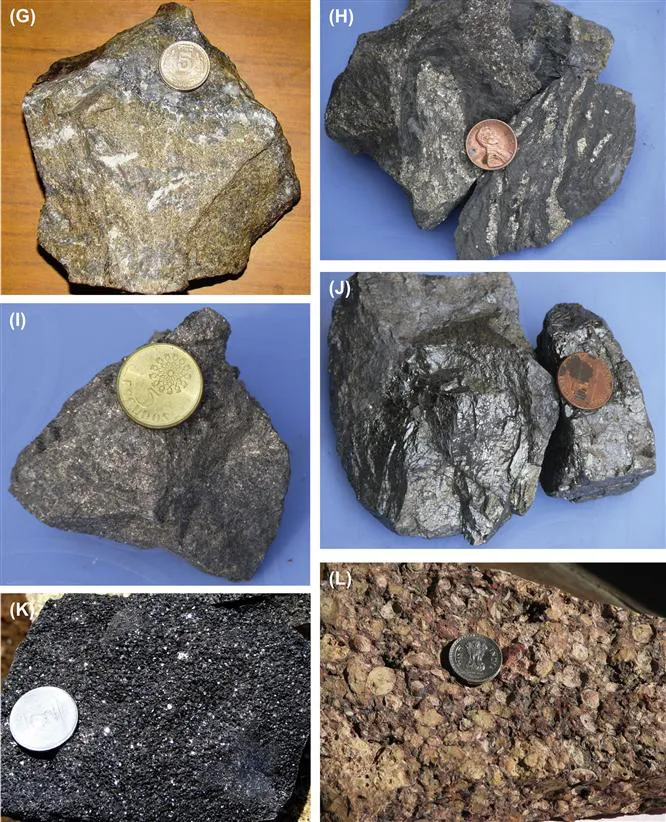
FIGURE 1.3 G-L Common ore minerals: (G) honey yellow sphalerite, (Rajpura-Dariba, credit: V. K. Jhanjhri), (H) stratiform pyrite in graphite schist (Rajpura-Dariba), (I) massive pyrrhotite (Sindesar Khurd), (J) wolframite (Degana mine, India), (K) crystalline chromite (Sukinda, India), (L) pisolitic structure in bauxite (Bagru Hill, Jharkhond, India).
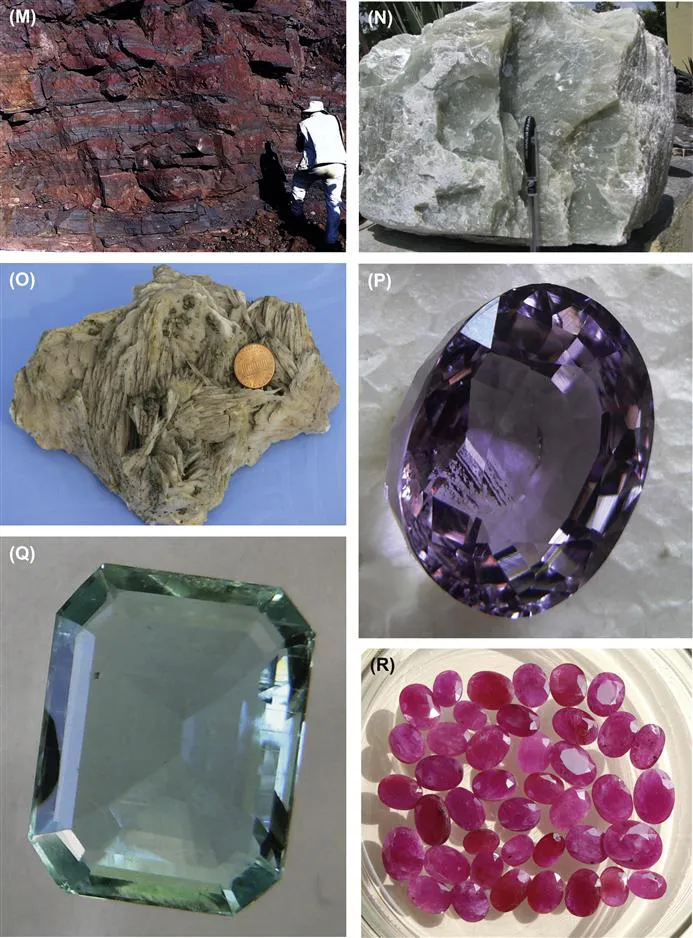
FIGURE 1.3 M-R Common ore minerals: (M) hematite (steel gray) and Jasper (red) (credit: Prof. A. B. Roy), (N) fluorite (Amba-Dungri, India), (O) barite embedded with pyrite crystals (Preislar mine, Germany), (P) amethyst, (Q) aquamarine, (R) ruby.
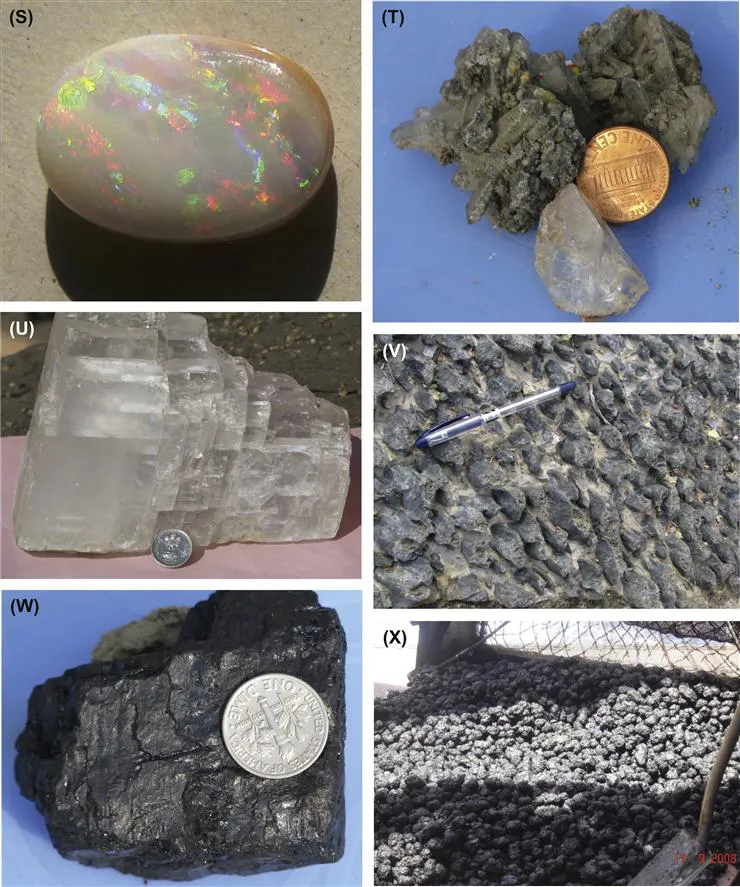
FIGURE 1.3 S-X Common ore minerals: (S) opal (image credit QP to S: Prof. R. V. Karanth), (T) quartz (Kolihan copper mine, India), (U) calcite, (V) rock phosphate (Jhamarkotra, India), (W) coal (Belatan mine, India), (X) poly-metallic nodules. (Indian Ocean, Credit: Ms Arpita De)
1.2.3 Ore Deposit
An ore deposit is a natural concentration of one or more minerals within the host rock. It has a definite shape on economic criteria with finit...
Table of contents
- Cover image
- Title page
- Table of Contents
- Copyright
- Dedication
- Preface
- List of Acronyms used in this book
- About the Author
- Chapter 1. Mineral Exploration
- Chapter 2. Economic Mineral Deposits and Host Rocks
- Chapter 3. Exploration Geology
- Chapter 4. Exploration Geochemistry
- Chapter 5. Exploration Geophysics
- Chapter 6. Photogeology, Remote Sensing and Geographic Information System in Mineral Exploration
- Chapter 7. Sampling Methods
- Chapter 8. Mineral Resource and Ore Reserve Estimation
- Chapter 9. Statistical and Geostatistical Applications in Geology
- Chapter 10. Exploration Modeling
- Chapter 11. Elements of Mining
- Chapter 12. Mineral Processing
- Chapter 13. Mineral Economics
- Chapter 14. Environmental System Management of Mineral Resources and Sustainable Development
- Chapter 15. Mineral Exploration—Case Histories
- References
- Index
Trusted by 375,005 students
Access to over 1.5 million titles for a fair monthly price.
Study more efficiently using our study tools.
Frequently asked questions
Yes, you can cancel anytime from the Subscription tab in your account settings on the Perlego website. Your subscription will stay active until the end of your current billing period. Learn how to cancel your subscription
No, books cannot be downloaded as external files, such as PDFs, for use outside of Perlego. However, you can download books within the Perlego app for offline reading on mobile or tablet. Learn how to download books offline
Perlego offers two plans: Essential and Complete
- Essential is ideal for learners and professionals who enjoy exploring a wide range of subjects. Access the Essential Library with 800,000+ trusted titles and best-sellers across business, personal growth, and the humanities. Includes unlimited reading time and Standard Read Aloud voice.
- Complete: Perfect for advanced learners and researchers needing full, unrestricted access. Unlock 1.5M+ books across hundreds of subjects, including academic and specialized titles. The Complete Plan also includes advanced features like Premium Read Aloud and Research Assistant.
We are an online textbook subscription service, where you can get access to an entire online library for less than the price of a single book per month. With over 1.5 million books across 990+ topics, we’ve got you covered! Learn about our mission
Look out for the read-aloud symbol on your next book to see if you can listen to it. The read-aloud tool reads text aloud for you, highlighting the text as it is being read. You can pause it, speed it up and slow it down. Learn more about Read Aloud
Yes! You can use the Perlego app on both iOS and Android devices to read anytime, anywhere — even offline. Perfect for commutes or when you’re on the go.
Please note we cannot support devices running on iOS 13 and Android 7 or earlier. Learn more about using the app
Please note we cannot support devices running on iOS 13 and Android 7 or earlier. Learn more about using the app
Yes, you can access Mineral Exploration by Swapan Kumar Haldar in PDF and/or ePUB format, as well as other popular books in Physical Sciences & Geology & Earth Sciences. We have over 1.5 million books available in our catalogue for you to explore.