- 768 pages
- English
- ePUB (mobile friendly)
- Available on iOS & Android
eBook - ePub
Emulsions
About this book
Emulsions, the third volume of the Nanotechnology in the Food Industry series, is an invaluable resource for anyone in the food industry who needs the most recent information about scientific advances in nanotechnology on this topic. This volume focuses on basic and advanced knowledge about nanoemulsion, and presents an overview of the production methods, materials (solvents, emulsifiers, and functional ingredients), and current analytical techniques that can be used for the identification and characterization of nanoemulsions.
The book also discusses the applications of nanoemulsion with special emphasis on systems suitable for utilization within the food industry. This book is useful to a wide audience of food science research professionals and students who are doing research in this field, as well as others interested in recent nanotechnological progress worldwide.
- Presents fundamentals of nanoemulsions, methods of preparation (high-energy and low-energy techniques), and applications in the food industry
- Includes research studies of nanoemulsification technology to improve bioavailability of food ingredients and research analysis
- Offers benefits and methods of risk assessment to ensure food safety
- Presents cutting-edge encapsulating systems to improve the quality of functional compounds
- Provides a variety of methods, such as high-shear stirring, high-pressure homogenizers, self-emulsification, phase transitions and phase-inversion, to further research in this field
Information
1
Nanoemulsions for food: properties, production, characterization, and applications
Weiping Jin*
Wei Xu*
Hongshan Liang*
Yan Li*,**
Shilin Liu*,**
Bin Li*,**
* College of Food Science and Technology, Huazhong Agricultural University, Wuhan, China
** Key Laboratory of Environment Correlative Dietology, Huazhong Agricultural University, Ministry of Education, Wuhan, China
* College of Food Science and Technology, Huazhong Agricultural University, Wuhan, China
** Key Laboratory of Environment Correlative Dietology, Huazhong Agricultural University, Ministry of Education, Wuhan, China
Abstract
With the increasing demand for healthier and safer food products, more and more attention has been paid to the utilization of nanotechnology to encapsulate, protect, and deliver functional compounds. Nanoemulsion technology is particularly suited as the delivery and encapsulation systems for functional compounds, which have more potential advantages than conventional emulsions. This chapter presents an overview of nanoemulsions, covering the basic knowledge, production methods, characterization techniques, and the applications in the food industry.
Keywords
emulsion
functional food
surfactant
oil
nanoemulsion
1. Introduction
An online literature survey, using database provided by “Web of Science” (Thomson Reuters), reveals that the terminology of “nanoemulsion” first appeared in 1996 (McClements, 2012). In the past 20 years, nanoemulsions have aroused great interest among researchers. More than 5000 items related to nanoemulsions have been published up to now. After 2008, a tremendous increase of published research is observed (Fig. 1.1a). The number of publications through 2014 is around 3 times higher than that through 2008. In the first half of 2015, the amount of publications reached 200, predicting a new climax of publications at the end of 2015.
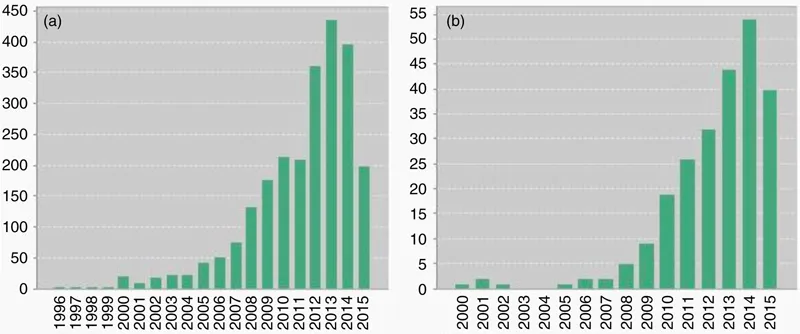
Figure 1.1 Number of published items per year including nanoemulsion (a) and food-related nanoemulsion (b) using statistics database from “Web of Science” (Thomson Reuters).
The majority of publications about nanoemulsions focus on their application in the preparation of polymeric nanoparticles or action as a nanoreactor due to their small droplet size, long-term stability, and high relative surface areas (Solans et al., 2005). Nevertheless, among the publications of nanoemulsions, food-related items are still fewer (Fig. 1.1b). But it displays a prospect for high-sustained growth. Utilizing emulsion technology to create broad applications, such as milk, soft drinks, nutriceuticals fortification, has been developed in the food industry (McClements and Rao, 2011; McClements, 2010). The application of emulsion technology in the food field can design new structures of products and control physicochemical properties, such as texture, taste, flavor, and stability. Furthermore, nanoemulsions have been proven to be considerable delivery systems for encapsulating, protecting, a...
Table of contents
- Cover
- Title page
- Table of Contents
- Copyright
- List of Contributors
- Series Foreword
- Series Preface
- Volume Preface
- 1: Nanoemulsions for food: properties, production, characterization, and applications
- 2: Preparation of nanomaterials for food applications using membrane emulsification and membrane mixing
- 3: Nanoemulsions containing unsaturated fatty acid concentrates
- 4: Nanoformulations of polyphenols for prevention and treatment of cardiovascular and metabolic disorders
- 5: Nanoemulsion: preparation and its application in food industry
- 6: Formation and properties of nanoemulsions
- 7: Application of nanoemulsion technology for encapsulation and release of lipophilic bioactive compounds in food
- 8: Gelation in nanoemulsion: structure formation and rheological behavior
- 9: Nanoemulsion-based delivery systems: preparation and application in the food industry
- 10: Biopolymers-embedded nanoemulsions and other nanotechnological approaches for safety, quality, and storability enhancement of food products: active edible coatings and films
- 11: Nanoemulsions as potential delivery systems for bioactive compounds in food systems: preparation, characterization, and applications in food industry
- 12: Production, stability and application of micro- and nanoemulsion in food production and the food processing industry
- 13: Nanostructural characterization of food grade microemulsions: ultrasonic resonator technology
- 14: Application of self-emulsifying delivery systems for effective delivery of nutraceuticals
- 15: The synthesis and application of vitamins in nanoemulsion delivery systems
- 16: Emulsified protein filaments: types, preparation, nutritional, functional, and biological properties of mayonnaise
- 17: Trends and methods for nanobased delivery for nutraceuticals
- 18: Nanoemulsions as delivery vehicles for food and pharmaceuticals
- 19: Nanoemulsions: an emerging technology in the food industry
- 20: Scientometric overview regarding nanoemulsions used in the food industry
- Subject index
Trusted by 375,005 students
Access to over 1.5 million titles for a fair monthly price.
Study more efficiently using our study tools.
Frequently asked questions
Yes, you can cancel anytime from the Subscription tab in your account settings on the Perlego website. Your subscription will stay active until the end of your current billing period. Learn how to cancel your subscription
No, books cannot be downloaded as external files, such as PDFs, for use outside of Perlego. However, you can download books within the Perlego app for offline reading on mobile or tablet. Learn how to download books offline
Perlego offers two plans: Essential and Complete
- Essential is ideal for learners and professionals who enjoy exploring a wide range of subjects. Access the Essential Library with 800,000+ trusted titles and best-sellers across business, personal growth, and the humanities. Includes unlimited reading time and Standard Read Aloud voice.
- Complete: Perfect for advanced learners and researchers needing full, unrestricted access. Unlock 1.5M+ books across hundreds of subjects, including academic and specialized titles. The Complete Plan also includes advanced features like Premium Read Aloud and Research Assistant.
We are an online textbook subscription service, where you can get access to an entire online library for less than the price of a single book per month. With over 1.5 million books across 990+ topics, we’ve got you covered! Learn about our mission
Look out for the read-aloud symbol on your next book to see if you can listen to it. The read-aloud tool reads text aloud for you, highlighting the text as it is being read. You can pause it, speed it up and slow it down. Learn more about Read Aloud
Yes! You can use the Perlego app on both iOS and Android devices to read anytime, anywhere — even offline. Perfect for commutes or when you’re on the go.
Please note we cannot support devices running on iOS 13 and Android 7 or earlier. Learn more about using the app
Please note we cannot support devices running on iOS 13 and Android 7 or earlier. Learn more about using the app
Yes, you can access Emulsions by Alexandru Grumezescu in PDF and/or ePUB format, as well as other popular books in Biological Sciences & Biotechnology. We have over 1.5 million books available in our catalogue for you to explore.