This book presents the ideas and industrial concepts in compact heat exchanger technology that have been developed in the last 10 years or so. Historically, the development and application of compact heat exchangers and their surfaces has taken place in a piecemeal fashion in a number of rather unrelated areas, principally those of the automotive and prime mover, aerospace, cryogenic and refrigeration sectors. Much detailed technology, familiar in one sector, progressed only slowly over the boundary into another sector. This compartmentalisation was a feature both of the user industries themselves, and also of the supplier, or manufacturing industries. These barriers are now breaking down, with valuable cross-fertilisation taking place. One of the industrial sectors that is waking up to the challenges of compact heat exchangers is that broadly defined as the process sector. If there is a bias in the book, it is towards this sector. Here, in many cases, the technical challenges are severe, since high pressures and temperatures are often involved, and working fluids can be corrosive, reactive or toxic. The opportunities, however, are correspondingly high, since compacts can offer a combination of lower capital or installed cost, lower temperature differences (and hence running costs), and lower inventory. In some cases they give the opportunity for a radical re-think of the process design, by the introduction of process intensification (PI) concepts such as combining process elements in one unit. An example of this is reaction and heat exchange, which offers, among other advantages, significantly lower by-product production.To stimulate future research, the author includes coverage of hitherto neglected approaches, such as that of the Second Law (of Thermodynamics), pioneered by Bejan and co- workers. The justification for this is that there is increasing interest in life-cycle and sustainable approaches to industrial activity as a whole, often involving exergy (Second Law) analysis. Heat exchangers, being fundamental components of energy and process systems, are both savers and spenders of exergy, according to interpretation.
I only make progress because I make a leap of faith.
A. Einstein
One of the encouraging aspects of heat exchanger developments in the last decade or so has been that the historical sectorial divisions utilising compact heat exchangers (CHEs), have been breaking down. These sectors, loosely defined as refrigeration, power, automotive, aerospace, process and cryogenic, are experiencing increasing cross- fertilisation of technology. Thus the advances in development and understanding in the well- established application areas of different types of plate-fin exchangers for gas separation (cryogenic) exchangers, gas turbine recuperators and the automotive sectors have come together, and have impacted on the power generation, refrigeration and process sectors. It is appropriate to review some of these advances.
Recent developments in compact heat exchanger technology
The well-known Plate and Frame Heat Exchanger (PHE) has undergone two such developments. The first of these is that of the Brazed Plate Exchanger (see chapter 2), originally developed by SWEP in Sweden, and now widely adopted by other manufacturers. Its success has been such that brazed plate exchangers now dominate the low to medium (100kW) capacity range of refrigeration and central air conditioning equipment, almost completely replacing shell- and tube exchangers.
Another, more recent derivative of the PHE is the welded plate exchanger, which utilises specialised seams to enable the welding of the plates together either as pairs or as a whole unit. These units are offered both in ‘stand- alone’ form or in a modified frame to contain higher pressures or differential pressures. Because of the (normally stainless steel) plate material they are suitable for a wide variety of process applications of moderate pressures.
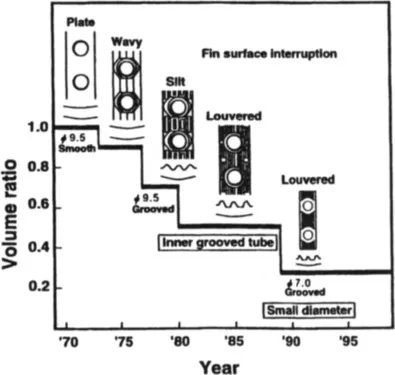
In the automotive and domestic air conditioning sector, there has been steady progress, largely cost and space- driven, to reduce the size of evaporators and condensers. This progress is graphically demonstrated in Figure 1.1 which shows the evolutionary progress of condensers since 1975. Whilst still retaining a tubular refrigerant side to contain the condensing pressure (now significantly higher than before with the replacement of R12 by R134a), development has progressed simultaneously on both sides. On the air side, louvred plate fins have replaced, in turn, wavy fins and plane fins, thus decreasing the air side flow length. On the tube side the diameter has decreased and grooves have been introduced. The consequence is a three-fold reduction in volume - largely in the depth (air side flow length).
Figure 1.1 Progress in air conditioning condenser technology, showing simultaneous air side and refrigerant side improvements. (Torikoshi and Ebisu (1997), reproduced by permission of Begell House, inc.)
Various forms of diffusion bonded heat exchangers, pioneered by Meggitt Heatric, have appeared in the process heat exchanger market. These are more fully described in chapter 2, and offer the combination of compactness (hydraulic diameters of the order of 1 mm) and great structural integrity. Their main applications so far have been in high- pressure gas processing, both on and offshore, although their potential is in principle considerable owing to the uniformity of the metallic structure, and their compactness. They and their developments such as compact reactors are likely to play a large role in the next generation of process plant, which will utilise concepts of Process Integration (PI). An outline of the principles of reactor exchangers is given at the end of this chapter, and thermal design aspects are discussed in chapter 6.
Finally, there is renewed interest in compact recuperators for gas turbines. Although some earlier development took place, driven by efficiency considerations following the oil crises of the early 1970s, this was largely suspended and development is only recently re-stimulated by the growing concern over carbon dioxide and other emissions. Ironically, the finite and politically fickle hydrocarbon resource issue is now relegated in importance. Part of the growing interest is centred on land-based electrical generation sets using natural gas, where recuperation improves the economics of operation in addition to reducing emissions. Two of the recent developments are the spiral recuperator of Rolls Royce, and the proposals of McDonald described in chapter 2.
Basic aspects of compactness
Preparatory to a more complete description in chapter 4, it is useful to investigate briefly some of the basic elements of compactness and its relationship with enhancement. To simplify the approach we will deal only with one side.
Geometrical aspects
The fundamental parameter describing compactness is the hydraulic diameter dh, defined as
(1.1)
For some types of surface the flow area Ac varies with flow length, so for these an alternative definition is
(1.2)
where Vs is the enclosed (wetted) volume.
This second definition enables us to link hydraulic diameter to the surface area density β, which is
, also often quoted as a measure of compactness. Here, the overall surface volume V is related to the surface porosity σ by
(1.3)
so that the surface area density β is
(1.4)
A commonly accepted lower threshold value for β is 300 m2/m3, which for a typical porosity of 0.75 gives a hydraulic diameter of about 10 mm. For tubes this represents the inside tube diameter, and for parallel plates it represents a plate spacing of 5 mm - typical of the plate and frame generation of exchangers. An informative...
Table of contents
Cover image
Title page
Table of Contents
Elsevier Science Internet Homepage
Copyright
FOREWORD
Preface
Acknowledgements
Chapter 1: INTRODUCTION
Chapter 2: INDUSTRIAL COMPACT EXCHANGERS
Chapter 3: THE HEAT EXCHANGER AS PART OF A SYSTEM: EXERGETIC (SECOND LAW) ANALYSIS
Chapter 4: SURFACE COMPARISONS, SIZE, SHAPE AND WEIGHT RELATIONSHIPS
Chapter 5: SURFACE TYPES AND CORRELATIONS
Chapter 6: THERMAL DESIGN
Chapter 7: COMPACT HEAT EXCHANGERS IN PRACTICE
Appendices
INDEX
Trusted by 375,005 students
Access to over 1.5 million titles for a fair monthly price.
Study more efficiently using our study tools.
Frequently asked questions
Yes, you can cancel anytime from the Subscription tab in your account settings on the Perlego website. Your subscription will stay active until the end of your current billing period. Learn how to cancel your subscription
No, books cannot be downloaded as external files, such as PDFs, for use outside of Perlego. However, you can download books within the Perlego app for offline reading on mobile or tablet. Learn how to download books offline
Perlego offers two plans: Essential and Complete
Essential is ideal for learners and professionals who enjoy exploring a wide range of subjects. Access the Essential Library with 800,000+ trusted titles and best-sellers across business, personal growth, and the humanities. Includes unlimited reading time and Standard Read Aloud voice.
Complete: Perfect for advanced learners and researchers needing full, unrestricted access. Unlock 1.5M+ books across hundreds of subjects, including academic and specialized titles. The Complete Plan also includes advanced features like Premium Read Aloud and Research Assistant.
Both plans are available with monthly, semester, or annual billing cycles.
We are an online textbook subscription service, where you can get access to an entire online library for less than the price of a single book per month. With over 1.5 million books across 990+ topics, we’ve got you covered! Learn about our mission
Look out for the read-aloud symbol on your next book to see if you can listen to it. The read-aloud tool reads text aloud for you, highlighting the text as it is being read. You can pause it, speed it up and slow it down. Learn more about Read Aloud
Yes! You can use the Perlego app on both iOS and Android devices to read anytime, anywhere — even offline. Perfect for commutes or when you’re on the go. Please note we cannot support devices running on iOS 13 and Android 7 or earlier. Learn more about using the app
Yes, you can access Compact Heat Exchangers by J.E. Hesselgreaves in PDF and/or ePUB format, as well as other popular books in Technology & Engineering & Mechanical Engineering. We have over 1.5 million books available in our catalogue for you to explore.