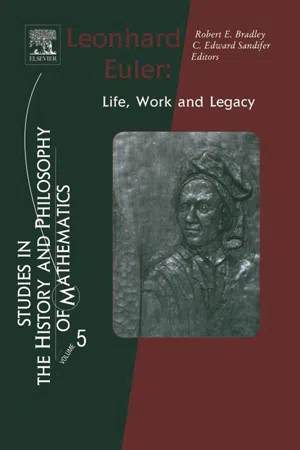
The year 2007 marks the 300th anniversary of the birth of one of the Enlightenment's most important mathematicians and scientists, Leonhard Euler. This volume is a collection of 24 essays by some of the world's best Eulerian scholars from seven different countries about Euler, his life and his work. Some of the essays are historical, including much previously unknown information about Euler's life, his activities in the St. Petersburg Academy, the influence of the Russian Princess Dashkova, and Euler's philosophy. Others describe his influence on the subsequent growth of European mathematics and physics in the 19th century. Still others give technical details of Euler's innovations in probability, number theory, geometry, analysis, astronomy, mechanics and other fields of mathematics and science.- Over 20 essays by some of the best historians of mathematics and science, including Ronald Calinger, Peter Hoffmann, Curtis Wilson, Kim Plofker, Victor Katz, Ruediger Thiele, David Richeson, Robin Wilson, Ivor Grattan-Guinness and Karin Reich- New details of Euler's life in two essays, one by Ronald Calinger and one he co-authored with Elena Polyakhova- New information on Euler's work in differential geometry, series, mechanics, and other important topics including his influence in the early 19th century
Trusted by 375,005 students
Access to over 1.5 million titles for a fair monthly price.
Cyclotomy: From Euler through Vandermonde to Gauss
Olaf Neumann Mathematisches Institut, Friedrich-Schiller-Universität Jena, D-07737 Jena Germany
The word “cyclotomy” is of Greek origin and means “division of the circle.” As a mathematical term it denotes the subdivision of a full circle line into a given number of equal parts. Consider the unit circle x2 + y2 = 1 in the Euclidean plane with Cartesian coordinates (x, y). If this circle is divided into n equal parts beginning with the point (1, 0) then the other division points will have coordinates
where k runs from 1 to (n − 1). All those points form the edges of a regular n-sided polygon. It is well-known that by means of the imaginary quantity
one can prove the formula
(1)
which is usually called de Moivre’s formula. But in the form (1) it is due to Leonhard Euler (1707–1783), see [Euler 1748], cap. VIII. In particular, the n arguments
with 0 ≤ k ≤ n − 1 provide us with the n powers 1, ζn, ζn2, …, ζnn − 1 of the complex number
:
(2)
satisfying the equation
(3)
This means that Eqn. (3) has exactly n roots which are given in the transcendental form (2) and which are the powers of one of them, namely ζn. For these powers we shall adopt the name nth roots of unity common today among mathematicians. If the exponent i is prime to n then ζni...
Table of contents
Cover image
Title page
Table of Contents
Copyright page
Foreword
Introduction
Leonhard Euler: Life and Thought
Leonhard Euler and Russia
Princess Dashkova, Euler, and the Russian Academy of Sciences
Leonhard Euler and Philosophy
Images of Euler
Euler and Applications of Analytical Mathematics to Astronomy
Euler and Indian Astronomy
Euler and Kinematics
Euler on Rigid Bodies
Euler’s Analysis Textbooks
Euler and the Calculus of Variations
Euler, D’Alembert and the Logarithm Function
Some Facets of Euler’s Work on Series
The Geometry of Leonhard Euler
Cyclotomy: From Euler through Vandermonde to Gauss
Euler and Number Theory: A Study in Mathematical Invention
Euler and Lotteries
Euler’s Science of Combinations
The Truth about Königsberg
The Polyhedral Formula
On the Recognition of Euler among the French, 1790-1830
Euler’s Influence on the Birth of Vector Mechanics
Euler’s Contribution to Differential Geometry and its Reception
Euler’s Mechanics as a Foundation of Quantum Mechanics
Index
Frequently asked questions
Yes, you can cancel anytime from the Subscription tab in your account settings on the Perlego website. Your subscription will stay active until the end of your current billing period. Learn how to cancel your subscription
No, books cannot be downloaded as external files, such as PDFs, for use outside of Perlego. However, you can download books within the Perlego app for offline reading on mobile or tablet. Learn how to download books offline
Perlego offers two plans: Essential and Complete
Essential is ideal for learners and professionals who enjoy exploring a wide range of subjects. Access the Essential Library with 800,000+ trusted titles and best-sellers across business, personal growth, and the humanities. Includes unlimited reading time and Standard Read Aloud voice.
Complete: Perfect for advanced learners and researchers needing full, unrestricted access. Unlock 1.5M+ books across hundreds of subjects, including academic and specialized titles. The Complete Plan also includes advanced features like Premium Read Aloud and Research Assistant.
Both plans are available with monthly, semester, or annual billing cycles.
We are an online textbook subscription service, where you can get access to an entire online library for less than the price of a single book per month. With over 1.5 million books across 990+ topics, we’ve got you covered! Learn about our mission
Look out for the read-aloud symbol on your next book to see if you can listen to it. The read-aloud tool reads text aloud for you, highlighting the text as it is being read. You can pause it, speed it up and slow it down. Learn more about Read Aloud
Yes! You can use the Perlego app on both iOS and Android devices to read anytime, anywhere — even offline. Perfect for commutes or when you’re on the go. Please note we cannot support devices running on iOS 13 and Android 7 or earlier. Learn more about using the app
Yes, you can access Leonhard Euler by Robert E. Bradley,Ed Sandifer in PDF and/or ePUB format, as well as other popular books in Mathematics & Algebra. We have over 1.5 million books available in our catalogue for you to explore.