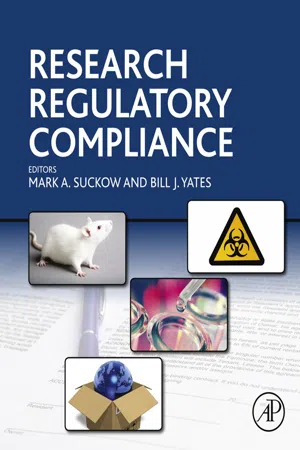
- 344 pages
- English
- ePUB (mobile friendly)
- Available on iOS & Android
eBook - ePub
Research Regulatory Compliance
About this book
Research Regulatory Compliance offers the latest information on regulations and compliance in the laboratory. With the increasing complexity of regulations and need for institutional infrastructure to deal with compliance of animal use issues, as well as a requirement surrounding human subjects, this publication provides reputable guidance and information.
The book is extremely helpful as a resource for researchers, administrators, and technicians in the laboratory, and is also a great asset for faculty or new researchers coming in to the laboratory environment. It will help prepare users for the deluge of regulatory and compliance issues they will face while conducting their scientific programs.
The book is edited and authored by known leaders in the field of compliance and regulations, and contains extensive research on the topics. It represents the new standard for information in every laboratory.
- Provides a "one-stop" , go-to resource for the many regulatory and compliance issues that affect laboratory study and research models
- Extremely helpful as a resource for researchers, administrators, and technicians in the laboratory, and also a great asset for faculty or new researchers coming in to the laboratory environment
- Focuses on United States regulations, covering both animal models and human subjects
- Written and edited by known leaders in the field of regulatory compliance who bring many years of collective experience to the book
Information
Topic
MedicineSubtopic
Endocrinology & MetabolismChapter 1
Human Subjects Research Protections
John R. Baumann, Heather Mullins-Owens, David Russell, and Amy Waltz Indiana University, Indianapolis and Bloomington, IN, USA
Abstract
The aim of this chapter is to present an overview of the history, processes, and selected issues related to the institutional oversight of human subjects research. Our beginning point is the human research protection program (HRPP). An HRPP encompasses all aspects and components of an institution involved in conduct and oversight of human subjects research—in other words, more than just the Institutional Review Board (IRB) or Research Ethics Committee (REC) itself. This chapter begins with a historical perspective—a discussion of some of the practices and processes that gave rise to our contemporary principles of, and processes for, human subject research protections. An overview of the regulatory context follows: review of the major regulatory mandates and the regulatory agencies as well as committees empowered to oversee and implement those mandates. The chapter concludes with a discussion of common challenges, mechanisms for addressing or preventing noncompliance issues, and, finally, a discussion of some of the issues that may shape the future directions of human subjects protection.
Keywords
Belmont Report; HRPP; Human subjects research; Noncompliance; Nuremberg code; Syphilis study1. Introduction
A researcher from the school of business seeks to enroll students in a study to assess variables that might influence levels of risk tolerance and aversion.
An anthropologist proposes an ethnographic study of disruptions in a local market in a Mexican community on the opening of a “big box” store in the near vicinity.
An oncologist proposes a study to test the safety of an investigational new drug (drug C) in patients with multiple myeloma. Patients participating in the study will receive either Treatment Arm 1 (drugs O, L, and D) or Treatment Arm 2 (drugs O, C, and D). The chances of being assigned to either treatment are approximately 50/50.
A sociologist proposes a mixed methods study to assess the impact of a recent hurricane on the city’s pattern of illegal drug use and illegal drug markets. Similar research will take place in two surrounding communities to which residents were re-located.
A physician-researcher proposes to access the electronic medical records of all patients undergoing a new presurgical preparation procedure to determine whether they have better outcomes than patients who do not undergo the procedure.
A school of education professor seeks to explore the relative effectiveness of three pedagogical approaches for teaching language arts to elementary school students.
A psychologist is funded to investigate and further develop a new approach for reducing “burn out” among the professional and paraprofessional staff of substance abuse and mental health service agencies.
The research studies summarized above are all very different from one another: different subject populations, different academic disciplines, different procedures, different methodologies, operating from different paradigms, and so on. However, they share one crucial factor: They are each an example of human subject research that requires the research team to submit their project to their institution’s human research protection program (HRPP) for review and approval in advance of initiation.
The aim of this chapter is to present an overview of the history, processes, and selected issues related to the institutional oversight of human subjects research. Our beginning point is the HRPP. An HRPP encompasses all aspects and components of an institution involved in conduct and oversight of human subject research—in other words, more than just the institutional review board (IRB) or research ethics committee (REC) itself. The organization perhaps most in the forefront of developing the idea of an HRPP is the Association for the Accreditation of Human Research Protection Programs (AAHRPP). AAHRPP describes an HRPP (http://www.aahrpp.org/learn/accreditation/goals-principles-standards) as consisting of:
• The organization. By organization, AAHRPP is referring to more than the office that receives studies for IRB review, sometimes named the IRB office, human subjects office, or compliance office. It refers, rather to a host of administrative components and features of organizational culture and practice in addition to that office. This may include, but is not limited to: the institutional official, other compliance committees (such as conflict of interest and radiation safety), grant/contracts office, pharmacy, and a host of activities beyond the review of individual studies.
• The IRB or REC itself. This is the specific group of individuals that has the responsibility and authority to review and approve, disapprove, or table human subject research studies.
• The researchers. These are researchers and research staff who are responsible for, and involved, in the design, conduct, and reporting of human subject research.
This chapter begins with a historical perspective—a discussion of some of the practices and processes that gave rise to our contemporary principles of, and processes for, human subject research protections. An overview of the regulatory context follows: review of the major regulatory mandates, the regulatory agencies, and committees empowered to oversee and implement those mandates. The chapter concludes with a discussion of common challenges, mechanisms for addressing or preventing noncompliance issues, and, finally, a discussion of some of the issues that may shape the future directions of human subject protection.
2. Historical Perspectives
2.1. Recognition of Need
The practice of research on humans is, of course, long standing. Even a quick review of medical history reveals countless examples of this. However, the formal idea and regulation of “human subjects research” is recent and was, like many such reforms, generated by a controversy. Serious ethical issues arising from the Tuskegee syphilis experiments in 1972 caused a moral outrage [1–3]. Congress was moved to act and in 1974 passed the National Research Act, which established the National Commission for the Protection of Human Subjects of Biomedical and Behavioral Research. From 1974 to 1978, the commission issued several reports related to biomedical and behavioral research with human subjects, culminating in 1979 with their final, formal report known as the Belmont Report, named after the conference room in which they met [4]. The Belmont Report summarized the basic ethical principles and corresponding guidelines that the commission recognized for the conduct of human experimentation. Principles and codes addressing the conduct of human subject research have existed in various forms and have been followed by a variety of organizations since the mid 1940s, but the Belmont Report has arguably had the greatest effect on human subject research protections in the United States.
The Belmont Report’s ethical principles and guidelines address key areas of concern following the aforementioned Tuskegee syphilis study. Officially known as the Tuskegee Study of Untreated Syphilis in the Negro Male, the study was sponsored by the United States Public Health Service and was conducted between 1932 and 1972. As the title suggests, the study aimed to follow the progression of untreated syphilis in the human body with a target study population of black males. Subjects infected with syphilis, and some who were not infected, were recruited into the study with the promise of medical care, free food, and burial insurance. The subjects were not informed of the true nature of the procedures to which they agreed and were told only that they were being treated for “bad blood” [1–3]. The researchers deliberately withheld penicillin and other treatments that were developed during the course of the study from the subjects so they could monitor and document the progression of the disease. As both a direct and indirect consequence, subjects experienced psychological/cognitive distress, physical deficiencies, and even death. Further, the disease may well have been transmitted to sexual partners and children born to research participants.
The core principles and practices identified in the Belmont Report were central to the public outcry regarding the overall conduct of this research and the treatment of the research subjects: patient autonomy, lack of informed consent, the direct harm done to subjects due to withholding medical care, and the unequal/inequitable distribution of research risks on one segment of the population. The Belmont Report identified three key ethical principles for the practice of human subject research: respect for persons, beneficence, and justice. Emerging from these three principles were three guidelines for their implementation or actualization: informed consent, assessment of risk and benefit, and equitable sharing of the burdens and benefits of research [4,5].
Respect for persons specifically addresses patient autonomy and requires that, as autonomous beings, subjects should be afforded the right to be informed of the procedures being performed in the research in which they are asked to participate and that their participation be voluntary. The Belmont Report describes an autonomous human being as one capable of self-determination and consideration of a variety of choices based on information provided to them. The full application of this principle, through informed consent, involves the provision of all relevant information, the confirmation that this information is comprehended and understood, and the ensuring of voluntary participation, or not, based on the potential subject’s choice.
Just as the autonomy of each person is recognized, the commission also recognized the necessity of protections for persons with diminished autonomy. Individuals who are incapacitated, ill, mentally disabled, immature, or are otherwise vulnerable to undue influence or coercion may have diminished autonomy requiring special care when including them in research—known as “vulnerable populations.” This care involves ongoing evaluation of their awareness of the consequences of participation, assessment of the subjects’ voluntariness, and protections to prevent coercion. It is the responsibility of the researchers to ensure patient autonomy is preserved and potentially to remove a subject from research if this cannot be established.
Beneficence refers to the prospective risks and harms that a research subject may face by participating in a study with the prospective benefits that may arise from the research for either the subject or, more generally, society with the development of new knowledge. For the Belmont committee, it addressed the direct harm done to the subjects in the Tuskegee syphilis study. By withholding medical care, specifically penicillin, the participants in this study were denied care that otherwise would have been available to them were they not research subjects. Penicillin was established as the standard treatment for syphilis in 1947, approximately 15 years after the initiation of this study; however, the subjects were denied this treatment, and the study continued for another 25 years. For these subjects, participation was actually maleficent, which is contrary to the very precepts of the practice of medicine and the principle of beneficence. The Belmont Report extends this precept of medicine into human subject research with the two prongs of beneficence: 1) to do no harm to subjects; and 2) if harm/risk is unavoidable, to maximize benefit while minimizing possible harm. The report acknowledged that individual research subjects may not directly benefit from their participation, but their inclusion in the study must still be justifiable in consideration of the benefits to be gained and possible risks. An evaluation should be made of the ratio of potential risks to potential benefits. There is, of course, some tension between this and the principle implicit in respect for persons. Respect for persons and autonomy require that researchers do not treat subjects as “means” to an “end,” but the assessment of risks/harm against possible benefits implies some dimension of this, especially when there is no direct benefit for the subjects and the only benefits are advancement of knowledge. The practice of informed consent, however, is designed to mitigate this tension.
The principle of justice addresses the unequal distribution of the burdens and risks of participation in research on subject populations in general, as illustrated by the inequitable inclusion of only the black male population in the Tuskegee syphilis study. This principle seeks to address the fairness of the distribution of research risks and possible benefits and to prevent injustice. There is no question that the rural black male population was exploited and manipulated in this study. Similarly, prisoners, the poor, and institutionalized individuals have been exploited in various other research studies throughou...
Table of contents
- Cover image
- Title page
- Table of Contents
- Copyright
- Contributors
- Preface
- Chapter 1. Human Subjects Research Protections
- Chapter 2. Investigational New Drug and Device Exemption Process
- Chapter 3. The Institutional Animal Care and Use Committee
- Chapter 4. Biological Hazards and Select Agents
- Chapter 5. Radiological Hazards and Lasers
- Chapter 6. Controlled Substances: Maintaining Institutional Compliance
- Chapter 7. Export Controls and US Research Universities
- Chapter 8. Data Management and Research Integrity
- Chapter 9. Intellectual Property
- Chapter 10. Financial Conflicts of Interest in Research
- Chapter 11. Good Laboratory Practices (GLPs)
- Chapter 12. Human Embryonic Stem Cell Research Oversight: A Confluence of Voluntary Self-Regulation and Shifting Policy Initiatives
- Index
Trusted by 375,005 students
Access to over 1.5 million titles for a fair monthly price.
Study more efficiently using our study tools.
Frequently asked questions
Yes, you can cancel anytime from the Subscription tab in your account settings on the Perlego website. Your subscription will stay active until the end of your current billing period. Learn how to cancel your subscription
No, books cannot be downloaded as external files, such as PDFs, for use outside of Perlego. However, you can download books within the Perlego app for offline reading on mobile or tablet. Learn how to download books offline
Perlego offers two plans: Essential and Complete
- Essential is ideal for learners and professionals who enjoy exploring a wide range of subjects. Access the Essential Library with 800,000+ trusted titles and best-sellers across business, personal growth, and the humanities. Includes unlimited reading time and Standard Read Aloud voice.
- Complete: Perfect for advanced learners and researchers needing full, unrestricted access. Unlock 1.5M+ books across hundreds of subjects, including academic and specialized titles. The Complete Plan also includes advanced features like Premium Read Aloud and Research Assistant.
We are an online textbook subscription service, where you can get access to an entire online library for less than the price of a single book per month. With over 1.5 million books across 990+ topics, we’ve got you covered! Learn about our mission
Look out for the read-aloud symbol on your next book to see if you can listen to it. The read-aloud tool reads text aloud for you, highlighting the text as it is being read. You can pause it, speed it up and slow it down. Learn more about Read Aloud
Yes! You can use the Perlego app on both iOS and Android devices to read anytime, anywhere — even offline. Perfect for commutes or when you’re on the go.
Please note we cannot support devices running on iOS 13 and Android 7 or earlier. Learn more about using the app
Please note we cannot support devices running on iOS 13 and Android 7 or earlier. Learn more about using the app
Yes, you can access Research Regulatory Compliance by Mark A. Suckow,Bill Yates in PDF and/or ePUB format, as well as other popular books in Medicine & Endocrinology & Metabolism. We have over 1.5 million books available in our catalogue for you to explore.