- 576 pages
- English
- ePUB (mobile friendly)
- Available on iOS & Android
eBook - ePub
Semiconductor Gas Sensors
About this book
Semiconductor gas sensors have a wide range of applications in safety, process control, environmental monitoring, indoor or cabin air quality and medical diagnosis. This important book summarises recent research on basic principles, new materials and emerging technologies in this essential field.The first part of the book reviews the underlying principles and sensing mechanisms for n- and p-type oxide semiconductors, introduces the theory for nanosize materials and describes the role of electrode–semiconductor interfaces. The second part of the book describes recent developments in silicon carbide- and graphene-based gas sensors, wide bandgap semiconductor gas sensors and micromachined and direct thermoelectric gas sensors. Part 3 discusses the use of nanomaterials for gas sensing, including metal oxide nanostructures, quantum dots, single-alled carbon nanotubes and porous silicon. The final part of the book surveys key applications in environmental monitoring, detecting chemical warfare agents and monitoring gases such as carbon dioxide.Semiconductor gas sensors is a valuable reference work for all those involved in gas monitoring, including those in the building industry, environmental engineers, defence and security specialists and researchers in this field.
- Provides an overview of resistor and non-resistor sensors
- Reviews developments in gas sensors and sensing methods, including graphene based sensors and direct thermoelectric sensors
- Discusses the use of nanomaterials in gas sensing
Information
Part I
Introduction
1
Fundamentals of semiconductor gas sensors
N. Yamazoe and K. Shimanoe, Kyushu University, Japan
Abstract:
As an introduction to this book, a variety of semiconductor gas sensors is presented. They are classified into five types, according to the transducers used: resistor, diode, MIS (metal-insulator-semiconductor) capacitor, MIS FET (metal-insulator-semiconductor field effect transistor) and oxygen concentration cell. The structure, working principle and sensing mechanism are described for each type. As the only type successfully on the market at present, the resistor is allotted considerably more space than the alternative semiconductor gas sensors, with experimental knowledge and the theory of gas response described in detail. The receptor function of metal oxides recently found in resistors is also of critical importance in other types incorporating the same oxides; the contact potential generated between oxide and metal is likely a main origin of the gas response of those devices. Finally, observations on the prospects for and problems with semiconductor gas sensors are made.
Key words
gas sensor
semiconductive oxide
field effect transistor (FET)
depletion layer
contact potential
grain size effect
1.1 Introduction
Semiconductor gas sensors using metal oxides such as SnO2 were pioneered by two research groups in Japan.1,2 These sensors were soon put on the market as gas leak alarms and proved to be indispensable in keeping people safe from the distressing circumstances resulting from gas leaks. At the same time, their success had worldwide impact on researchers, creating awareness of the importance of gas sensors, or chemical sensors more generally. Great effort has subsequently been made in the development of new gas sensors, including those using silicon semiconductor devices and solid electrolytes devices. If the definition of a semiconductor gas sensor is a sensor into which a semiconductor material is incorporated, there is a variety of semiconductor gas sensors of varying structures, made of different materials and involving various working principles.
This introduction describes the fundamental aspects of the various semiconductor gas sensors that have been developed so far, or that are proposed. First, they are classified into five types, based on the constitutional principle of sensor devices (Section 1.2). The structure of devices, their working principles and sensing mechanisms are described in subsequent sections. However, the greatest space is devoted to describing experimental knowledge and the theory of gas response of the sensors based on resistors, which have been made full use of and which still have potential for further development. It has long been queried why sensors of this type are promoted with regard to their sensitivity, as the constituent oxides are smaller than in other types of device,3 though a semiempirical analysis has been attempted.4,5 This issue was recently resolved by developing a new theory on the receptor function of small-sized oxides.6,7 As revealed in the new theory, small semiconductors are depleted of electrons in two stages by a process of ionosorption of oxygen or oxidizing gases, resulting in the appearance of regional depletion followed by volume depletion. Gas response can be sufficiently understood based on the same theory. It is shown that the theory gives an important clue to understanding the gas response of oxides attached to potentiometric gas sensors (Section 1.5). The chapter closes with personal observations regarding semiconductor gas sensors (Section 1.6).
1.2 Classification of semiconductor gas sensors
Generally speaking, a gas sensor is composed of a receptor and a transducer, as illustrated in Fig. 1.1. The former is provided with a material or a materials system which, on interacting with a target gas, either induces a change in its own properties (work function, dielectric constant, electrode potential, mass, etc.), or emits heat or light. The transducer is a device to transform such an effect into an electrical signal (sensor response). The construction of a sensor is determined by the transducer used, with the receptor appearing to be implanted within it. From this perspective, a semiconductor gas sensor can be defined as a sensor in which a semiconductor material is used as a receptor and/or transducer.
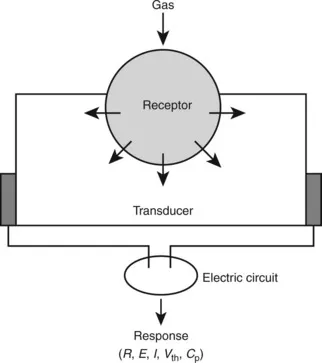
1.1 Gas sensor as constituted of a receptor and a transducer. R = resistance, E = electromotive force, I = current, Vth = threshold voltage (FET), Cp = capacitance.
There are two groups of semiconductors: oxide and non-oxide (typically, silicon). Non-oxide semiconductors cannot work as a receptor because they are coated with a protective insulation layer, but they can provide a transducer in the form of MIS FETs and MIS capacitors. In contrast, oxide semiconductors can work as both a receptor and a transducer (mostly in the form of a resistor) owing to their chemical and physical stability in hostile environments at elevated temperatures.
Table 1.1 shows various examples of semiconductor gas sensors classified according to the types of transducer used, and sub-classified by the kinds of receptor used, together with the kinds of signal output (response), typical sensor devices and the gases targeted. The transducers are seen to be available in the forms of resistors, diodes, MIS capacitors, MIS FETs or oxygen concentration cells. For each type of sensor thus classified, devices, sensing principles and the important features of semiconductor g...
Table of contents
- Cover image
- Title page
- Table of Contents
- Copyright
- Contributor contact details
- Woodhead Publishing Series in Electronic and Optical Materials
- Part I: Introduction
- Part II: Advanced sensing methods and structures
- Part III: Nanomaterials for gas sensing
- Part IV: Applications of semiconductor gas sensors
- Index
Trusted by 375,005 students
Access to over 1.5 million titles for a fair monthly price.
Study more efficiently using our study tools.
Frequently asked questions
Yes, you can cancel anytime from the Subscription tab in your account settings on the Perlego website. Your subscription will stay active until the end of your current billing period. Learn how to cancel your subscription
No, books cannot be downloaded as external files, such as PDFs, for use outside of Perlego. However, you can download books within the Perlego app for offline reading on mobile or tablet. Learn how to download books offline
Perlego offers two plans: Essential and Complete
- Essential is ideal for learners and professionals who enjoy exploring a wide range of subjects. Access the Essential Library with 800,000+ trusted titles and best-sellers across business, personal growth, and the humanities. Includes unlimited reading time and Standard Read Aloud voice.
- Complete: Perfect for advanced learners and researchers needing full, unrestricted access. Unlock 1.5M+ books across hundreds of subjects, including academic and specialized titles. The Complete Plan also includes advanced features like Premium Read Aloud and Research Assistant.
We are an online textbook subscription service, where you can get access to an entire online library for less than the price of a single book per month. With over 1.5 million books across 990+ topics, we’ve got you covered! Learn about our mission
Look out for the read-aloud symbol on your next book to see if you can listen to it. The read-aloud tool reads text aloud for you, highlighting the text as it is being read. You can pause it, speed it up and slow it down. Learn more about Read Aloud
Yes! You can use the Perlego app on both iOS and Android devices to read anytime, anywhere — even offline. Perfect for commutes or when you’re on the go.
Please note we cannot support devices running on iOS 13 and Android 7 or earlier. Learn more about using the app
Please note we cannot support devices running on iOS 13 and Android 7 or earlier. Learn more about using the app
Yes, you can access Semiconductor Gas Sensors by Raivo Jaaniso,Ooi Kiang Tan in PDF and/or ePUB format, as well as other popular books in Technology & Engineering & Electrical Engineering & Telecommunications. We have over 1.5 million books available in our catalogue for you to explore.