This book develops the thesis that structure and function in a variety of condensed systems - from the atomic assemblies in inorganic frameworks and organic molecules, through molecular self-assemblies to proteins - can be unified when curvature and surface geometry are taken together with molecular shape and forces. An astonishing variety of synthetic and biological assemblies can be accurately modelled and understood in terms of hyperbolic surfaces, whose richness and beauty are only now being revealed by applied mathematicians, physicists, chemists and crystallographers. These surfaces, often close to periodic minimal surfaces, weave and twist through space, carving out interconnected labyrinths whose range of topologies and symmetries challenge the imaginative powers.The book offers an overview of these structures and structural transformations, convincingly demonstrating their ubiquity in covalent frameworks from zeolites used for cracking oil and pollution control to enzymes and structural proteins, thermotropic and lyotropic bicontinuous mesophases formed by surfactants, detergents and lipids, synthetic block copolymer and protein networks, as well as biological cell assemblies, from muscles to membranes in prokaryotic and eukaryotic cells. The relation between structure and function is analysed in terms of the previously neglected hidden variables of curvature and topology. Thus, the catalytic activity of zeolites and enzymes, the superior material properties of interpenetrating networks in microstructured polymer composites, the transport requirements in cells, the transmission of nerve signals and the folding of DNA can be more easily understood in the light of this.The text is liberally sprinkled with figures and colour plates, making it accessible to both the beginning graduate student and researchers in condensed matter physics and chemistry, mineralogists, crystallographers and biologists.
This book deals with shape and form, and especially the role of curvature in the natural sciences. Our search is for a connection between structure and function posed by D’Arcy Thompson in his famous book “On Growth and Form” [1] almost a century ago. Our theme will be that curvature, a neglected dimension, is central. Some of the curved surfaces that will preoccupy us and recur are shown in the Appendix to this Chapter. The reader is invited to pursue them at once. They are not just computer generated art or mathematical abstractions, and will be seen later to be ubiquitous in nature. They represent situations as diverse as:
• equipotential surfaces dividing space between the atoms of a crystal
• real structures formed spontaneously by the constituent molecules of biological membranes
• the shapes of bio-macromolecules, from proteins to starch
Euclidean geometry underlies practically all of science and our intuition has depended on it. The shapes provided: planes, cylinders, spheres, polyhedra, all have constant or even zero curvature. Only in theoretical physics, in subjects like general relativity where the curvature of space-time is essential, has non-Euclidean geometry and especially so-called hyperbolic geometry played any part in the scheme of things. The scientific community has been prepared to leave such matters to physicists alone. It can do so no longer, and the idea of curvature is becoming an essential tool to the understanding of many phenomena.
This Chapter is concerned with some of the mathematical tools required to describe special properties of curved surfaces. The tools are to be found in differential geometry, analytical function theory, and topology. General references can be found at the end of the Chapter. The reader uninterested in the mathematics can skip the equations and their development. The ideas we want to focus on will be clear enough in the text. A particular class of saddle-shaped (hyperbolic) surfaces called minimal surfaces will be treated with special attention since they are relatively straightforward to treat mathematically and do form good approximate representations of actual physical and chemical structures.
1.2 Curvature
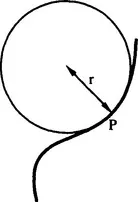
The concept of curvature was developed by Isaac Newton in the middle of the 17th century, as a natural extension to his work on the calculus. At that time, the determination of the perimeter of planar curves and the area under curves were major problems. In particular, Newton’s new analytical tools allowed him to determine the “quadrature” (area) of a circle. It occurred to Newton that the radius of the circle of best fit to an arbitrary planar curve at all points on the curve was a useful measure, for which he coined the term “crookedness”[2]. This is curvature (Fig. 1.1).
Figure 1.1 The curvature of a planar curve at a point (P) is equal to the reciprocal of the radius of the circle of best fit to the curve at P, r.
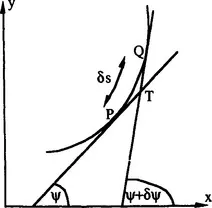
The curvature of a planar curve relates arc length along the curve to changes of tangent vector (Fig. 1.2).
Figure 1.2 Tangents TP and QT at two points, P and Q, on a planar curve.
The tangents TP and QT in Fig. 1.2 subtend angles ψ, ψ+δψ with the x-axis, so that δψ is the angle between the two tangents. If δs is the length of the arc PQ along the curve, then
is the average curvature of the planar curve along the arc PQ. The curvature at the point P is defined to be the limit of this expression as Q approaches P, i.e.
If PQ is the arc of a circle of radius r, the angle δψ between the tangents at P and Q is equal to the angle subtended at the centre of the circle by the arc PQ, so that δs=rδψ, whence
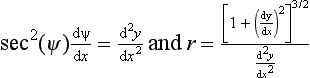
. The curvature is constant at all points of a circle, and the radius is equal to the reciprocal of the curvature (Fig. 1.1). If the curve is described in cartesian coordinates by a function y=y(x):
so that:
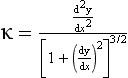
The curvature, κ, is thus given by the expression:
(1.1)
If the positive value of the root of the denominator is taken, the sign of the curvature will be the same as that of
; i.e. positive if the curve lies above the tangent, and negative below it. At a point of inflection (or a straight line),
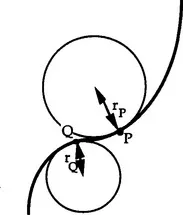
is zero and therefore the curvature is zero in these cases. The sign of the curvature signifies the convex or concave nature of the curve. It is also related to the side of the curve at which the centre of the circle of best fit is located (cf. Fig. 1.3).
Figure 1.3 The radii of curvature, rP and rQ at two points, P and Q, on a planar curve. The centres of the circles of best fit to the curve at P and Q lie on opposite sides of the curve and the curvature changes sign at the point of inflection on the curve between these points. The curvature at Q is positive and at P it is negative.
1.3 The differential geometry of surfaces
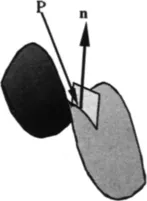
The curvatures of a surface are more complex entities, but can be understood as a generalisation of the curvature of planar curves. Imagine a plane containing a point P on the (smooth) surface, which contains the vector (n) passing through P, normal to the surface (Fig. 1.4).
Figure 1.4 The intersection of a surface with the plane...
Table of contents
Cover image
Title page
Table of Contents
Copyright
Acknowledgments
Preface
Chapter 1: The Mathematics of Curvature
Chapter 2: The Lessons of Chemistry
Chapter 3: Molecular Forces and Self-Assembly
Chapter 4: Beyond Flatland: The Geometric Forms due to Self-Assembly
Chapter 5: Lipid Self-Assembly and Function In Biological Systems
Chapter 6: Folding and Function In Proteins and DNA
Chapter 7: Cytomembranes and Cubic Membrane Systems Revisited
Chapter 8: Some Miscellaneous Speculations
Index (All names are capitalised.)
Trusted by 375,005 students
Access to over 1.5 million titles for a fair monthly price.
Study more efficiently using our study tools.
Frequently asked questions
Yes, you can cancel anytime from the Subscription tab in your account settings on the Perlego website. Your subscription will stay active until the end of your current billing period. Learn how to cancel your subscription
No, books cannot be downloaded as external files, such as PDFs, for use outside of Perlego. However, you can download books within the Perlego app for offline reading on mobile or tablet. Learn how to download books offline
Perlego offers two plans: Essential and Complete
Essential is ideal for learners and professionals who enjoy exploring a wide range of subjects. Access the Essential Library with 800,000+ trusted titles and best-sellers across business, personal growth, and the humanities. Includes unlimited reading time and Standard Read Aloud voice.
Complete: Perfect for advanced learners and researchers needing full, unrestricted access. Unlock 1.5M+ books across hundreds of subjects, including academic and specialized titles. The Complete Plan also includes advanced features like Premium Read Aloud and Research Assistant.
Both plans are available with monthly, semester, or annual billing cycles.
We are an online textbook subscription service, where you can get access to an entire online library for less than the price of a single book per month. With over 1.5 million books across 990+ topics, we’ve got you covered! Learn about our mission
Look out for the read-aloud symbol on your next book to see if you can listen to it. The read-aloud tool reads text aloud for you, highlighting the text as it is being read. You can pause it, speed it up and slow it down. Learn more about Read Aloud
Yes! You can use the Perlego app on both iOS and Android devices to read anytime, anywhere — even offline. Perfect for commutes or when you’re on the go. Please note we cannot support devices running on iOS 13 and Android 7 or earlier. Learn more about using the app
Yes, you can access The Language of Shape by S. Hyde,Z. Blum,T. Landh,S. Lidin,B.W. Ninham,S. Andersson,K. Larsson in PDF and/or ePUB format, as well as other popular books in Scienze fisiche & Geometria differenziale. We have over 1.5 million books available in our catalogue for you to explore.