- 122 pages
- English
- ePUB (mobile friendly)
- Available on iOS & Android
eBook - ePub
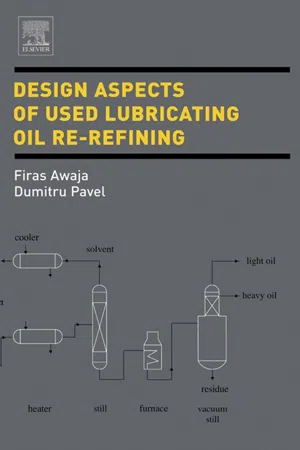
Design Aspects of Used Lubricating Oil Re-Refining
About this book
Design Aspects of Used Lubricating Oil Re-Refining presents a feasible and comprehensive technology for recycling of used lubricating oils. This book discusses efficient and effective ways of reusing lubricating oil which, if implemented, will result in a better quality of life, the stability of the environment, the health of national economies and better relationships between nations. It presents essential experimental results for process designers and engineers to establish a complete process design. The conditions and behaviour in each step in the re-refining process, (dehydration, solvent extraction, solvent stripping, and vacuum distillation) are examined in order to discover ways to recover and reuse wastes that are produced by lubricating oils.
- Addresses and demonstrates the current knowledge of the process behaviour and re-refining technology of used lubricating oils
- Introduces background information on the lubrication, oil recycling industry outlining the major manufacturers and detailing their processes
- Contains 94 figures and 22 tables that on results regarding the re-refining process behaviour of used lubricating oil
Information
Subtopic
Environmental ScienceIndex
Biological SciencesChapter 1
Introduction
Publisher Summary
The processes of re-refining of used lubricating oils depend greatly on the nature of the oil base stock and on the nature and amount of contaminants in the lubricant resulting from operations. The contaminants are introduced either from the surrounding air and from the engine, which are called extraneous contaminants, or from the products of oil deterioration. These contaminants has to be totally removed in order to reuse the lubricating oil and the processes for recovery of used oil vary from simple settling or filtration to solvent extraction or vacuum distillation or a combination of these and other processes. This chapter aims at investigating a process of solvent extraction of an alcohol–ketone mixture as a pretreatment step followed by vacuum distillation. The primary step is conducted before the solvent extraction involving dehydration for removing the water and fuel contaminants from the used oil. The solvent extraction and vacuum distillation steps are used to remove higher molecular weight contaminants. Experiments are conducted on an Iraqi mixed base stock used lubricating oil to produce lubricating cuts free of contaminants.
The processes of re-refining of used lubricating oils depend greatly on the nature of the oil base stock and on the nature and amount of contaminants in the lubricant resulting from operations. The contaminants are introduced either from the surrounding air and from the engine, which are called extraneous contaminants, or from the products of oil deterioration. These contaminants must be totally removed in order to reuse the lubricating oil. Processes for recovery of used oil vary from simple settling or filtration to solvent extraction or vacuum distillation or a combination of these and other processes.
Preliminary study of Iraqi used lubricating oil did not involve pre-treatment steps before distillation, while international studies show complete processes that involve pre-treatment, vacuum distillation and finishing steps such as clay contacting, hydro treating and blending. Neither the distillation behaviors nor optimum procedures to evaluate the operating conditions were reported by literatures for refining used oil. Iraqi lubricating oil properties differ from western lubricating oil properties; therefore, it was not possible to compare their process operating conditions.
This study aims to investigate a process of solvent extraction of an alcohol–ketone mixture as a pre-treatment step followed by vacuum distillation. The primary step was conducted before the solvent extraction that involves dehydration to remove the water and fuel contaminants from the used oil. The solvent extraction and vacuum distillation steps were used to remove higher molecular weight contaminants. Experiments were conducted on an Iraqi mixed base stock used lubricating oil to produce lubricating cuts free of contaminants. Recovered lubricating cut can be blended with original lubricating cuts from the refinery. Additives may be used to improve the quality of re-refined lubricating oil.
Chapter 2
Background
Publisher Summary
This chapter focuses on the characteristics of virgin lubricating oil and the used lubricating oil. Automotive lubricating oil is made by introducing proper additives to lubricating oil cuts manufactured from paraffin or mixed-base crude oils. The main functions of lubricating oil include reducing friction, carrying away heat, protecting against rust, protecting against wear and removing contaminants from the engine. The main additives used for lubricating oil are oxidation inhibitor, detergent and dispersant additives, viscosity index improvers, and pour point depressants. The automotive lubricating oil loses its effectiveness during operation due to the presence of various types of contaminants. Extraneous contaminants are introduced from the surrounding air and by metallic particles from the engine. Contaminants from the air are dust, dirt, and moisture that may cause foaming of the oil. The contaminants from the engine include metallic particles resulting from wear of the engine, carbonaceous particles due to incomplete fuel combustion, and metallic oxides present as corrosion products of metals. The chapter presents several physical and chemical processes employed for reclamation, re-refining, and reprocessing of used lubricating oils. The earliest process is known as the acid–clay treatment process involving the mixing of the used oil with 93 to 98% sulfuric acid. An alternate process using dehydration, distillation, and hydro finishing was developed by the national oil recovery corporation (NORCO, USA) in 1969, in which the feed oil passes through a flash furnace and a tower to separate water and gasoline fractions. The oil is then heated up to 360–370o C and passed to vacuum fractionators operating at 400o C and 34 mBar. The column then separates the oil into light and heavy oil products.
2.1 Virgin Oil Characteristics
Automotive lubricating oil is made by introducing proper additives to lubricating oil cuts manufactured from paraffin or mixed-base crude oils (Nelson, 1964; Forbes and Neustadter, 1972). The main functions of lubricating oil include reducing friction, carrying away heat, protecting against rust, protecting against wear and removing contaminants from the engine. A typical blend of lubricating oil is shown in Table 2.1. Table 2.2 shows the typical properties of virgin crankcas...
Table of contents
- Cover image
- Title page
- Table of Contents
- Preface
- Chapter 1: Introduction
- Chapter 2: Background
- Chapter 3: Experimental Methods
- Chapter 4: The Re-refining Process Experimental Results
- Chapter 5: Conclusions
- Appendix A: Distribution Coefficient
- Appendix B: Optimization Program
- Appendix C: Re-refining Process Diagrams
- References
- Subject Index
Trusted by 375,005 students
Access to over 1.5 million titles for a fair monthly price.
Study more efficiently using our study tools.
Frequently asked questions
Yes, you can cancel anytime from the Subscription tab in your account settings on the Perlego website. Your subscription will stay active until the end of your current billing period. Learn how to cancel your subscription
No, books cannot be downloaded as external files, such as PDFs, for use outside of Perlego. However, you can download books within the Perlego app for offline reading on mobile or tablet. Learn how to download books offline
Perlego offers two plans: Essential and Complete
- Essential is ideal for learners and professionals who enjoy exploring a wide range of subjects. Access the Essential Library with 800,000+ trusted titles and best-sellers across business, personal growth, and the humanities. Includes unlimited reading time and Standard Read Aloud voice.
- Complete: Perfect for advanced learners and researchers needing full, unrestricted access. Unlock 1.5M+ books across hundreds of subjects, including academic and specialized titles. The Complete Plan also includes advanced features like Premium Read Aloud and Research Assistant.
We are an online textbook subscription service, where you can get access to an entire online library for less than the price of a single book per month. With over 1.5 million books across 990+ topics, we’ve got you covered! Learn about our mission
Look out for the read-aloud symbol on your next book to see if you can listen to it. The read-aloud tool reads text aloud for you, highlighting the text as it is being read. You can pause it, speed it up and slow it down. Learn more about Read Aloud
Yes! You can use the Perlego app on both iOS and Android devices to read anytime, anywhere — even offline. Perfect for commutes or when you’re on the go.
Please note we cannot support devices running on iOS 13 and Android 7 or earlier. Learn more about using the app
Please note we cannot support devices running on iOS 13 and Android 7 or earlier. Learn more about using the app
Yes, you can access Design Aspects of Used Lubricating Oil Re-Refining by Firas Awaja,Dumitru Pavel in PDF and/or ePUB format, as well as other popular books in Biological Sciences & Environmental Science. We have over 1.5 million books available in our catalogue for you to explore.