- 920 pages
- English
- ePUB (mobile friendly)
- Available on iOS & Android
eBook - ePub
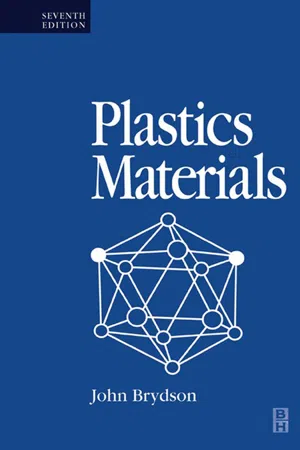
Plastics Materials
About this book
The seventh edition of this classic reference work once more provides a comprehensive overview of commercially available plastics materials. Bridging the gap between theory and practice, it enables scientists to understand the commercial implications of their work as well as providing technologists with a theoretical background.Since the previous edition, several new materials have been announced. Many of these materials result from metallocene catalyst technology. In addition, developments also continue with condensation polymers with several new polyester type materials of interest for bottle-blowing and/or degradable plastics. New phenolic-type resins have also been announced. As with previous editions, an explanation of the properties of these new materials in terms of their structure and morphology involving the principles laid down in the earlier chapters is presented.
Information
Table of contents
- Cover image
- Title page
- Table of Contents
- Copyright
- Preface to the Seventh Edition
- Preface to the First Edition
- Acknowledgements for the Seventh Edition
- Abbreviations for Plastics and Rubbers
- Chapter 1: The Historical Development of Plastics Materials
- Chapter 2: The Chemical Nature of Plastics
- Chapter 3: States of Aggregation in Polymers
- Chapter 4: Relation of Structure to Thermal and Mechanical Properties
- Chapter 5: Relation of Structure to Chemical Properties
- Chapter 6: Relation of Structure to Electrical and Optical Properties
- Chapter 7: Additives for Plastics
- Chapter 8: Principles of the Processing of Plastics
- Chapter 9: Principles of Product Design
- Chapter 10: Polyethylene
- Chapter 11: Aliphatic Polyolefins other than Polyethylene, and Diene Rubbers
- Chapter 12: Vinyl Chloride Polymers
- Chapter 13: Fluorine-containing Polymers
- Chapter 14: Poly(vinyl acetate) and its Derivatives
- Chapter 15: Acrylic Plastics
- Chapter 16: Plastics Based on Styrene
- Chapter 17: Miscellaneous Vinyl Thermoplastics
- Chapter 18: Polyamides and Polyimides
- Chapter 19: Polyacetals and Related Materials
- Chapter 20: Polycarbonates
- Chapter 21: Other Thermoplastics Containing p-Phenylene Groups
- Chapter 22: Cellulose Plastics
- Chapter 23: Phenolic Resins
- Chapter 24: Aminoplastics
- Chapter 25: Polyesters
- Chapter 26: Epoxide Resins
- Chapter 27: Polyurethanes and Polyisocyanurates
- Chapter 28: Furan Resins
- Chapter 29: Silicones and Other Heat-resisting Polymers
- Chapter 30: Miscellaneous Plastics Materials
- Chapter 31: Selected Functional Polymers
- Chapter 32: Material Selection
- Appendix: A Short List of Additional Information Sources
- Index
Trusted by 375,005 students
Access to over 1.5 million titles for a fair monthly price.
Study more efficiently using our study tools.
Frequently asked questions
Yes, you can cancel anytime from the Subscription tab in your account settings on the Perlego website. Your subscription will stay active until the end of your current billing period. Learn how to cancel your subscription
No, books cannot be downloaded as external files, such as PDFs, for use outside of Perlego. However, you can download books within the Perlego app for offline reading on mobile or tablet. Learn how to download books offline
We are an online textbook subscription service, where you can get access to an entire online library for less than the price of a single book per month. With over 1.5 million books across 990+ topics, we’ve got you covered! Learn about our mission
Look out for the read-aloud symbol on your next book to see if you can listen to it. The read-aloud tool reads text aloud for you, highlighting the text as it is being read. You can pause it, speed it up and slow it down. Learn more about Read Aloud
Yes! You can use the Perlego app on both iOS and Android devices to read anytime, anywhere — even offline. Perfect for commutes or when you’re on the go.
Please note we cannot support devices running on iOS 13 and Android 7 or earlier. Learn more about using the app
Please note we cannot support devices running on iOS 13 and Android 7 or earlier. Learn more about using the app
Yes, you can access Plastics Materials by J A Brydson in PDF and/or ePUB format, as well as other popular books in Technology & Engineering & Materials Science. We have over 1.5 million books available in our catalogue for you to explore.