- 286 pages
- English
- ePUB (mobile friendly)
- Available on iOS & Android
eBook - ePub
Non-Bovine Milk and Milk Products
About this book
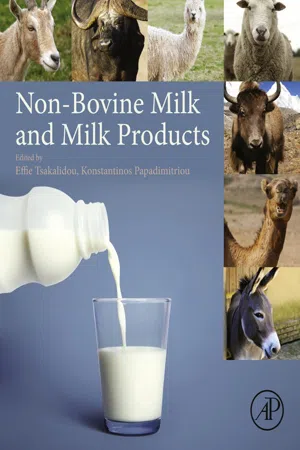
Non-Bovine Milk and Milk Products presents a compiled and renewed vision of the knowledge existing as well as the emerging challenges on animal husbandry and non-cow milk production, technology, chemistry, microbiology, safety, nutrition, and health, including current policies and practices. Non-bovine milk products are an expanding means of addressing nutritional and sustainable food needs around the world. While many populations have integrated non-bovine products into their diets for centuries, as consumer demand and acceptance have grown, additional opportunities for non-bovine products are emerging. Understanding the proper chain of production will provide important insight into the successful growth of this sector. This book is a valuable resource for those involved in the non-cow milk sector, e.g. academia, research institutes, milk producers, dairy industry, trade associations, government, and policy makers.
- Discusses important social, economic, and environmental aspects of the production and distribution of non-bovine milk and milk products
- Provides insight into non-bovine milk from a broad range of relevant perspectives with contributions from leading researchers around the world
- Focuses on current concerns including animal health and welfare, product safety, and production technologies
- Serves as a valuable resource for those involved in the non-cow milk sector
Information
Chapter 1
Food Security and the Role of Local Communities in Non-cow Milk Production
B. Faye UMR SELMET, CIRAD-ES, Montpellier, France
Abstract
Cow is the dominant species for providing milk to humans, but other dairy species (eg, buffalo, goat, sheep, camel, yak, horse and donkey, reindeer, and occasionally lama) provide 15% of the world’s milk supply. Non-cow milk is mainly collected in low-input systems managed by local communities, contributing to the food security of unproductive areas such as desert, steppe, high mountains, swamps, or polar zones. The organoleptic properties and physico-chemical composition of non-cow milk and its potential health benefits could contribute to food security and environmental preservation. Non-cow milk production systems include all types of farming systems from extensive to traditional, with low input and high mobility, to highly intensive production processes with indoor milking units. Improvement of productivity for non-cow dairy species, better milking hygiene in local communities, and diversification of dairy products are among the most important challenges for this sector.
Keywords
Farming system; Food security; Milk processing; Milk productivity; Non-cow milk1. Introduction
Among the 2000 species of mammals producing milk, only 10 are used regularly or exceptionally for providing milk to humans. Besides the cow, which provides 85% of the milk produced in the world (FAOstat, 2015), buffalo (10.7%), goat (2.4%), sheep (1.4%), and camel (0.4%) are the most important dairy animals. In spite of their regular use for milk production, there is no data regarding yak. Horse, donkey, reindeer, and lama (Skenneberg, 1984; Morin et al., 1995) are not commonly used and thus do not change the global statistics.
While the total quantity of non-cow milk (NCM) is a small part of the total quantity of milk consumed in the world, non-cow dairy species provided 110 million tons of milk in 2013 (FAOstat, 2015), notably in remotes areas. Thus the contribution of NCM to food security is important, especially since it is produced by households in low-input farming systems, and except for small ruminants, only in southern countries.
The objective of the present chapter is (i) to assess the importance of the non-cow dairy species and of the NCM in the food security, (ii) to provide short description of the farming systems producing NCM, and (iii) to discuss the role of small farmers in the production of NCM and its use in local, national, and international markets.
2. The Contribution of Non-cow Milk to Food Security
2.1. Quantitative Importance of Non-cow Milk
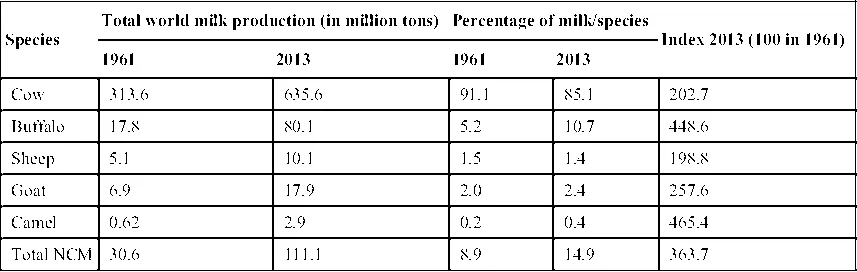
As a whole, NCM species provided 30.6 million tons of milk in 1961 (first available FAO statistics). Although it comprised a relatively low percentage of total milk available for human consumption, the growth of NCM is important (Faye and Konuspayeva, 2012a). In 2013 dairy cow production was double what it was in 1961 (×2.03), and NCM more than tripled (×3.64) 1961 data, with all non-cow species having higher growth than cow except sheep (Table 1.1).
Table 1.1
Total Milk Production (in Million Tons), Percentage of Species Contribution, and 2013 Index Compared to Index 100 in 1961 for Cow and Non-cow Milk
| Species | Total world milk production (in million tons) | Percentage of milk/species | Index 2013 (100 in 1961) | ||
| 1961 | 2013 | 1961 | 2013 | ||
| Cow | 313.6 | 635.6 | 91.1 | 85.1 | 202.7 |
| Buffalo | 17.8 | 80.1 | 5.2 | 10.7 | 448.6 |
| Sheep | 5.1 | 10.1 | 1.5 | 1.4 | 198.8 |
| Goat | 6.9 | 17.9 | 2.0 | 2.4 | 257.6 |
| Camel | 0.62 | 2.9 | 0.2 | 0.4 | 465.4 |
| Total NCM | 30.6 | 111.1 | 8.9 | 14.9 | 363.7 |
FAOstat, 2015.
NCM production growth is higher than human population growth; NCM species provided 10 L of milk for 1000 inhabitants in 1961 versus 16 L in 2013. Moreover, this contribution appears more significant when specific regions are considered. The percentage of NCM is high in Asia (34.4%) and in Africa (25.7%) but lower in other continents (Table 1.2). In some regions such as West Africa or South Asia, NCM represents almost 50% of produced milk (FAOstat, 2015).
The proportion of NCM appears higher in southern countries especially in Africa and Asia, but there is no clear evidence of a negative correlation between the percentage of NCM in the different countries and their gross domestic product/habitant (GDP/hab.) (Table 1.3). Although the highest percentage of milk produced by species other than cow (22.7 ± 28.3%) is observed on average in the poorest countries (GDP less than 1000 USD/hab), a significant percentage (2.5 ± 6.8%) is observed in intermediary countries (GDP 7500–15,000 USD/hab). Bangladesh (goat, buffalo, and sheep), Mali, Eritrea, Oman, and United Arab Emirates (sheep, camel, and goat), Swaziland, Jamaica, Papua New Guinea, and Timor-Leste (goat) are among the countries with more than 75% of milk from non-cow species. Regarding the different species, only a negative relationship between the percentage of goat milk and GDP/hab is observed, confirming the role of the goat as the “dairy cow of the poor” (French proverb).
Thus in spite of the lack of a clear relationship between the importance of NCM and the wealth of a country, the contribution to food security is important and the use of species other than cow to provide milk should be considered not only for econ...
Table of contents
- Cover image
- Title page
- Table of Contents
- Dedication
- Copyright
- List of Contributors
- Preface
- Acknowledgments
- Chapter 1. Food Security and the Role of Local Communities in Non-cow Milk Production
- Chapter 2. Non-cow Milk Production: The Greenhouse-Gas Emissions and Climate Change
- Chapter 3. Husbandry Practices and Animal Health
- Chapter 4. Influence of Animal Health, Breed, and Diet on Non-cow Milk Composition
- Chapter 5. Composition and Properties of Non-cow Milk and Products
- Chapter 6. The Microbiota of Non-cow Milk and Products
- Chapter 7. Existing Technologies in Non-cow Milk Processing and Traditional Non-cow Milk Products
- Chapter 8. Novel Technologies for Dairy Processing: Applications for Non-cow Milk
- Chapter 9. Macro- and Micronutrients in Non-cow Milk and Products and Their Impact on Human Health
- Conclusions
- Index
Trusted by 375,005 students
Access to over 1.5 million titles for a fair monthly price.
Study more efficiently using our study tools.
Frequently asked questions
Yes, you can cancel anytime from the Subscription tab in your account settings on the Perlego website. Your subscription will stay active until the end of your current billing period. Learn how to cancel your subscription
No, books cannot be downloaded as external files, such as PDFs, for use outside of Perlego. However, you can download books within the Perlego app for offline reading on mobile or tablet. Learn how to download books offline
Perlego offers two plans: Essential and Complete
- Essential is ideal for learners and professionals who enjoy exploring a wide range of subjects. Access the Essential Library with 800,000+ trusted titles and best-sellers across business, personal growth, and the humanities. Includes unlimited reading time and Standard Read Aloud voice.
- Complete: Perfect for advanced learners and researchers needing full, unrestricted access. Unlock 1.5M+ books across hundreds of subjects, including academic and specialized titles. The Complete Plan also includes advanced features like Premium Read Aloud and Research Assistant.
We are an online textbook subscription service, where you can get access to an entire online library for less than the price of a single book per month. With over 1.5 million books across 990+ topics, we’ve got you covered! Learn about our mission
Look out for the read-aloud symbol on your next book to see if you can listen to it. The read-aloud tool reads text aloud for you, highlighting the text as it is being read. You can pause it, speed it up and slow it down. Learn more about Read Aloud
Yes! You can use the Perlego app on both iOS and Android devices to read anytime, anywhere — even offline. Perfect for commutes or when you’re on the go.
Please note we cannot support devices running on iOS 13 and Android 7 or earlier. Learn more about using the app
Please note we cannot support devices running on iOS 13 and Android 7 or earlier. Learn more about using the app
Yes, you can access Non-Bovine Milk and Milk Products by Effie Tsakalidou,Konstantinos Papadimitriou in PDF and/or ePUB format, as well as other popular books in Biological Sciences & Zoology. We have over 1.5 million books available in our catalogue for you to explore.