eBook - ePub
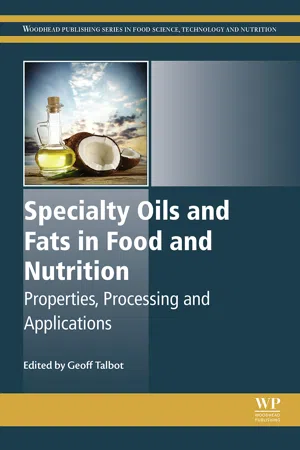
Specialty Oils and Fats in Food and Nutrition
Properties, Processing and Applications
- 384 pages
- English
- ePUB (mobile friendly)
- Available on iOS & Android
eBook - ePub
About this book
Specialty Oils and Fats in Food and Nutrition: Properties, Processing and Applications examines the main specialty oils and fats currently in use in food processing, as well as those with significant potential. Specialty oils and fats have an increasing number of applications in the food industry, due to growing consumer interest in "clean label functional foods and the emerging markets in "free-from and specialist foods.
Part One of this book covers the properties and processing of specialty oils and fats, with a focus on the chemistry, extraction, and quality of different fats and oils, including chapters on shea butter, tropical exotic oils, and structured triglycerides. Part Two looks at the applications of specialty oils and fats in different food and nutraceutical products, such as confectionary, ice cream, and margarine.
Specialty Oils and Fats in Food and Nutrition is a key text for R&D managers and product development personnel working in the dairy, baking, and dairy analogue sectors, or any sector using fats and oils. It is a particularly useful reference point for companies reformulating their products or developing new products to alter fat content, as well as academics with a research interest in the area, such as lipid scientists or food scientists.
- Authored by an industry expert with 35 years of experience working for Unilever and Loders Croklaan
- Broad coverage encompasses tropical exotic oils, tree nut oils, algal oils, GM vegetable oils, and more
- Addresses growing application areas including nutraceuticals, infant formula, and ice cream and confectionery
Information
Part One
Properties and processing of specialty oils and fats
1
Olive oil
Properties and processing for use in food
D. Boskou Aristotle University, Thessaloniki, Hellas
Abstract
Olive oil, a staple food for the people living in the countries surrounding the Mediterranean Sea, has a unique character and flavour as it is obtained from a fruit only by mechanical or other physical methods. The Mediterranean diet, which has olive oil as the principal source of fat, is associated with a decreased risk of cardiovascular disease, obesity, metabolic syndrome, type 2 diabetes, hypertension and with protection against brain disorders, and age-related disease. Experimental and human cellular studies have also provided evidence on olive oil and cancer. These properties are attributed to the fatty acid composition of the oil and the presence of minor constituents mainly biophenols, squalene, tocopherols, and triterpenes. The production of high-quality virgin olive oil requires healthy and properly ripened olive fruits and a process control throughout the entire manufacture from olive fruits to bottling. Quality, identity, and authenticity of olive oil are guaranteed by international standards and regulated limits and analytical methods. More sophisticated methods such as high pressure liquid chromatography coupled to mass spectrometry, hyphenated gas chromatography, nuclear magnetic resonance, and DNA-based methods may also be applied for quantitation of bioactive constituent, evaluation of flavour, and for accessing geographical origin. Virgin olive oil has a remarkable stability to oxidation if properly stored. This stability and the various flavour notes and other distinct features due to different cultivars of olives and variations in processing offer opportunities for a variety of culinary applications and preparation of traditional and gourmet dishes.
Keywords
Olive oil grades
Virgin olive oil
Composition
Processing and bioactive constituents
Mediterranean diet
Health properties
Quality
Authenticity
Culinary applications.
1.1 Mediterranean world and the culture of the olive tree
Virgin olive oil is a staple food for the people living in the countries surrounding the Mediterranean Sea. The olive tree has probably been cultivated before recorded history and originates either from Iran and Mesopotamia or North Africa. It has contributed to the economy, cuisine, and health of the inhabitants of the coastal regions of Greece and the Greek Islands; Cyprus; Syria; Lebanon; the south of Italy, France, and Spain; and the coasts of North Africa. The culture of the olive tree, manifested in objects, pieces of art, medical prescriptions, rituals, and religious symbols has three aspects: the landscape, the use of the oil, and the symbolic importance of the tree and its fruit (Polymerou-Kamilakis, 2006). Greek mythology and the Old Testament provide information for the role of olive tree oil in everyday life and religion. Among the various myths, perhaps the most symbolic ones are the origin of the city of Athens and the flying of the dove from Noah’s ark. In ancient times the olive tree symbolized peace and friendship. The champions of the Olympics were crowned with a wreath of olive branches. Modern historians believe that the olive can be a marker and a compass to explore the history of cultures and civilizations.
Olive oil, the oil of the olive tree (Olea europaea L.), has been produced for over 6000 years. The natural oil is a “fruit juice” ready for direct human consumption and highly appreciated for its nutritional and sensory properties, dominant in the specialty foods arena. The production of high-quality virgin olive oil requires healthy and properly ripened olive fruit and a process control throughout the entire manufacture from olive tree and olive fruits to bottled oil. In the last 30 years, there has been a global interest in the use of olive oil in the diet and this is due to the awareness of the healthy virtues of a Mediterranean diet. The oil is now gaining popularity among consumers not only for its unique character and flavor but also because scientific research suggests important health benefits. Virgin olive oil is a typical example of a “natural” functional food, and its role in health is universally re...
Table of contents
- Cover image
- Title page
- Table of Contents
- Copyright
- List of contributors
- Woodhead Publishing Series in Food Science, Technology and Nutrition
- Part One: Properties and processing of specialty oils and fats
- Part Two: Applications of specialty oils and fats in foods and nutraceuticals
- Index
Trusted by 375,005 students
Access to over 1.5 million titles for a fair monthly price.
Study more efficiently using our study tools.
Frequently asked questions
Yes, you can cancel anytime from the Subscription tab in your account settings on the Perlego website. Your subscription will stay active until the end of your current billing period. Learn how to cancel your subscription
No, books cannot be downloaded as external files, such as PDFs, for use outside of Perlego. However, you can download books within the Perlego app for offline reading on mobile or tablet. Learn how to download books offline
Perlego offers two plans: Essential and Complete
- Essential is ideal for learners and professionals who enjoy exploring a wide range of subjects. Access the Essential Library with 800,000+ trusted titles and best-sellers across business, personal growth, and the humanities. Includes unlimited reading time and Standard Read Aloud voice.
- Complete: Perfect for advanced learners and researchers needing full, unrestricted access. Unlock 1.5M+ books across hundreds of subjects, including academic and specialized titles. The Complete Plan also includes advanced features like Premium Read Aloud and Research Assistant.
We are an online textbook subscription service, where you can get access to an entire online library for less than the price of a single book per month. With over 1.5 million books across 990+ topics, we’ve got you covered! Learn about our mission
Look out for the read-aloud symbol on your next book to see if you can listen to it. The read-aloud tool reads text aloud for you, highlighting the text as it is being read. You can pause it, speed it up and slow it down. Learn more about Read Aloud
Yes! You can use the Perlego app on both iOS and Android devices to read anytime, anywhere — even offline. Perfect for commutes or when you’re on the go.
Please note we cannot support devices running on iOS 13 and Android 7 or earlier. Learn more about using the app
Please note we cannot support devices running on iOS 13 and Android 7 or earlier. Learn more about using the app
Yes, you can access Specialty Oils and Fats in Food and Nutrition by Geoff Talbot in PDF and/or ePUB format, as well as other popular books in Technology & Engineering & Nutrition, Dietics & Bariatrics. We have over 1.5 million books available in our catalogue for you to explore.