- 536 pages
- English
- ePUB (mobile friendly)
- Available on iOS & Android
eBook - ePub
About this book
TRP Channels as Therapeutic Targets: From Basic Science to Clinical Use is authored by experts across academia and industry, providing readers with a complete picture of the therapeutic potential and challenges associated with using TRP channels as drug targets.
This book offers a unique clinical approach by covering compounds that target TRP channels in pre-clinical and clinical phases, also offering a discussion of TRP channels as biomarkers.
An entire section is devoted to the novel and innovative uses of these channels across a variety of diseases, offering strategies that can be used to overcome the adverse effects of first generation TRPV1 antagonists.
Intended for all researchers and clinicians working toward the development of successful drugs targeting TRP channels, this book is an essential resource chocked full of the latest clinical data and findings.
- Contains comprehensive coverage of TRP channels as therapeutic targets, from emerging clinical indications to completed clinical trials
- Discusses TRP channels as validated targets, ranging from obesity and diabetes through cancer and respiratory disorders, kidney diseases, hypertension, neurodegenerative disorders, and more
- Provides critical analysis of the complications and side effects that have surfaced during clinical trials, offering evidence-based suggestions for overcoming them
Information
Topic
MedicineSubtopic
PharmacologyChapter 1
An Introduction to Transient Receptor Potential Ion Channels and Their Roles in Disease
Michael J. Caterina1,2,3,4,* 1 Department of Neurosurgery, Johns Hopkins School of Medicine, Baltimore, Maryland, USA
2 Department of Biological Chemistry, Johns Hopkins School of Medicine, Baltimore, Maryland, USA
3 Solomon H. Snyder Department of Neuroscience, Johns Hopkins School of Medicine, Baltimore, Maryland, USA
4 Neurosurgery Pain Research Institute, Johns Hopkins School of Medicine, Baltimore, Maryland, USA
* Corresponding author: [email protected]
2 Department of Biological Chemistry, Johns Hopkins School of Medicine, Baltimore, Maryland, USA
3 Solomon H. Snyder Department of Neuroscience, Johns Hopkins School of Medicine, Baltimore, Maryland, USA
4 Neurosurgery Pain Research Institute, Johns Hopkins School of Medicine, Baltimore, Maryland, USA
* Corresponding author: [email protected]
Abstract
The transient receptor potential (TRP) cation channel family consists of seven subfamilies that are widely expressed in mammalian tissues. By mediating flux of calcium, sodium, and other cations across cell membranes, in addition to nonionic signaling mechanisms, these channels contribute to many sensory and nonsensory processes throughout the body. Abnormalities in TRP channel function, whether a consequence of mutations in their sequence, alterations in their expression levels, or changes in their myriad regulators, have been associated with numerous disease states ranging from chronic pain to cardiovascular disease, skeletal abnormalities, and cancer. Such prevalent involvement in disease stems not only from the ubiquity of TRP channels but also from their complex pattern of polymodal gating. The connection between TRP channels and disease creates numerous opportunities for therapeutic intervention at these channels, whether through inhibition, activation, or co-opting of their ability to transport cations to alter the course of pathophysiological processes.
Keywords
Transient receptor potential
Ion channel
Channelopathy
Pain
Calcium
Discovery and General Properties of TRP Channels
The diverse repertoire of ion channels expressed in mammalian and nonmammalian species is encoded by a multitude of gene families. Among these, the transient receptor potential (TRP) ion channel family exhibits an especially prevalent and complex link with disease. Fittingly for the theme of this book, the TRP channel name emerged as a consequence of a disease state, although the victims of this disease were not human beings, but rather members of a line of visually impaired fruit flies [1]. Electroretinograms recorded from photoreceptors of these flies revealed that the electrical response to a light pulse (receptor potential), instead of remaining robust throughout a pulse of several seconds, decayed prematurely. Subsequent molecular and physiological studies revealed that the gene mutated in these so-called transient receptor potential (trp) flies encoded an ion channel subunit that, together with a homologous channel subunit, TRPL, forms the functional photoreceptor channel. This channel is not gated directly by light, but rather is activated by a G protein-coupled phospholipase C signaling pathway following the photoisomerization of the light receptor protein, rhodopsin.
Following the identification of the Drosophila TRP channel, numerous homologous proteins were discovered, both in invertebrate species, such as fruit flies and nematodes, and in vertebrate species from fish to mammals [2]. Based on their domain structure and details of their sequences, members of the TRP channel family can be divided into seven subfamilies: TRPA (ankyrin, 1 human member), TRPC (canonical, 6 human members, plus 1 human pseudogene), TRPM (melastatin, 8 human members), TRPML (mucolipin, 3 human members), TRPN (NompC, no human members), TRPP (polycystin, 3 human members), and TRPV (vanilloid, 6 human members). There is also a distantly related family, TRPY, found in yeast. Functional TRP channels consist of homomeric or heteromeric tetramers of subunits from these subfamilies. The domain structure of an example TRP channel subunit, TRPV1, is shown in Figure 1.1a. A common structural feature of all TRP channel subunits is a core of six transmembrane domains (S1-S6), flanked by intracellular amino- and carboxyl-termini. Between S5 and S6 there is a complex pore-loop structure, which breaches the extracellular plane of the plasma membrane and forms the ion selectivity filter. This overall architecture resembles that of the voltage-gated and cyclic nucleotide-gated channel families. The TRPC, TRPM, TRPV, TRPA, and TRPN subfamilies, referred to as Group I TRP channels, resemble one another more closely than they do the TRPP or TRPML subfamilies, which are classified as Group II. Two features found among most Group I TRP channels include a TRP box homology element (absent in the TRPA subfamily), just distal to the sixth transmembrane domain, that participates in channel multimerization and modulation of gating, and a string of 4-16 sequential ankyrin repeat domains in the amino terminus (absent in the TRPM subfamily) that serves as a site of channel regulation (Figure 1.1a). Several TRPM subfamily members also contain kinase or nucleotide binding domains within their carboxyl termini and are therefore referred to as “chanzymes.” Ion flux through TRP channels occurs via a central pore lined by the pore loop domains of the four channel subunits (Figure 1.1b). All known TRP channels are selective for cations, although their degree of discrimination among cations can vary. For example, although some channels such as TRPV5 and TRPV6 are highly selective for Ca2 +, and TRPM4 and TRPM5 are relatively Ca2 + impermeant, most TRP channels are nonselective cation channels that can mediate flux of multiple monovalent and divalent cations [3]. Whereas most of these channels function at the plasma membrane, some are also found in organellar membranes. For example, TRPM2, TRPML, and TRPV2 channels can reside and function within the endolysosomal pathway [4]. A higher-resolution understanding of structural features of TRP channels has recently emerged with the solution of the atomic-level structure of one family member, TRPV1, by cryo-electron microscopy (Figure 1.1b and c) [5,6]. A few details and implications of this important advance will be described later in this chapter.
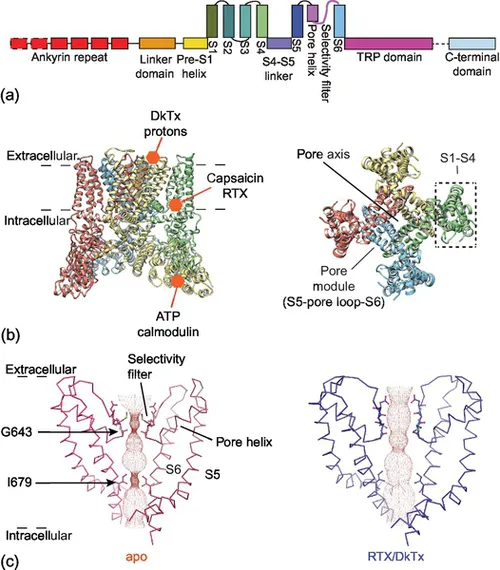
Figure 1.1 Representative TRP channel structure. (a) Domain map of a TRPV1 subunit. Amino terminus is at left. (b) TRPV1 holochannel structure in the apo (closed) state, solved by cryo-electron microscopy. Each subunit is in a different color. At left the channel is viewed from the side, illustrating distinct sites at which several agonists and regulators bind to allosterically control gating. At right, the transmembrane portion of the channel is viewed from the bottom and illustrates the separation between the S1-S4 domain and the S5-pore loop-S6 domain that forms the pore module lining the central pore axis (RTX, resiniferatoxin; DkTx, tarantula double-knot toxin). (c) Comparison of the TRPV1 pore module in the apo form (left) vs. a strongly activated state (right) evoked by a combination of RTX and DkTx. Path available for ion permeation is marked by dotted volume. For clarity, only two opposing subunits are shown. Sites of maximal constriction (G643 in the upper pore and I679 in the lower pore) are indicated. Note widening of both constrictions on activation. Modified, with permission, from Liao et al. [3] and Cao et al. [4].
TRP Channels in Normal Physiology
TRP channels as a family are broadly expressed in mammalian tissues. In fact, every cell in the body likely expresses at least one family member, and often more. Moreover, these channels can be activated by a number of heterogeneous stimuli, including a plethora of endogenous and exogenous chemical ligands, physical stimuli such as temperature and mechanical force, free cytosolic Ca2 + ions, depletion of endoplasmic reticulum Ca2 + stores, and many others. It should therefore not be surprising that these channels have been linked to numerous physiological functions. The following examples provide a glimpse into the ubiquitous involvement of TRP channels in the fundamental processes of life. As will be emphasized later in this chapter, and throughout this book, the pervasiveness of TRP channels in normal mammalian biology sets the stage for them to serve as contributors to, modulators of, or even primary causes of numerous human diseases.
TRP Channels and Sensory Physiology
Perhaps the best understood physiological functions of TRP channels are in the realm of sensory signal transduction. Just as the Drosophila TRP channel is a key effector in phototransduction, many other TRP channels serve either as primary transducers of environmental stimuli or as amplifiers or modulators of signals transduced by other receptors. The most extensively studied example from mammalian systems is TRPV1, a channel expressed at disproportionately high levels in a subpopulation of primary afferent nociceptors, sensory neurons that trigger the perception of pain [7]. TRPV1 was discovered on the basis of, and derives its name from, its ability to be gated by painful vanilloid compounds such as capsaicin (the main pungent ingredient in chili peppers) and resiniferatoxin (a highly potent irritant produced in the latex of Euphorbia plant species). Functional studies subsequently...
Table of contents
- Cover image
- Title page
- Table of Contents
- Copyright
- Contributors
- Preface
- Chapter 1: An Introduction to Transient Receptor Potential Ion Channels and Their Roles in Disease
- Chapter 2: Transient Receptor Potential Dysfunctions in Hereditary Diseases: TRP Channelopathies and Beyond
- Chapter 3: The Role of TRPV1 in Acquired Diseases: Therapeutic Potential of TRPV1 Modulators
- Chapter 4: TRP Gene Polymorphism and Disease Risk
- Chapter 5: Use of Topical Capsaicin for Pain Relief
- Chapter 6: TRPV1 Agonist Cytotoxicity for Chronic Pain Relief: From Mechanistic Understanding to Clinical Application
- Chapter 7: Intravesical Capsaicin and Resiniferatoxin for Bladder Disorders
- Chapter 8: Clinical and Preclinical Experience with TRPV1 Antagonists as Potential Analgesic Agents
- Chapter 9: Transient Receptor Potential Ankyrin 1 Channel Antagonists for Pain Relief
- Chapter 10: TRPA1 Antagonists as Potential Therapeutics for Respiratory Diseases
- Chapter 11: Is TRPV3 a Drug Target?—A Decade of Learning
- Chapter 12: Small Molecule Agonists and Antagonists of TRPV4
- Chapter 13: Potential Therapeutic Applications for TRPV4 Antagonists in Lung Disease
- Chapter 14: TRPM8 as a Target for Analgesia
- Chapter 15: Connecting TRP Channels and Cerebrovascular Diseases
- Chapter 16: Activating, Inhibiting, and Highjacking TRP Channels for Relief from Itch
- Chapter 17: Role of TRP Channels in Skin Diseases
- Chapter 18: Transient Receptor Potential Channels in Hypertension and Metabolic Syndrome
- Chapter 19: Transient Receptor Potential (TRP) Cation Channels in Diabetes
- Chapter 20: TRP Channels in Cardiovascular Disease
- Chapter 21: Targeting of Transient Receptor Potential Channels in Digestive Disease
- Chapter 22: TRP Channels in Cancer
- Chapter 23: Are Brain TRPs Viable Targets for Curing Neurodegenerative Disorders and Improving Mental Health?
- Chapter 24: Mucolipidosis Type IV: Part I
- Chapter 25: TRPML1-Dependent Processes as Therapeutic Targets
- Chapter 26: TRPs in Respiratory Disorders: Opportunities Beyond TRPA1
- Chapter 27: Conclusions
- Index
Trusted by 375,005 students
Access to over 1.5 million titles for a fair monthly price.
Study more efficiently using our study tools.
Frequently asked questions
Yes, you can cancel anytime from the Subscription tab in your account settings on the Perlego website. Your subscription will stay active until the end of your current billing period. Learn how to cancel your subscription
No, books cannot be downloaded as external files, such as PDFs, for use outside of Perlego. However, you can download books within the Perlego app for offline reading on mobile or tablet. Learn how to download books offline
Perlego offers two plans: Essential and Complete
- Essential is ideal for learners and professionals who enjoy exploring a wide range of subjects. Access the Essential Library with 800,000+ trusted titles and best-sellers across business, personal growth, and the humanities. Includes unlimited reading time and Standard Read Aloud voice.
- Complete: Perfect for advanced learners and researchers needing full, unrestricted access. Unlock 1.5M+ books across hundreds of subjects, including academic and specialized titles. The Complete Plan also includes advanced features like Premium Read Aloud and Research Assistant.
We are an online textbook subscription service, where you can get access to an entire online library for less than the price of a single book per month. With over 1.5 million books across 990+ topics, we’ve got you covered! Learn about our mission
Look out for the read-aloud symbol on your next book to see if you can listen to it. The read-aloud tool reads text aloud for you, highlighting the text as it is being read. You can pause it, speed it up and slow it down. Learn more about Read Aloud
Yes! You can use the Perlego app on both iOS and Android devices to read anytime, anywhere — even offline. Perfect for commutes or when you’re on the go.
Please note we cannot support devices running on iOS 13 and Android 7 or earlier. Learn more about using the app
Please note we cannot support devices running on iOS 13 and Android 7 or earlier. Learn more about using the app
Yes, you can access TRP Channels as Therapeutic Targets by Arpad Szallasi in PDF and/or ePUB format, as well as other popular books in Medicine & Pharmacology. We have over 1.5 million books available in our catalogue for you to explore.