eBook - ePub
Designing Quiet Structures
A Sound Power Minimization Approach
- 244 pages
- English
- ePUB (mobile friendly)
- Available on iOS & Android
eBook - ePub
About this book
This book is the first of its kind. It provides the reader with a logical and highly quantitative means of including noise as a parameter in the early design stages of a machine or structure. The unique and unified methodology builds upon the familiar disciplines of acoustics, structural dynamics and optimization. It also exemplifies the art of simplification - the essence of all good engineering design.
Strategies for designing quiet structures require extensive analytical and experimental tools. For computing the sound power from complex structures the authors recommend a new 3-D, lumped parameter formulation. This fully developed, user-friendly program can be applied generally to noise-control-by-design problems. Detailed instructions for running the application are given in the appendix as well as several sample problems to help the user get started.
The authors also describe a new instrument: a specially developed resistance probe used to measure a structure=92s acoustic surface resistance. As an example, the procedure is outlined for measuring the valve cover of an internal combustion engine. Indeed, throughout the book the reader is presented with actual experiments, numerical and physical that they can replicate in their own laboratory.
This is a must-have book for engineers working in industries that include noise control in the design of a product. Its practical and didactic approach also makes it ideally suited to graduate students.
- First text covering the design of quiet structures
- Written by two of the leading experts in the world in the area of noise control
- Strong in its integration of structural dynamics, acoustics, and optimization theory
- Accompanied by a computer program that allows the computation of sound power
- Presents numerous applications of noise-control-by-design methods as well as methods for enclosed and open spaces
- Each chapter is supported by homework problems and demonstration experiments
Information
CHAPTER 1
BASIC EQUATIONS OF ACOUSTICS
To understand the physics of noise control, it is first necessary to understand acoustics, the science of sound. To make the type of problems that we will address in this book tractable, we will only consider linear acoustics and further assume that the ambient quantities of pressure, density, velocity, etc. do not vary as a function of either time or space. As we shall see, these assumptions considerably simplify the associated mathematics. The scope of our required acoustic analysis is further narrowed by the type of problem which is typically encountered in the design of a quiet structure. In many applications, noise, the unwanted sound, is generated by the surface vibrations of a machine which in turn interact with the surrounding acoustic medium. The movement of the surface of the machine compresses the adjacent fluid and causes sound waves to radiate. Only this mechanism for generating noise will be considered, and thus mechanisms such as sound generation by turbulence, combustion, etc. are not considered. Even with these restrictions, a very broad range of design problems can be addressed, as will be seen subsequently.
1.1 Derivation of the Wave Equation
The spatial and time dependence of the sound waves radiating away from a vibrating structure are governed by the physics of the acoustic medium. The change in pressure associated with a sound wave is usually very small in comparison to the ambient pressure, so that the pressure, density, and particle velocity of an acoustic disturbance can be written in terms of an ambient quantity, denoted by a subscript 0, plus a small fluctuating quantity, denoted by a superscript. Thus, the pressure, density, and particle velocity at a point in the fluid are given as p = p0 + p′, ρ = ρ0 + ρ′, and v = v′, respectively, where v0 = 0 because there is no ambient fluid flow. Defining the acoustic variables in this form allows products of the variables to be linearized; for example, p v = (p0 + p′)v′ ≈ p0 v′ because the nonlinear term, p’ v’, is small in comparison to the linear term, p0 v’. The linearization process is revisited later in this section, after the partial differential equations governing sound waves have been derived.
The propagation and radiation of sound waves is governed by three basic equations of fluid dynamics: (1) the equation of continuity or conservation of mass, (2) Euler’s equation of motion of a fluid, and (3) the equation of state. Only a brief derivation of each of these equations is given in the subsequent text because similar derivations can be found in any book on acoustics, including Pierce (1989, pp. 6–20), Beranek (1986, pp. 16–23), Morse (1976, pp. 217–222), Morse and Ingard (1968, 227–305), Temkin (1981, pp. 1–58), and Kinsler et al. (1982, pp. 98–110). These three equations can be combined to give the wave equation, which is the basic partial differential equation governing the spatial and time dependence of an acoustic field.
Conservation of mass
The most physically intuitive of the basic equations of fluid dynamics is the equation of continuity or conservation of mass. To derive this equation, consider a fixed “control volume” V through which fluid is free to flow, as shown in Figure 1.1.
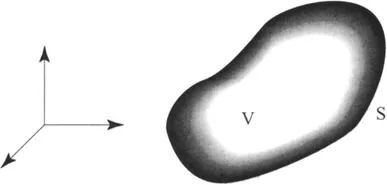
Figure 1.1 Surface S enclosing a volume of fluid V.
The total mass of fluid within the control volume at a particular moment is given as

so that the rate of change of mass within the control volume is

The rate of change of mass within the control volume can also be written in terms of the velocity of the particles flowing through the surface of...
Table of contents
- Cover image
- Title page
- Table of Contents
- Copyright
- Dedication
- PREFACE
- ACKNOWLEDGMENTS
- Chapter 1: BASIC EQUATIONS OF ACOUSTICS
- Chapter 2: A LUMPED PARAMETER MODEL FOR THE ACOUSTIC RADIATION PROBLEM
- Chapter 3: NUMERICAL SOLUTION OF THE ACOUSTIC RADIATION PROBLEM
- Chapter 4: EXPERIMENTAL MEASUREMENT OF THE RESISTANCE MATRIX
- Chapter 5: POWER OUTPUT COMPUTATIONS USING THE RESISTANCE MATRIX
- Chapter 6: MINIMIZING SOUND POWER USING MATERIAL TAILORING
- Chapter 7: ACTIVE CONTROL OF RADIATED ACOUSTIC POWER
- Chapter 8: CHARACTERIZING AND CONTROLLING SOUND IN AN ENCLOSURE
- APPENDIX: USING THE COMPUTER PROGRAMS
- INDEX
Trusted by 375,005 students
Access to over 1.5 million titles for a fair monthly price.
Study more efficiently using our study tools.
Frequently asked questions
Yes, you can cancel anytime from the Subscription tab in your account settings on the Perlego website. Your subscription will stay active until the end of your current billing period. Learn how to cancel your subscription
No, books cannot be downloaded as external files, such as PDFs, for use outside of Perlego. However, you can download books within the Perlego app for offline reading on mobile or tablet. Learn how to download books offline
Perlego offers two plans: Essential and Complete
- Essential is ideal for learners and professionals who enjoy exploring a wide range of subjects. Access the Essential Library with 800,000+ trusted titles and best-sellers across business, personal growth, and the humanities. Includes unlimited reading time and Standard Read Aloud voice.
- Complete: Perfect for advanced learners and researchers needing full, unrestricted access. Unlock 1.5M+ books across hundreds of subjects, including academic and specialized titles. The Complete Plan also includes advanced features like Premium Read Aloud and Research Assistant.
We are an online textbook subscription service, where you can get access to an entire online library for less than the price of a single book per month. With over 1.5 million books across 990+ topics, we’ve got you covered! Learn about our mission
Look out for the read-aloud symbol on your next book to see if you can listen to it. The read-aloud tool reads text aloud for you, highlighting the text as it is being read. You can pause it, speed it up and slow it down. Learn more about Read Aloud
Yes! You can use the Perlego app on both iOS and Android devices to read anytime, anywhere — even offline. Perfect for commutes or when you’re on the go.
Please note we cannot support devices running on iOS 13 and Android 7 or earlier. Learn more about using the app
Please note we cannot support devices running on iOS 13 and Android 7 or earlier. Learn more about using the app
Yes, you can access Designing Quiet Structures by Gary H. Koopmann,John B. Fahnline in PDF and/or ePUB format, as well as other popular books in Technology & Engineering & Civil Engineering. We have over 1.5 million books available in our catalogue for you to explore.