- 838 pages
- English
- ePUB (mobile friendly)
- Available on iOS & Android
eBook - ePub
About this book
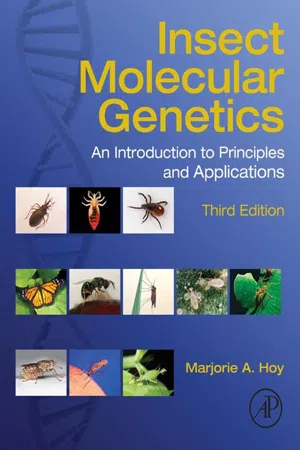
Insect Molecular Genetics, Third Edition, summarizes and synthesizes two rather disparate disciplines—entomology and molecular genetics. This volume provides an introduction to the techniques and literature of molecular genetics; defines terminology; and reviews concepts, principles, and applications of these powerful tools. The world of insect molecular genetics, once dominated by Drosophila, has become much more diverse, especially with the sequencing of multiple arthropod genomes (from spider mites to mosquitoes). This introduction includes discussion of honey bees, mosquitoes, flour beetles, silk moths, fruit flies, aphids, house flies, kissing bugs, cicadas, butterflies, tsetse flies and armyworms.
This book serves as both a foundational text and a review of a rapidly growing literature. With fully revised and updated chapters, the third edition will be a valuable addition to the personal libraries of entomologists, geneticists, and molecular biologists.
- Up-to-date references to important review articles, websites, and seminal citations in the disciplines
- Well crafted and instructive illustrations integral to explaining the techniques of molecular genetics
- Glossary of terms to help beginners learn the vocabulary of molecular biology
Information
Part I
Genes and Genome Organization in Eukaryotes
Chapter 1 DNA, Gene Structure, and DNA Replication
Chapter 2 Transcription, Translation, and Regulation of Eukaryotic DNA
Chapter 3 Nuclear and Extranuclear DNA in Insects
Chapter 4 Genetic Systems, Genome Evolution, and Genetic Control of Embryonic Development in Insects
Chapter 1
DNA, Gene Structure, and DNA Replication
Chapter Outline
1.1 Overview
1.2 DNA is the Hereditary Material: A Brief History
1.3 The Central Dogma
1.4 The “RNA World” Came First?
1.5 The Molecular Structure of DNA
1.6 The Molecular Structure of RNA
1.7 The Double Helix
1.8 Complementary Base Pairing is Fundamental
1.9 DNA Exists in Several Forms
1.10 Genes
1.11 The Genetic Code for Protein-Coding Genes is a Triplet and is Degenerate
1.12 Gene Organization
1.13 Efficient DNA Replication is Essential
1.14 DNA Replication is Semiconservative
1.15 Replication Begins at Replication Origins
1.16 DNA Replication Occurs Only in the 5′ to 3′ Direction
1.17 Replication of DNA Requires an RNA Primer
1.18 Ligation of Replicated DNA Fragments
1.19 DNA Replication during Mitosis in Eukaryotes
1.20 Telomeres at the End: A Solution to the Loss of DNA during Replication
1.21 DNA Replication Fidelity and DNA Repair
1.22 Mutations in the Genome
1.23 Common Genetic Terminology
1.24 Independent Assortment and Recombination during Sexual Reproduction
General References
References Cited
General References
References Cited
1.1 Overview
Arthropod genes are made of deoxyribonucleic acid (DNA) and are located in chromosomes that consist of proteins, RNA, and DNA. DNA is a polymer of nucleotides (nt). Each nucleotide consists of a pentose sugar, one of four nitrogenous bases, and a phosphoric acid component. DNA consists of two complementary strands in a helix form. Pairing of the nitrogenous bases adenine (A) with thymine (T) and cytosine (C) with guanine (G) on the two complementary strands occurs by hydrogen bonding. A pairs with T by two hydrogen bonds, and C pairs with G by three hydrogen bonds. DNA has chemically distinct 5′ and 3′ ends, and the two strands are antiparallel, with one strand running in the 5′ to 3′ direction and the other strand running in the 3′ to 5′ direction. The antiparallel orientation of the two strands creates a special problem when the DNA is duplicated or replicated during mitosis or meiosis.
Genetic information in protein-coding genes is determined by the sequence of nitrogenous bases (A, T, G, C) in one of the strands, with a three-base (triplet) codon designating an amino acid. The genetic code is degenerate, meaning that more than one codon specifies most amino acids. The genetic information is expressed when DNA is transcribed into pre-messenger RNA (pre-mRNA) that is processed into mRNA and then translated into polypeptides. Most insect genes have intervening noncoding sequences (introns) that must be removed from the primary RNA molecule before translation into the protein can occur.
Efficient and accurate replication of DNA must occur at each cell division, or the cell or organism may not survive. DNA replication is semiconservative, i.e., one of the nucleotide strands of each new DNA molecule is new and the other nucleotide strand is old in each “cell generation.” The new DNA strand is complementary to the parental (or template) strand. DNA replication occurs in one direction only, from the 5′ to the 3′ end of the strand, and thus replication takes place differently on the two antiparallel strands. Replication on the “leading strand” can occur in the 5′ to 3′ direction in a continuous manner. DNA replication on the other strand, the “lagging strand,” occurs in short segments (Okazaki fragments) because the DNA runs in the 3′ to 5′ direction. Subsequently, the Okazaki fragments must be ligated together. Replication of DNA in chromosomes begins at multiple sites called origins of replication along the chromosome, and it involves many enzymes and proteins. Although DNA replication is usually highly accurate, errors in DNA replication, or mutations, can result from duplications, deletions, inversions, and translocations of nucleotides, all of which may affect the functioning of the resultant polypeptide. New combinations of genes can occur through recombination during meiosis.
1.2 DNA is the Hereditary Material: A Brief History
Gregor Johann Mendel founded modern genetics in 1866 by publishing his studies on inheritance in garden peas. He confirmed that hereditary traits were transmitted from generation to generation, and he proposed the principles of Segregation and Independent Assortment, which are discussed further in the description of meiosis and mitosis in Chapter 3. His work, however, was not widely known until 1900, when Hugo de Vries, Carl Correns, and Erich von Tschermak rediscovered these laws of inheritance. Mendel described traits in peas that were “dominant” or “recessive,” showed that peas could be selected for different traits, and showed that the traits were inherited in a stable manner.
The discovery that DNA is the hereditary material was first determined using a bacterium that causes pneumonia, Streptococcus pneumoniae (Griffiths 1928). Before this discovery, scientists speculated that the hereditary material might be composed of proteins or RNA. Proteins were considered the most likely hereditary material because they were known to be more variable (having 20 amino acids that could serve as the genetic code) than DNA. Furthermore, proteins are present in the nucleus in amounts nearly equal to DNA. DNA, by contrast, seemed to have only four types of structure (consisting of A, T, C, or G) that could serve as the genetic code. Griffiths (1928) found that nonvirulent forms of S. pneumoniae could be “transformed” to virulent forms by combining heat-treated virulent bacteria with nonvirulent bacteria. The reverse was true and led to the conclusion that the virulence traits were heritable and that the heritable material was capable of surviving mild heat treatment. Subsequently, Avery et al. (1944) conducted experiments in which the “transforming principle” was found to have the characteristics of DNA, and the transforming factors did not test positive for proteins or RNA. Avery et al. (1944) showed that enzymes that degrade proteins or RNA did not degrade the transforming principle but that enzymes that could degrade DNA did degrade the transforming principle. Hershey and Chase (1952) conducted experiments to further resolve whether protein or DNA was the hereditary material. They labeled DNA and protein from viruses that infect bacteria (bacteriophages) with different radioactive markers and monitored whether labeled DNA or labeled protein entered the bacterial host. Only labeled DNA entered the bacteria, confirming that the transforming principle, or genetic information, was contained in DNA.
The next big questions were how the DNA was structured, how the genetic information was encoded, and how the genetic information was replicated in a reliable manner. Answers to these questions were hotly pursued by several scientists, including Francis Crick, James Watson, Rosalind Franklin, Maurice Wilkins, Linus Pauling, and others. Rosalind Franklin and Maurice Wilkins provided critical information relevant to the solution of the structure of DNA with their X-ray diffraction pictures of purified DNA. The X-ray diffraction photographs provided an essential clue that allowed Watson and Crick to propose the correct structure of DNA and to hypothesize how the genetic information was reliably replicated (Watson and Crick 1953). Previous proposals had been made that suggested that DNA “consists of three intertwined chains, with the phosphates near the fibre axis, and the bases on the outside.” Another three-chain structure also had been suggested in which “the phosphates are on the outside and the bases on the inside, linked together by hydrogen bonds.” Watson and Crick (1953) proposed that DNA “has two helical chains each coiled round the same axis… the bases on the inside of the helix and the phosphates on the outside…” and indicated the “novel feature of the structure is the manner in which the two chains are held together by the purine and pyrimidine bases…They are joined together in pairs, a single base from one chain being hydrogen-bonded to a single base from the other chain.” Watson and Crick stated, “It has not escaped our notice that the specific pairing we have postulated immediately suggests a possible copying mechanism for the genetic material,” the accuracy of which is crucial to the transmission of genetic information from cell to cell and from generation to generation. The next big question to be answered involved the issue of how the purine and pyrimidine bases were able to encode the genetic information.
Crick et al. (1961) deciphered the genetic code, by showing that three bases of DNA code for one amino acid. As noted by Crick et al. (1961), “If the coding ratio is indeed 3 … and if the code is the same throughout Nature, then the genetic code may well be solved within a year.” To resolve the question, Crick et al. (1961) found that mutations in a bacteriophage gene caused by the insertion or deletion of a single ba...
Table of contents
- Cover image
- Title page
- Table of Contents
- Copyright
- Preface to the Third Edition
- Preface to the Second Edition
- Preface to the First Edition
- Acknowledgments
- Part I: Genes and Genome Organization in Eukaryotes
- Part II: Molecular Genetic Techniques
- Part III: Applications in Entomology
- Glossary
- Index
Trusted by 375,005 students
Access to over 1.5 million titles for a fair monthly price.
Study more efficiently using our study tools.
Frequently asked questions
Yes, you can cancel anytime from the Subscription tab in your account settings on the Perlego website. Your subscription will stay active until the end of your current billing period. Learn how to cancel your subscription
No, books cannot be downloaded as external files, such as PDFs, for use outside of Perlego. However, you can download books within the Perlego app for offline reading on mobile or tablet. Learn how to download books offline
Perlego offers two plans: Essential and Complete
- Essential is ideal for learners and professionals who enjoy exploring a wide range of subjects. Access the Essential Library with 800,000+ trusted titles and best-sellers across business, personal growth, and the humanities. Includes unlimited reading time and Standard Read Aloud voice.
- Complete: Perfect for advanced learners and researchers needing full, unrestricted access. Unlock 1.5M+ books across hundreds of subjects, including academic and specialized titles. The Complete Plan also includes advanced features like Premium Read Aloud and Research Assistant.
We are an online textbook subscription service, where you can get access to an entire online library for less than the price of a single book per month. With over 1.5 million books across 990+ topics, we’ve got you covered! Learn about our mission
Look out for the read-aloud symbol on your next book to see if you can listen to it. The read-aloud tool reads text aloud for you, highlighting the text as it is being read. You can pause it, speed it up and slow it down. Learn more about Read Aloud
Yes! You can use the Perlego app on both iOS and Android devices to read anytime, anywhere — even offline. Perfect for commutes or when you’re on the go.
Please note we cannot support devices running on iOS 13 and Android 7 or earlier. Learn more about using the app
Please note we cannot support devices running on iOS 13 and Android 7 or earlier. Learn more about using the app
Yes, you can access Insect Molecular Genetics by Marjorie A. Hoy in PDF and/or ePUB format, as well as other popular books in Biological Sciences & Entomology. We have over 1.5 million books available in our catalogue for you to explore.