eBook - ePub
Writing for Science and Engineering
Papers, Presentations and Reports
- 208 pages
- English
- ePUB (mobile friendly)
- Available on iOS & Android
eBook - ePub
About this book
Learning how to write clearly and concisely is an integral part of furthering your research career; however, doing so is not always easy. In this second edition, fully updated and revised, Dr. Silyn-Roberts explains in plain English the steps to writing abstracts, theses, journal papers, funding bids, literature reviews, and more. The book also examines preparing seminar and conference presentations. Written in a practical and easy to follow style specifically for postgraduate students in Engineering and Sciences, this book is essential in learning how to create powerful documents.
Writing for Science and Engineering will prove invaluable in all areas of research and writing due its clear, concise style. The practical advice contained within the pages alongside numerous examples to aid learning will make the preparation of documentation much easier for all students.
- Written in modular format, so you only need to access the relevant chapter
- Covers a wide range of document and presentation types
- Includes easy-to-understand rules to improve writing
Information
Section 1
Document Structure. The Requirements for each Section
1 Structuring a Document
2 The Core Chapter
1
Structuring a Document
Using the Headings Skeleton
This chapter covers:
• TAIMRAD: the classic structure of an experimental report.
• When TAIMRAD isn’t an appropriate structure for your document.
• The basic skeleton of section headings.
• Building an extended skeleton of section headings.
• Using the Outline mode of Microsoft Word® to help organise your document.
• The importance of overview information: building a navigational route through your document.
• Deliberate repetition of information in the basic skeleton.
The Basic Skeleton of Section Headings for a Technical Document
This section covers:
• The classic TAIMRAD structure for an experimental report.
• When TAIMRAD isn’t suitable: choosing section headings.
• The basic set of headings forming the skeleton of a document, whatever its topic or length.
TAIMRAD: The classic structure of an experimental report
The classic, traditional structure for an experimental report, particularly a journal paper, is the TAIMRAD structure: Title, Abstract, Introduction, Methods, Results and Discussion.
When TAIMRAD Isn’t an appropriate structure for your document
The classic TAIMRAD structure may not be suitable if you are reporting on:
• Experimental work but the structure needs to be expanded from the restrictive TAIMRAD form
or
• Work that is not of an experimental nature.
In this case, you will need to construct your own set of headings.
There is no single structure that can be applied to all reports. The following sections give guidelines for this.
Choosing a set of main headings
The basic skeleton of all professional technical documents is made up of a set of main headings. The headings don’t depend on the topic or length of the report, or whether it presents experimental or investigational work that you’ve done, or material that you’ve researched only from the literature (e.g. a generalised project report).
Documents tend to start and end with the same sections; the middle part will depend on the subject matter of your document. To show this, Table 1.1 compares the basic format for a generalised short and a long document.
Table 1.1 A Basic, General Skeleton for a Generalised Short and a Long Document to Show the Similarities

Choosing Section Headings: Building an Extended Skeleton
This section describes how to:
• Build up the general skeleton into an appropriate extended skeleton of sections for your document. This covers every type of document that is not of a strictly TAIMRAD structure.
• Use the standard sections frequently used in longer documents.
Steps to take
Step 1: Working from the basic skeleton, plan an enlarged skeleton for your document. Use Table 1.2 for help: it does the following:
• It lists many standard sections used in postgraduate science and technological documents in the approximate order in which they would occur in the document.
• It gives the purpose of each section.
• It cross-refers you to the pages of this book that give guidelines on how to write each section described in Table 1.2.
Table 1.2 To Determine What Sections You Will Need for a Document
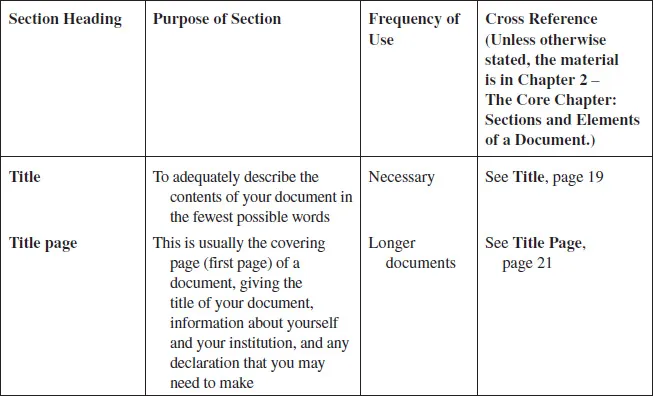
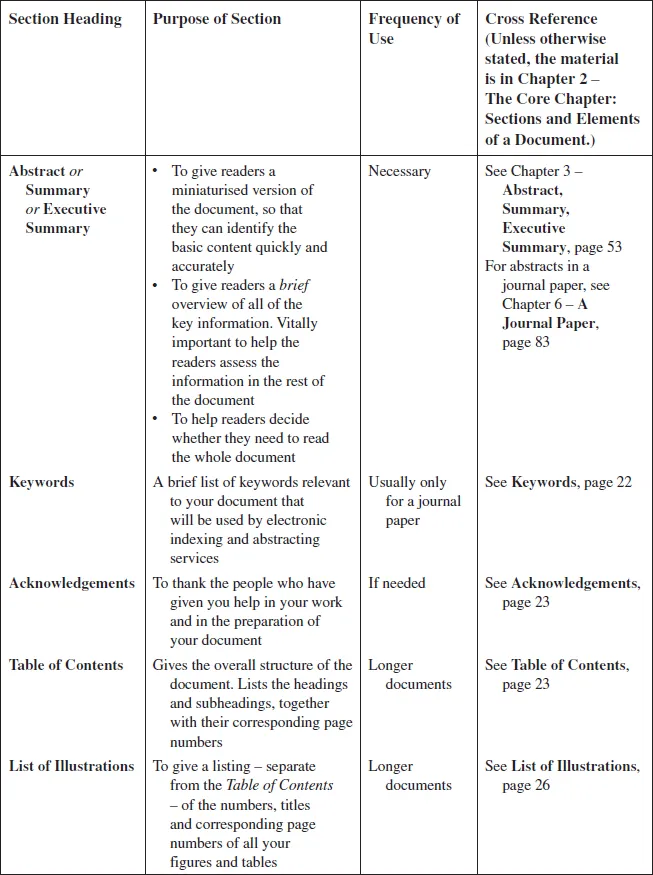
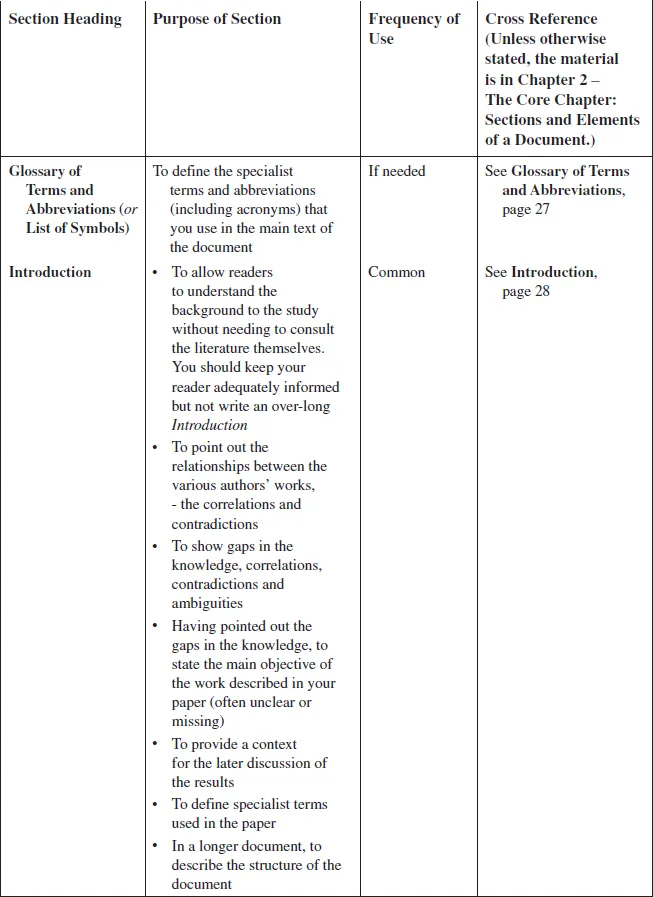
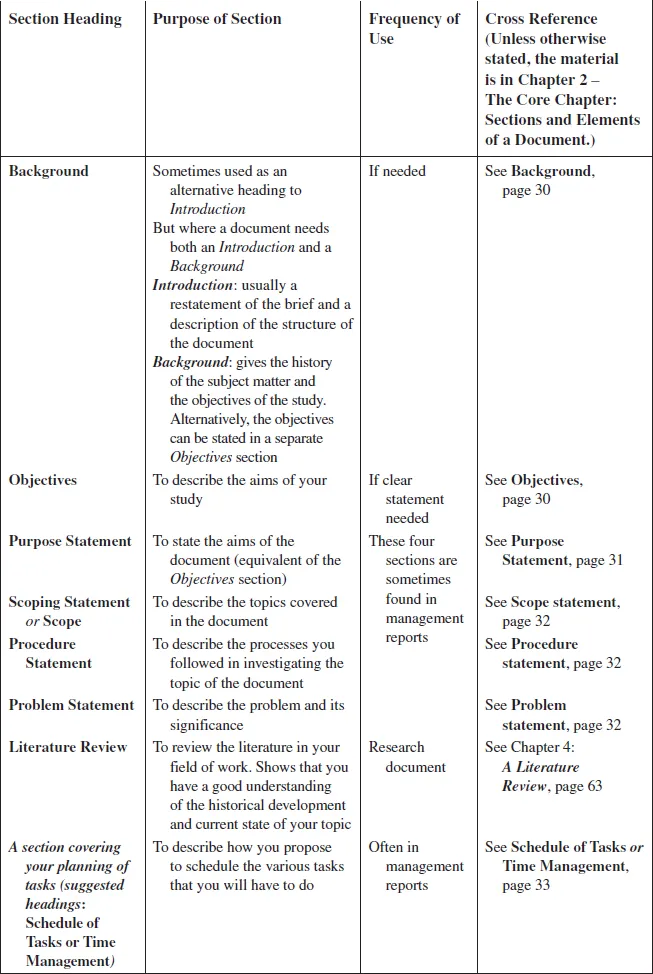
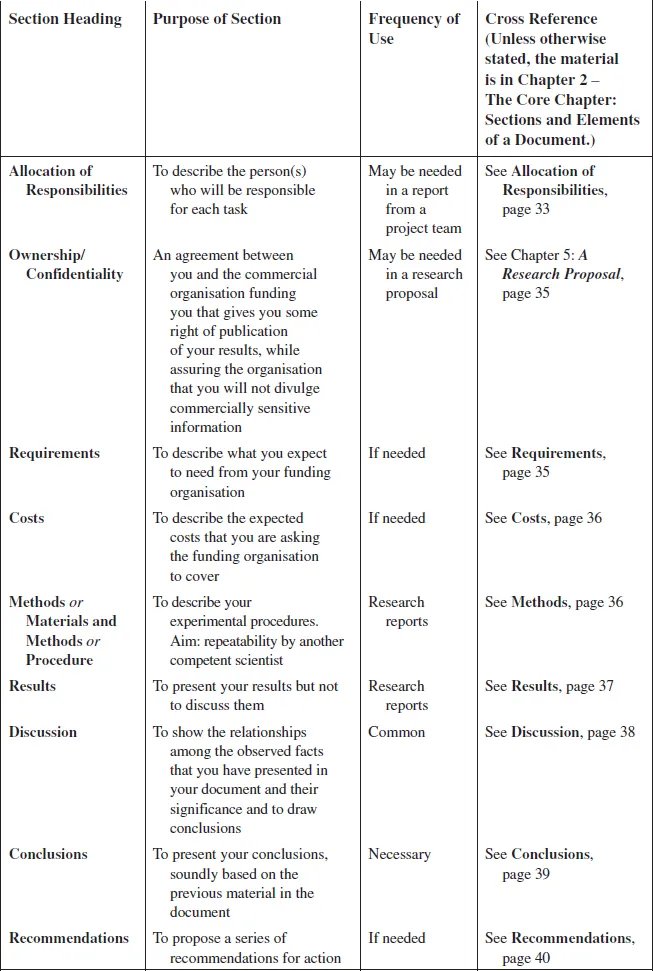
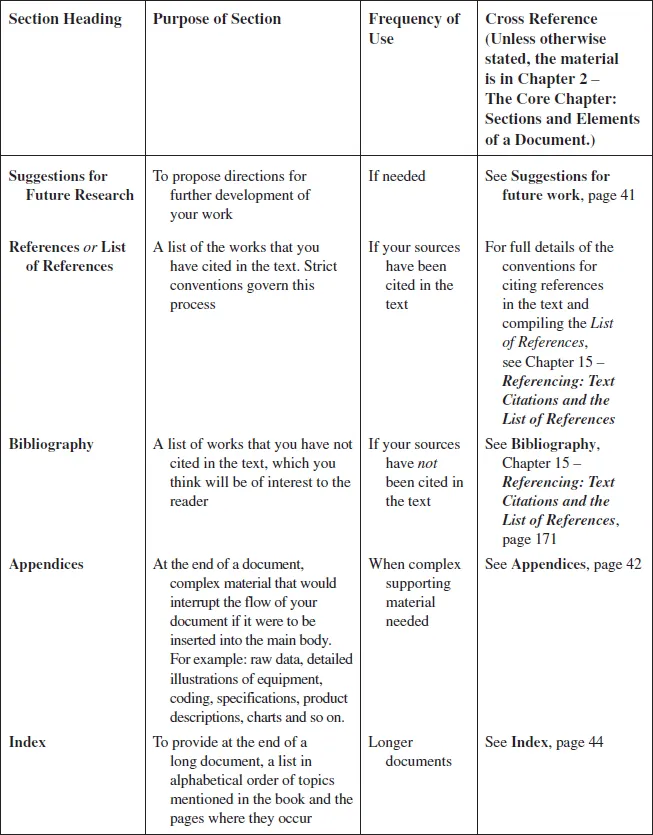
It shows (i) the possible standard sections of a graduate technical document, (ii) the purpose of each section, (iii) how often the section is used and (iv) the relevant cross-reference to guidelines in this book.
Step 2: Work out your own headings for ...
Table of contents
- Cover image
- Title page
- Table of Contents
- Copyright
- Introduction: How to Use This Book
- Section 1: Document Structure. The Requirements for each Section
- Section 2: Specific Types of Documents
- Section 3: Referencing, Editorial Conventions, Revising, Proofreading
- Section 4: Writing Style
- Section 5: Presenting Your Work Orally
- Appendix 1: SI Units and Their Abbreviations
- Appendix 2: The Parts of Speech; Tenses and Forms of the Verb
- Appendix 3: Recommended Scientific Style Manuals
Trusted by 375,005 students
Access to over 1.5 million titles for a fair monthly price.
Study more efficiently using our study tools.
Frequently asked questions
Yes, you can cancel anytime from the Subscription tab in your account settings on the Perlego website. Your subscription will stay active until the end of your current billing period. Learn how to cancel your subscription
No, books cannot be downloaded as external files, such as PDFs, for use outside of Perlego. However, you can download books within the Perlego app for offline reading on mobile or tablet. Learn how to download books offline
Perlego offers two plans: Essential and Complete
- Essential is ideal for learners and professionals who enjoy exploring a wide range of subjects. Access the Essential Library with 800,000+ trusted titles and best-sellers across business, personal growth, and the humanities. Includes unlimited reading time and Standard Read Aloud voice.
- Complete: Perfect for advanced learners and researchers needing full, unrestricted access. Unlock 1.5M+ books across hundreds of subjects, including academic and specialized titles. The Complete Plan also includes advanced features like Premium Read Aloud and Research Assistant.
We are an online textbook subscription service, where you can get access to an entire online library for less than the price of a single book per month. With over 1.5 million books across 990+ topics, we’ve got you covered! Learn about our mission
Look out for the read-aloud symbol on your next book to see if you can listen to it. The read-aloud tool reads text aloud for you, highlighting the text as it is being read. You can pause it, speed it up and slow it down. Learn more about Read Aloud
Yes! You can use the Perlego app on both iOS and Android devices to read anytime, anywhere — even offline. Perfect for commutes or when you’re on the go.
Please note we cannot support devices running on iOS 13 and Android 7 or earlier. Learn more about using the app
Please note we cannot support devices running on iOS 13 and Android 7 or earlier. Learn more about using the app
Yes, you can access Writing for Science and Engineering by Heather Silyn-Roberts in PDF and/or ePUB format, as well as other popular books in Technology & Engineering & Engineering General. We have over 1.5 million books available in our catalogue for you to explore.