- 584 pages
- English
- ePUB (mobile friendly)
- Available on iOS & Android
eBook - ePub
About this book
Organic Nanoreactors: From Molecular to Supramolecular Organic Compounds provides a unique overview of synthetic, porous organic compounds containing a cavity which can encapsulate one or more guest(s). Confined space within a nanoreactor can isolate the guest(s) from the bulk and effectively influence the reaction inside the nanoreactor. Naturally occurring enzymes are compelling catalysts for selective reactions as their three-dimensional structures build up clefts, caves, or niches in which the active site is located. Additionally, reactive sites carrying special functional groups allow only specific reagents to react in a particular way, to lead to specific enantiomers as products. Equipped with suitable functional groups, then, nanoreactors form a new class of biomimetic compounds, which have multiple important applications in the synthesis of nanomaterials, catalysis, enzyme immobilization, enzyme therapy, and more. This book addresses various synthetic, organic nanoreactors, updating the previous decade of research and examining recent advances in the topic for the first comprehensive overview of this exciting group of compounds, and their practical applications. Bringing in the Editor's experience in both academic research and industrial applications, Organic Nanoreactors focuses on the properties and applications of well-known as well as little-examined nanoreactor compounds and materials and includes brief overviews of synthetic routes and characterization methods.
- Focuses on organic nanoreactor compounds for greater depth
- Covers the molecular, supramolecular, and macromolecular perspectives
- Compiles previous and current sources from this growing field in one unique reference
- Provides brief overviews of synthetic routes and characterization methods
Information
Topic
Physical SciencesSubtopic
Organic ChemistryChapter 1
Introduction to Nanoreactors
Samahe Sadjadi Gas Conversion Department, Iran Polymer and Petrochemical Institute, Faculty of Petrochemicals, Tehran, Iran
Abstract
This chapter intends to provide an overview of nanoreactor (NR) and encapsulation concepts. The first section is devoted to a short introduction to the principles of artificial enzymes. In the next section fundamental concepts of NRs are addressed, including NR definition, classification, and encapsulation effects. The potential applications of NRs are discussed briefly in the last section.
Keywords
nanoreactors
encapsulation
enzyme mimic
1. Approaches to artificial enzymes
Nature provides us with the most efficient catalysts, enzymes that catalyze reactions under mild and green conditions (ie, atmospheric pressure, temperature, and aqueous solution). Efficiency and chemo-, regio-, and stereoselectivity in enzyme-catalyzed reactions are so remarkable that they inspire scientists to design synthetic systems with comparable activity and selectivity [1,2]. Enzymes made of proteins are more than just highly evolved catalysts. They recognize and respond to molecules other than their specific substrate and product [3]. The evolution of artificial enzymes is in its infancy and its main goal is efficient catalysis [1,3].
Using enzyme principles, efficient and selective synthetic catalysts can be designed that may be more practical than enzymes in the industrial section, due to their more robust entities and greater tolerance to reaction conditions such as temperature and pH.
Two key features of enzymes are their binding ability and product release. Enzymes can stabilize the transition state of a reaction more than the ground state of the substrate is stabilized. This can be achieved through additional binding interactions between enzyme functionalities and the substrate within its cavity. This concept is illustrated in Fig. 1.1 with a unimolecular example where the enzyme-substrate complex is stabilized relative to the free species in solution. The activation barrier to reaction is represented by the difference ∆Gcat and ∆Guncat for the enzyme catalyzed and the unanalyzed reactions, respectively [4]. It is clear from this picture that, for catalysis to work, the difference ∆GETS# must be larger than ∆GES.
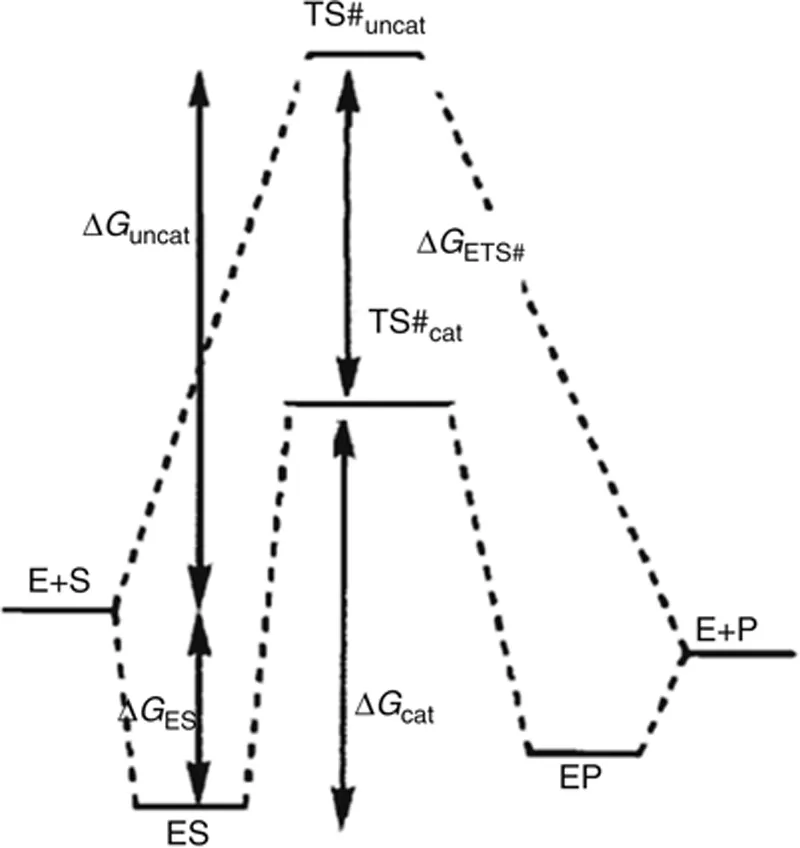
Figure 1.1 Enzymes ability to stabilize the transition state of a reaction relative to that of the ground state.
S, substrate; E, enzyme; P, product; ES, enzyme–substrate complex; TS#, transition state; EP, enzyme–product complex. (Adapted from Ref. [4] with permission of Elsevier.)
S, substrate; E, enzyme; P, product; ES, enzyme–substrate complex; TS#, transition state; EP, enzyme–product complex. (Adapted from Ref. [4] with permission of Elsevier.)
The microenvironment within the enzyme cavity has a great influence on t...
Table of contents
- Cover
- Title page
- Table of Contents
- Copyright
- List of Contributors
- Chapter 1: Introduction to Nanoreactors
- Chapter 2: Cyclodextrins as Porous Material for Catalysis
- Chapter 3: The Use of Cucurbit[n]urils as Organic Nanoreactors
- Chapter 4: Systems Based on Calixarenes as the Basis for the Creation of Catalysts and Nanocontainers
- Chapter 5: Carbon Nanotube Nanoreactors for Chemical Transformations
- Chapter 6: Dendrimers as Nanoreactors
- Chapter 7: Catalysis Within the Self-Assembled Resorcin[4]arene Hexamer
- Chapter 8: The Varied Supramolecular Chemistry of Pyrogallol[4]arenes
- Chapter 9: Supramolecular Coordination Cages as Nanoreactors
- Chapter 10: Metal Organic Frameworks as Nanoreactors and Host Matrices for Encapsulation
- Chapter 11: Bionanoreactors: From Confined Reaction Spaces to Artificial Organelles
- Chapter 12: Supercritical Fluids in Nanoreactor Technology
- Chapter 13: Pyrene: The Guest of Honor
- Chapter 14: Nanoreactors Based on Porphyrin-Functionalized Carbon Compounds
- Chapter 15: Therapeutic Nanoreactors: Toward a Better Blood Substitute
- Subject Index
Trusted by 375,005 students
Access to over 1.5 million titles for a fair monthly price.
Study more efficiently using our study tools.
Frequently asked questions
Yes, you can cancel anytime from the Subscription tab in your account settings on the Perlego website. Your subscription will stay active until the end of your current billing period. Learn how to cancel your subscription
No, books cannot be downloaded as external files, such as PDFs, for use outside of Perlego. However, you can download books within the Perlego app for offline reading on mobile or tablet. Learn how to download books offline
Perlego offers two plans: Essential and Complete
- Essential is ideal for learners and professionals who enjoy exploring a wide range of subjects. Access the Essential Library with 800,000+ trusted titles and best-sellers across business, personal growth, and the humanities. Includes unlimited reading time and Standard Read Aloud voice.
- Complete: Perfect for advanced learners and researchers needing full, unrestricted access. Unlock 1.5M+ books across hundreds of subjects, including academic and specialized titles. The Complete Plan also includes advanced features like Premium Read Aloud and Research Assistant.
We are an online textbook subscription service, where you can get access to an entire online library for less than the price of a single book per month. With over 1.5 million books across 990+ topics, we’ve got you covered! Learn about our mission
Look out for the read-aloud symbol on your next book to see if you can listen to it. The read-aloud tool reads text aloud for you, highlighting the text as it is being read. You can pause it, speed it up and slow it down. Learn more about Read Aloud
Yes! You can use the Perlego app on both iOS and Android devices to read anytime, anywhere — even offline. Perfect for commutes or when you’re on the go.
Please note we cannot support devices running on iOS 13 and Android 7 or earlier. Learn more about using the app
Please note we cannot support devices running on iOS 13 and Android 7 or earlier. Learn more about using the app
Yes, you can access Organic Nanoreactors by Samahe Sadjadi in PDF and/or ePUB format, as well as other popular books in Physical Sciences & Organic Chemistry. We have over 1.5 million books available in our catalogue for you to explore.