Combining solid theoretical discussions with practical design examples, this book is an essential reference on developing RF and microwave switchmode power amplifiers.
With this book you will be able to:
- Design high-efficiency RF and microwave power amplifiers on different types of bipolar and field-effect transistors using well-known and novel theoretical approaches, nonlinear simulation tools, and practical design techniques
- Design any type of high-efficiency switchmode power amplifiers operating in Class D or E at lower frequencies and in Class E or F and their subclasses at microwave frequencies, with specified output power
- Understand the theory and practical implementation of load-network design techniques based on lumped and transmission-line elements
- Combine multi-stage Doherty architecture and switchmode power amplifiers to significantly increase efficiency of the entire radio transmitter
- Learn the different types of predistortion linearization techniques required to improve the quality of signal transmission in a nonlinear amplifying system
New to this edition:
- Comprehensive overview of different Doherty architectures which are, and will be used in modern communication systems to save power consumption and reduce costs
- A new chapter on analog and digital predistortion techniques
- Coverage of broadband Class-F power amplifiers, high-power inverse Class-F power amplifiers for WCDMA systems, broadband Class-E techniques
- Unique focus on switchmode RF and microwave power amplifiers that are widely used in cellular/wireless, satellite and radar communication systems and which offer major power consumption savings
- Complete coverage of the new Doherty architecture which offers major efficiencies and savings on power consumption
- Balances theory with practical implementatation, avoiding a cookbook approach, enabling engineers to develop better designs
- Trusted content from leading figures in the field with a Foreword of endorsement by Zoya Popovic
This introductory chapter presents the basic principles for understanding the power amplifiers design procedure in principle. Based on the spectral-domain analysis, the concept of a conduction angle is introduced, by which the basic Classes A, AB, B, and C of the power-amplifier operation are analyzed and illustrated in a simple and clear form. The frequency-domain analysis is less ambiguous because a relatively complex circuit often can be reduced to one or more sets of immittances at each harmonic component. Classes of operation based upon a finite number of harmonics are discussed and described. The different nonlinear models for various types of MOSFET, MESFET, HEMT, and BJT devices including HBTs, which are very prospective for modern microwave monolithic integrated circuits of power amplifiers, are given. The effect of the input device parameters on the conduction angle at high frequencies is explained. The design and concept of push–pull amplifiers using balanced transistors are presented. The possibility of the maximum power gain for a stable power amplifier is discussed and analytically derived. The device bias conditions and required bias circuits depend on the classes of operations and type of the active device. The parasitic parametric effect due to the nonlinear collector capacitance and measures for its cancellation in practical power amplifiers are discussed. In addition, the basics of the load–pull characterization and distortion fundamentals are presented.
1.1 Spectral-domain analysis
The best way to understand the electrical behavior of a power amplifier and the fastest way to calculate its basic electrical characteristics such as output power, power gain, efficiency, stability, or harmonic suppression is to use a spectral-domain analysis. Generally, such an analysis is based on the determination of the output response of the nonlinear active device when applying the multiharmonic signal to its input port, which analytically can be written as
(1.1)
where i(t) is the output current, v(t) is the input voltage, and f(v) is the nonlinear transfer function of the device. Unlike the spectral-domain analysis, time-domain analysis establishes the relationships between voltage and current in each circuit element in the time domain when a system of equations is obtained applying Kirchhoff’s law to the circuit to be analyzed. Generally, such a system will be composed of nonlinear integro-differential equations in a nonlinear circuit. The solution to this system can be found by applying the numerical-integration methods.
The voltage v(t) in the frequency domain generally represents the multiple-frequency signal at the device input which is written as
(1.2)
where V0 is the constant voltage, Vk is the voltage amplitude, ϕk is the phase of the k-order harmonic component ωk, k=1, 2, …
, N, and N is the number of harmonics.
The spectral-domain analysis, based on substituting Eq. (1.2) into Eq. (1.1) for a particular nonlinear transfer function of the active device, determines the output spectrum as a sum of the fundamental-frequency and higher-order harmonic components, the amplitudes and phases of which will determine the output signal spectrum. Generally, it is a complicated procedure that requires a harmonic-balance technique to numerically calculate an accurate nonlinear circuit response. However, the solution can be found analytically in a simple way when it is necessary to only estimate the basic performance of a power amplifier in terms of the output power and efficiency. In this case, a technique based on a piecewise-linear approximation of the device transfer function can provide a clear insight to the basic behavior of a power amplifier and its operation modes. It can also serve as a good starting point for a final computer-aided design and optimization procedure.
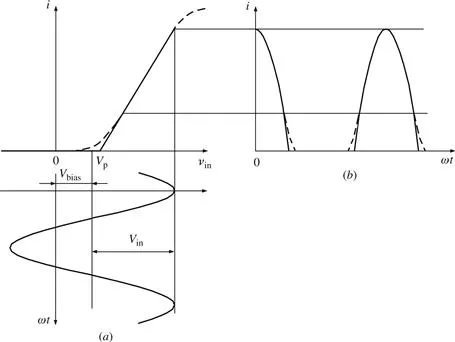
The piecewise-linear approximation of the active device current–voltage transfer characteristic is a result of replacing the actual nonlinear dependence i=f(vin), where vin is the voltage applied to the device input, by an approximated one that consists of the straight lines tangent to the actual dependence at the specified points. Such a piecewise-linear approximation for the case of two straight lines is shown in Fig. 1.1(a).
The output-current waveforms for the actual current–voltage dependence (dashed curve) and its piecewise-linear approximation by two straight lines (solid curve) are plotted in Fig. 1.1(b). Under large-signal operation mode, the waveforms corresponding to these two dependences are practically the same for the most part, with negligible deviation for small values of the output current close to the pin...
Table of contents
Cover image
Title page
Table of Contents
Copyright
About the Authors
Foreword
Preface
Acknowledgments
Chapter 1. Power Amplifier Design Principles
Chapter 2. Class-D Power Amplifiers
Chapter 3. Class-F Power Amplifiers
Chapter 4. Inverse Class-F
Chapter 5. Class-E with Shunt Capacitance
Chapter 6. Class-E with Finite DC-Feed Inductance
Chapter 7. Class-E with Quarterwave Transmission Line
Chapter 8. Broadband Class-E
Chapter 9. Alternative and Mixed-Mode High-Efficiency Power Amplifiers
Chapter 10. High-Efficiency Doherty Power Amplifiers
Chapter 12. Computer-Aided Design of Switchmode Power Amplifiers
Index
Trusted by 375,005 students
Access to over 1.5 million titles for a fair monthly price.
Study more efficiently using our study tools.
Frequently asked questions
Yes, you can cancel anytime from the Subscription tab in your account settings on the Perlego website. Your subscription will stay active until the end of your current billing period. Learn how to cancel your subscription
No, books cannot be downloaded as external files, such as PDFs, for use outside of Perlego. However, you can download books within the Perlego app for offline reading on mobile or tablet. Learn how to download books offline
Perlego offers two plans: Essential and Complete
Essential is ideal for learners and professionals who enjoy exploring a wide range of subjects. Access the Essential Library with 800,000+ trusted titles and best-sellers across business, personal growth, and the humanities. Includes unlimited reading time and Standard Read Aloud voice.
Complete: Perfect for advanced learners and researchers needing full, unrestricted access. Unlock 1.5M+ books across hundreds of subjects, including academic and specialized titles. The Complete Plan also includes advanced features like Premium Read Aloud and Research Assistant.
Both plans are available with monthly, semester, or annual billing cycles.
We are an online textbook subscription service, where you can get access to an entire online library for less than the price of a single book per month. With over 1.5 million books across 990+ topics, we’ve got you covered! Learn about our mission
Look out for the read-aloud symbol on your next book to see if you can listen to it. The read-aloud tool reads text aloud for you, highlighting the text as it is being read. You can pause it, speed it up and slow it down. Learn more about Read Aloud
Yes! You can use the Perlego app on both iOS and Android devices to read anytime, anywhere — even offline. Perfect for commutes or when you’re on the go. Please note we cannot support devices running on iOS 13 and Android 7 or earlier. Learn more about using the app
Yes, you can access Switchmode RF and Microwave Power Amplifiers by Andrei Grebennikov,Nathan O. Sokal,Marc J. Franco in PDF and/or ePUB format, as well as other popular books in Technology & Engineering & Engineering General. We have over 1.5 million books available in our catalogue for you to explore.