- 544 pages
- English
- ePUB (mobile friendly)
- Available on iOS & Android
eBook - ePub
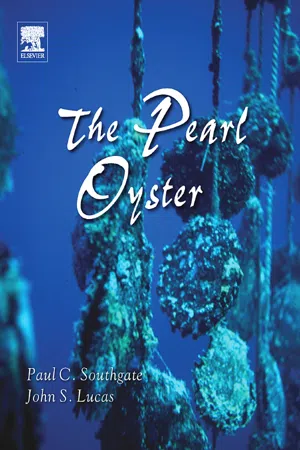
The Pearl Oyster
About this book
Contrary to a generally held view that pearls are found by chance in oysters, almost all are now produced from farms. This book is a comprehensive treatment of all aspects of the biology of pearl oysters, their anatomy, reproduction, genetics, diseases, etc. It considers how they are farmed from spawning and culturing larvae in hatcheries to adults in the ocean; how various environmental factors, including pollution affect them; and how modern techniques are successfully producing large numbers of cultured pearls. This is the ultimate reference source on pearl oysters and the culture of pearls, written and edited by a number of scientists who are world experts in their fields.
- Comprehensive treatment of pearl oyster biology and pearl culture
- Written by the top world authorities
- Highly illustrated and figured
- Of practical relevance to a broad readership, from professional biologists to those involved in the practicalities and practice of pearl production
Trusted by 375,005 students
Access to over 1.5 million titles for a fair monthly price.
Study more efficiently using our study tools.
Information
Subtopic
Marine BiologyChapter 1. Introduction
1.1. Historical Overview
The delicate beauty of the pearl has fascinated mankind since the dawn of time and it has been cherished by the most uncivilized peoples and highly refined civilizations in equal measures. Pearls were treasures, symbols of wealth, power and prestige, and they were met with devotion and respect.
The first pearls may have been found accidentally while searching for food, and it is not difficult to imagine that both the iridescent shells and the round, white and shining objects found within them attracted the admiration of our early ancestors.
Shells were themselves worked into jewelry and decorative objects. The oldest findings, discovered in early 2004, are 75,000 years old; they come from the Blombos cave in South Africa. Forty-one shells of the marine snail Nassarius kraussianus, only 7–8 mm in size, were pierced in an identical manner and were painted with ocher on the inside.
1.1.1. Antiquity
Mother-of-pearl (MOP) inlays made around 4500 bc were found within the ruins of Bismaya in Mesopotamia, and sculptures dating from the Babylonian era from excavations in Nineveh and Nimrud confirm that pearls had been known as decorative objects (Strack, 2006). Although no direct findings are available, historians take it for granted that the early civilizations knew of the pearl grounds in the Persian Gulf and the Red Sea. The oldest discoveries of pearl shells in Egypt date back to the 4th millennium bc, while it is only after the Persian conquest in the 5th century that interest in pearls became larger, leading to extravagant use in Alexandria during the Ptolemaic period.
Quotations in the Talmud and the Bible are an indication of the significance the ancients attributed to pearls. The Talmud mentions in Genesis that the dresses God provided for Adam and Eve were “as beautiful as pearls” and speaks of “Manna as white as pearls”. The Old Testament refers to pearls within the Proverbs of Solomon (8: 11): Wisdom is more precious than coral or pearls,and it is not even equalled by rubies.
Later translations do not mention pearls anymore and speak instead of rubies as treasures. The reason for this is that the old Hebrew word for pearls has not yet been defined precisely and different interpretations are encountered today. The New Testament mentions pearls in a parable of Jesus (Matthew 13: 45–46): Again, the kingdom of heaven is like a merchant looking for fine pearls. When he found one of great value, he went away and sold everything he had and bought it.
And Matthew 7: 6 mentions in the famous Sermon on the Mount: Do not give dogs what is sacred;do not throw your pearls to pigs.If you do, they may trample them under their feet,and then turn and tear you to pieces.
The Revelation of John (21: 21) speaks of the 12 pearly gates in the wall encircling New Jerusalem, made entirely of precious stones: And the twelve gates were twelve pearls,each gate was made of a single pearl.
The Koran mentions pearls as a symbol for precious objects. The trees in paradise bear fruit made of pearls and emeralds; and the believer who enters paradise will be crowned with pearls of incomparable beauty.
Indian history makes first mention of pearls in the Veda, the holy books of the Brahmans, who speak of “krisana”. A Hindu legend recounts that Lord Krishna offered the first pearl that he found in the deepest place of the sea to his daughter Pandaia as a wedding gift, and until today Indian brides traditionally wear pearls on their wedding days. But pearls are also a symbol of tears, going back to the story of the daughter of the Great Mogul of Delhi whose daughter wept bitter tears on her lost love and when she died, the God of Love and Passion transformed her tears into pearls.
In classical Sanskrit pearls were named “mukta”, which means as much as purity or escape, alluding to the spirit of the mollusc that wants to escape and solidify as a pearl. In the East, as far away as the Sulu Islands, the names for pearls will later be derived from the Sanskrit name. Sanskrit also uses the word “maracata” from which the Persian “morvarid” and the Greek “margarita” were later derived.
The ancient Greeks dedicated the pearl to Aphrodite, the goddess of love who was herself compared to a precious pearl as she had risen out of the water from a shell. Homer rarely mentions pearls, although the following line from the Ilias (XIV, 183) may refer to pearls: In three shining drops the glittering gems were hanging from her ears.
The origin of pearls was explained by the help of legends and the idea was favoured that pearls were being formed by lightning striking the sea. In the 4th century bc, Theophrastus mentions for the first time the word “margarita” and makes the first scientific attempt to explain why pearls form in molluscs. The word “margarita”, still used in modern Greek language for pearls, was used by 18th and 19th century zoologists when they created the first scientific names for pearl-producing molluscs, for example, Mytilus margaritiferus, Meleagrina margaritifera. “Margaritology” denotes the science of pearls. Most European languages use “Margarita” as a name for girls and in English language even the word “Pearl” itself is used as a name for girls.
It was not until the conquests of Alexander the Great (356–323 bc) that lavish quantities of pearls from the East poured onto the Western markets. Alexandria, capital of the Ptolemaic empire since 304 bc, developed into a rich metropolis where even freshwater pearls, derived from mussels from Britain, were offered for sale. They were brought by the Phoenicians who came to England as early as the 7th century bc.
The early trade with pearls reached its climax during the Roman Empire. The riches originated from Pompeius’ conquest of the East, and consequently pearls flowed into Rome from all countries and all major cities of the old world. The pearl trade was grouped in the hands of the so-called “margaritarii”, a name given to divers but also to pearl traders and jewelers as well. They kept their “officinae margaritariorum” in the Forum Romanum. Pearls, called “margarita”, rose to become the top luxury item. In his “Historia naturalis”, Gaius Plinius Secundus (24–79 ad) writes of a number of other names that were used for pearls, among them the word “perla”; while “margarita” was also used for other cherished objects or even for beloved persons, especially children.
Plinius gives a vivid description of the luxurious use of pearls of his time. Caesar paid six million sestertia for one single pearl in the year 59 bc, which he gave to Servilia, mother of Brutus. The amount would equal about US$650,000 today. Plinius also writes of seeing Lollia Paulina, the second wife of Emperor Caligula, wearing lavish pearl and emerald jewelry; and he complains about the vanity of the Roman ladies of his time. Plinius also recounts the legend of Cleopatra’s bet with Marc Anthony, that she would be able to eat in his presence a meal worth 60 million sestertia (ca. US$6.5 million today). She dissolved the pearl from an earring in a glass of vinegar and proceeded to drink. The pearl from the second earring, saved from suffering the same fate as the first by Lucius Plancus, the adjudicator of the bet, was allegedly later brought to Rome, divided into two halves, and used to adorn the ears of the state of Venus in the Pantheon.
1.1.2. Medieval Times
The luxurious use of pearls continued long into the later period of antiquity and into the early Middle Ages. When Rome was taken by Alarich in 410 ad, the Roman pearl treasures fell into the hands of the Goths and passed in the 6th and 7th century to the Franconian rulers. Byzantium became the capital of the Eastern Roman empire and replaced Rome as the center of the ancient world. Pearls continued to be used luxuriously, and their lavish use is best reflected in the famous mosaic picture of Ravenna’s San Vitale cathedral that shows the early Byzantine Emperor Justinian I (483–585) and his wife Theodora in shining regalia.
The Franconian period saw a continuing use of pearls in sacred goldsmith art, and the tradition was continued until into the 15th century. Reliquaries, crosses, chalices and evangelaries, scepters, coats for priests and antependia were decorated and embroidered with pearls.
In the early Middle Ages pearls became a symbol of purity for worshiping the Madonna, and Christ came to be seen as the exquisite pearl carried by Mary. Images of love and femininity had by now been successfully integrated into Christian symbolism. The Orthodox Church later adopted the traditions and used pearls to decorate icons.
The sacred use of pearls reached its climax during the time of Charlemagne (768–814), and Albrecht Dürer’s painting of the emperor in his coronation robes demonstrates the Franconian pearl luxury. While the last traces of pearls from antiquity were gradually lost, local river pearls replaced them. The Romans had already known pearls from freshwater mussels in the River Moselle and its tributaries in the Eifel and Hunsrück mountains in southwest Germany. Ausonius, a tutor to Emperor Valentian I, speaks of them in his hymn to the Mosella.
Pearls remained a symbol of power and wealth even after the empire of Charlemagne was divided up upon his death. The so-called Imperial Crown of Konrad II (1024–1039), kept today at the Kunsthistorisches Museum in Vienna, was made during the 10th and 11th centuries (Fig. 1.1).The crown is embellished with enameled pictures of Byzantine influence and a variety of colored gemstones, interspersed with pearls and signed with a pearl-studded inscription of the emperor’s name.
Figure 1.1. The so-called Imperial Crown of Konrad II. The front plate is 14.9 cm high. Weltliche und Geistliche Schatzkammer, Kunsthistorisches Museum, Vienna. (Photo: Kunsthistorisches Museum, Vienna.)

The 11th and 12th centuries saw the art of pearl embroideries develop in European monasteries and courts. The origin goes back to the East Roman Empire, and Crusaders brought the art to Europe. The church soon discovered the new art as a means of representation and had altar cloths, garments for priests, bishops’ caps, corporalia bags and tiny coats for statuettes of the Virgin Mary embroidered with pearls. Pearl embroideries were most popular from the 12th century onwards in the Heath Monasteries on Lüneburg Heath in North Germany. The “Kasel Cross” of Ebstorf Monastery on Lüneburg Heath, originating from around 1500, is an especially beautiful example (Fig. 1.2). The art did not survive the reformation period.
Figure 1.2. The “Kasel Cross” was embroidered around 1500 and is today part of on antependium at Ebstorf Monastery in North Germany. It measures 95 cm in height and 73.5 cm in width. The...
Table of contents
- Cover
- Title
- Brief Table of Contents
- Table of Contents
- Copyright Page
- Preface
- List of Contributors
- Dedication
- Acknowledgments
- Chapter 1. Introduction
- BibliographyReferences
- Chapter 2. Taxonomy and Phylogeny
- BibliographyReferences
- Chapter 3. Soft Tissue Anatomy, Shell Structure and Biomineralization
- BibliographyReferences
- Chapter 4. Feeding and Metabolism
- BibliographyReferences
- Chapter 5. Reproduction, Development and Growth
- BibliographyReferences
- Chapter 6. Environmental Influences
- BibliographyReferences
- Chapter 7. Pearl Oyster Culture
- BibliographyReferences
- Chapter 8. Pearl Production
- BibliographyReferences
- Chapter 9. Exploitation and Culture of Major Commercial Species
- BibliographyReferences
- Chapter 10. The Pearl Market
- BibliographyReferences
- Chapter 11. Disease and Predation
- BibliographyReferences
- Chapter 12. Population Genetics and Stock Improvement
- BibliographyReferences
- Chapter 13. Economics of Pearl Farming
- BibliographyReferences
- Chapter 14. Environmental Impacts of Pearl Farming
- BibliographyReferences
- Chapter 15. Biofouling
- BibliographyReferences
- Chapter 16. Future Developments
- BibliographyReferences
- Index
Frequently asked questions
Yes, you can cancel anytime from the Subscription tab in your account settings on the Perlego website. Your subscription will stay active until the end of your current billing period. Learn how to cancel your subscription
No, books cannot be downloaded as external files, such as PDFs, for use outside of Perlego. However, you can download books within the Perlego app for offline reading on mobile or tablet. Learn how to download books offline
Perlego offers two plans: Essential and Complete
- Essential is ideal for learners and professionals who enjoy exploring a wide range of subjects. Access the Essential Library with 800,000+ trusted titles and best-sellers across business, personal growth, and the humanities. Includes unlimited reading time and Standard Read Aloud voice.
- Complete: Perfect for advanced learners and researchers needing full, unrestricted access. Unlock 1.5M+ books across hundreds of subjects, including academic and specialized titles. The Complete Plan also includes advanced features like Premium Read Aloud and Research Assistant.
We are an online textbook subscription service, where you can get access to an entire online library for less than the price of a single book per month. With over 1.5 million books across 990+ topics, we’ve got you covered! Learn about our mission
Look out for the read-aloud symbol on your next book to see if you can listen to it. The read-aloud tool reads text aloud for you, highlighting the text as it is being read. You can pause it, speed it up and slow it down. Learn more about Read Aloud
Yes! You can use the Perlego app on both iOS and Android devices to read anytime, anywhere — even offline. Perfect for commutes or when you’re on the go.
Please note we cannot support devices running on iOS 13 and Android 7 or earlier. Learn more about using the app
Please note we cannot support devices running on iOS 13 and Android 7 or earlier. Learn more about using the app
Yes, you can access The Pearl Oyster by Paul Southgate,John Lucas in PDF and/or ePUB format, as well as other popular books in Technology & Engineering & Marine Biology. We have over 1.5 million books available in our catalogue for you to explore.