Carbon Dioxide Utilisation: Closing the Carbon Cycle explores areas of application such as conversion to fuels, mineralization, conversion to polymers, and artificial photosynthesis as well as assesses the potential industrial suitability of the various processes. After an introduction to the thermodynamics, basic reactions, and physical chemistry of carbon dioxide, the book proceeds to examine current commercial and industrial processes, and the potential for carbon dioxide as a green and sustainable resource.
While carbon dioxide is generally portrayed as a "bad" gas, a waste product, and a major contributor to global warming, a new branch of science is developing to convert this "bad" gas into useful products. This book explores the science behind converting CO2 into fuels for our cars and planes, and for use in plastics and foams for our homes and cars, pharmaceuticals, building materials, and many more useful products.
Carbon dioxide utilization is a rapidly expanding area of research that holds a potential key to sustainable, petrochemical-free chemical production and energy integration.
- Accessible and balanced between chemistry, engineering, and industrial applications
- Informed by blue-sky thinking and realistic possibilities for future technology and applications
- Encompasses supply chain sustainability and economics, processes, and energy integration
What is CO2? Thermodynamics, Basic Reactions and Physical Chemistry
Michael North Green Chemistry Centre of Excellence, Department of Chemistry, The University of York, Heslington, York, UK
Abstract
This introductory chapter introduces the structural, physical and spectroscopic properties of carbon dioxide and shows how these are linked to its role in global warming. The phase behaviour of carbon dioxide is introduced including the accessibility of a supercritical phase. The kinetics and thermodynamics of reactions involving carbon dioxide are introduced to provide a theoretical basis for understanding the reactions of carbon dioxide and the limitations as to what catalysis can achieve. Finally, the commercially important chemical reactions of carbon dioxide are surveyed within this kinetic and thermodynamic framework.
Carbon dioxide (CO2) is a triatomic molecule with a molecular weight of 44Da. It is a gas at room temperature and pressure. At atmospheric pressure it sublimes directly from a solid to a gas at −78°C. Carbon dioxide is a relatively inert gas which is neither explosive nor flammable and which does not support combustion. Therefore, it is widely used in fire extinguishers and fire suppression systems, though some care is needed especially in confined spaces as it is an asphyxiant and has a density (1.98kg/m3 at 0°C) greater than that of air. Carbon dioxide occurs naturally in the Earth's atmosphere as a result of volcanic eruptions, forest fires and plant and animal respiration. It is essential to the growth of green plants which use photosynthesis to convert carbon dioxide and water into sugars. These are key parts of the natural carbon cycle which controls the level of carbon dioxide in the Earth's atmosphere and hence the surface temperature of the planet.1 Prior to the start of the industrial revolution, atmospheric carbon dioxide levels were around 270ppm by volume.2
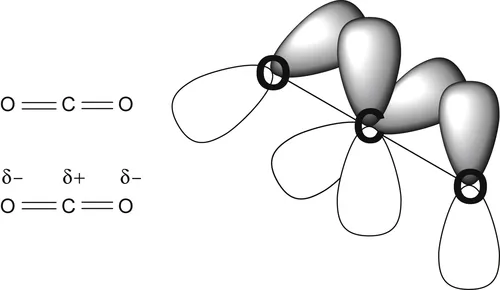
The carbon dioxide molecule has a linear structure in which each carbon–oxygen bond has a length of 116.3pm and is composed of a σ- and a π-bond. The two π-bonds are orthogonal to one another and like any carbon–oxygen bonds are polarised such that the carbon atom carries a partial positive charge (+0.592) and the oxygen atoms carry a partial negative charge (−0.296) due to the higher electronegativity of oxygen compared to carbon. Figure 1.1 shows various representations of carbon dioxide.
FIGURE 1.1 Representations of carbon dioxide.
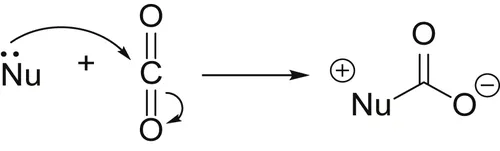
The chemical reactivity of carbon dioxide is determined by the polarisation of the carbon oxygen bonds, and the chemistry is dominated by the reaction of carbon dioxide with nucleophiles which react at the central carbon atom (Scheme 1.1). The nucleophile may be a neutral species with a lone pair of electrons (e.g., an amine), may possess an electron-rich π-bond (e.g., a phenolate) or may possess a carbon-metal σ-bond (e.g., a Grignard reagent). The other key feature of the chemistry of carbon dioxide is its coordination to metals. This is an important area as the coordination of carbon dioxide to a metal can significantly change both the electron distribution and molecular geometry within the carbon dioxide molecule, thus dramatically changing its chemical reactivity.
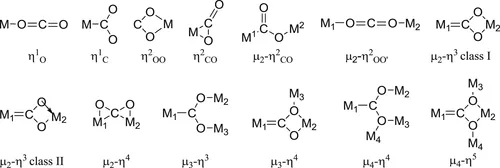
This is the basis of many metal-induced and metal-catalysed reactions of carbon dioxide. The area is however complicated by the numerous ways in which carbon dioxide can coordinate to one or more metals due to its ability to coordinate through either carbon or oxygen and to bridge between metal atoms. As shown in Figure 1.2, there are at least 13 known coordination geometries in carbon dioxide metal complexes.3a–3d,4 If just the monometallic complexes are considered, an electron deficient metal will coordinate to one of the oxygen atoms
and this does not change the geometry of the carbon dioxide, but will withdraw electron density from it, thus making the carbon atom more susceptible to attack by nucleophiles. In contrast, metals with loosely held electrons may coordinate to the carbon atom of carbon dioxide
which both makes the carbon atom less electron deficient and hence less susceptible to attack by nucleophiles: this also changes the overall geometry of the CO2 unit from linear to bent.
SCHEME 1.1 Reaction of carbon dioxide with nucleophiles.
FIGURE 1.2 Carbon dioxide metal complex geometries.
1.2. Spectroscopy and its role in climate change
The carbon dioxide molecule has three vibrational modes: two stretches (symmetric and anti-symmetric) and a bend (Figure 1.3). For gaseous carbon dioxide, the symmetric stretch (1286–1388cm−1) does not involve a change in the molecular dipole moment and hence it is infrared inactive, but Raman active. The anti-symmetric stretch (2349cm−1) and bend (667cm−1) do involve a change in the molecular dipole moment and hence are infrared active.4 The 13C NMR resonance of carbon dioxide in non-polar solvents occurs at 126ppm.4
The infrared active vibrations of carbon dioxide are directly responsible for its role as a greenhouse gas. The Earth's atmosphere is transparent to visible light coming from the sun which strikes the Earth's surface and is reemitted as infrared radiation. The main components of the Earth's atmosphere (oxygen and nitrogen) are also transparent to infrared radiation. Howe...
Table of contents
Cover image
Title page
Table of Contents
Copyright
List of Contributors
Preface
Part 1. Introductory Concepts
Part 2. Contribution to Materials
Part 3. Energy and Fuels
Part 4. Perspectives and Conclusions
Index
Trusted by 375,005 students
Access to over 1.5 million titles for a fair monthly price.
Study more efficiently using our study tools.
Frequently asked questions
Yes, you can cancel anytime from the Subscription tab in your account settings on the Perlego website. Your subscription will stay active until the end of your current billing period. Learn how to cancel your subscription
No, books cannot be downloaded as external files, such as PDFs, for use outside of Perlego. However, you can download books within the Perlego app for offline reading on mobile or tablet. Learn how to download books offline
Perlego offers two plans: Essential and Complete
Essential is ideal for learners and professionals who enjoy exploring a wide range of subjects. Access the Essential Library with 800,000+ trusted titles and best-sellers across business, personal growth, and the humanities. Includes unlimited reading time and Standard Read Aloud voice.
Complete: Perfect for advanced learners and researchers needing full, unrestricted access. Unlock 1.5M+ books across hundreds of subjects, including academic and specialized titles. The Complete Plan also includes advanced features like Premium Read Aloud and Research Assistant.
Both plans are available with monthly, semester, or annual billing cycles.
We are an online textbook subscription service, where you can get access to an entire online library for less than the price of a single book per month. With over 1.5 million books across 990+ topics, we’ve got you covered! Learn about our mission
Look out for the read-aloud symbol on your next book to see if you can listen to it. The read-aloud tool reads text aloud for you, highlighting the text as it is being read. You can pause it, speed it up and slow it down. Learn more about Read Aloud
Yes! You can use the Perlego app on both iOS and Android devices to read anytime, anywhere — even offline. Perfect for commutes or when you’re on the go. Please note we cannot support devices running on iOS 13 and Android 7 or earlier. Learn more about using the app
Yes, you can access Carbon Dioxide Utilisation by Peter Styring,Elsje Alessandra Quadrelli,Katy Armstrong in PDF and/or ePUB format, as well as other popular books in Technology & Engineering & Renewable Power Resources. We have over 1.5 million books available in our catalogue for you to explore.