eBook - ePub
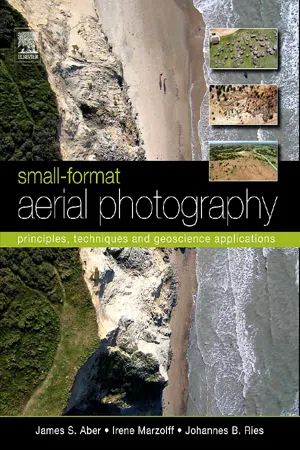
Small-Format Aerial Photography
Principles, Techniques and Geoscience Applications
- 268 pages
- English
- ePUB (mobile friendly)
- Available on iOS & Android
eBook - ePub
Small-Format Aerial Photography
Principles, Techniques and Geoscience Applications
About this book
As the need for geographical data rapidly expands in the 21st century, so too do applications of small-format aerial photography for a wide range of scientific, commercial and governmental purposes. Small-format Aerial Photography (SFAP) presents basic and advanced principles and techniques with an emphasis on digital cameras. Unmanned platforms are described in considerable detail, including kites, helium and hot-air blimps, model airplanes, and paragliders. Several case studies, primarily drawn from the geosciences, are presented to demonstrate how SFAP is actually used in various applications. Many of these integrate SFAP with ground-based investigations as well as conventional large-format aerial photography, satellite imagery, and other kinds of geographic information.
- Full-color photographs throughout
- Case studies from around the globe
- Techniques presented allow for image resolution impossible to match via traditional aerial photography or satellite datasets
- Glossary clarifies key terms
Information
Subtopic
Civil EngineeringChapter 1
Introduction to Small-Format Aerial Photography
Small is beautiful.
E. Schumacher 1973, quoted by Mack (2007)
1.1. OVERVIEW
People have acquired aerial photographs ever since the means have existed to lift cameras above the Earth’s surface, beginning in the mid-19th century. Human desire to see the Earth “as the birds do” is strong for many practical and aesthetic reasons. From rather limited use in the 19th century, the scope and technical means of aerial photography expanded throughout the 20th century. The technique is now utilized for all manners of earth-resource applications from small and simple to large and sophisticated.
Aerial photographs are taken normally from manned airplanes or helicopters, but many other platforms may be used, including balloons, tethered blimps, drones, gliders, rockets, model airplanes, kites, and even birds (Tielkes, 2003). Recent innovations for cameras and platforms have led to new scientific, commercial, and artistic possibilities for acquiring dramatic aerial photographs (Fig. 1-1).
The emphasis of this book is small-format aerial photography (SFAP) utilizing 35- and 70-mm film cameras as well as compact digital and video cameras. In general terms, such cameras are typically designed for hand-held use, in other words of such size and weight that amateur or professional photographers normally hold the camera in one or both hands while taking pictures. Such cameras may be employed from manned or unmanned platforms ranging in height from just 10s of meters above the ground to 100s of kilometers into space. Platforms may be as simple as a fiberglass rod to lift up a point-and-shoot camera, as purpose-designed as a remotely controlled blimp for vertical image acquisition, or as complex as the International Space Station with its specially designed nadir window dedicated to Earth observation (Fig. 1-2).

FIGURE 1-1 Vertical view of abandoned agricultural land dissected by erosion channels near Freila, Province of Granada (Spain) during a photographic survey taken with a hot-air blimp (left of center) at low flying heights. The blimp is navigated by tether lines from the ground; camera functions are remotely controlled. Its picture was taken with a compact digital camera in continuous shooting mode from an autopiloted model airplane following Google Earth-digitized flight lines at ~ 200 m height. The takeoff pad at right is 12 × 8 m in size. Photo by C. Claussen, M. Niesen, and JBR, September 2008.

FIGURE 1-2 Artist’s rendition of the International Space Station following installation of its nadir-viewing optical-quality window in 2001. Arrow (^) indicates position of nadir window. Image adapted from Johnson Space Center Office of Earth Sciences (Image JSC2001e00360) <http://visibleearth.nasa.gov/>.
SFAP became a distinct niche within remote sensing during the 1990s and has been employed in recent years for documenting all manners of natural and human resources (Warner et al., 1996; Bauer et al., 1997). The field is ripe with experimentation and innovation of equipment and techniques applied to diverse situations. In the past, most aerial photography was conducted from manned platforms, as the presence of a human photographer looking through the camera viewfinder was thought to be essential for acquiring useful imagery. For example, Henrard developed an aerial camera in the 1930s, and he photographed Paris from small aircrafts for the next four decades compiling a remarkable aerial survey of the city (Cohen, 2006).
This is still true for many missions and applications today. Perhaps the most famous modern aerial artist-photographer, Y. Arthus-Bertrand, produced his Earth from above masterpiece by simply flying in a helicopter using hand-held cameras (Arthus-Bertrand, 2002). Likewise, G. Gerster has spent a lifetime acquiring superb photographs of archaeological ruins and natural landscapes throughout the world from the open door of a small airplane or helicopter (Gerster, 2004).
The most widely available and commonly utilized manned platform nowadays is the conventional fixed-wing small airplane, employed by many small-format aerial photographers (Caulfield, 1987). Among several recent examples, archaeological sites were documented for many years by O. Braasch in Germany (Braasch and Planck, 2005), and by Eriksen and Olesen in northwestern Denmark (2002). In central Europe, Markowski (1993) adopted this approach for aerial views of Polish castles. Bárta and Barta (2006), a father and son team, produced stunning pictures of landscapes, villages and urban scenes in Slovakia.
In the United States, Hamblin (2004) focused on panoramic images of geologic scenery in Utah, and D. Maisel has sought out provocative images of strip mines, dry lake beds, and other unusual landscape patterns in the western United States (Gambino, 2008). In one of the most unusual manned vehicles, C. Feil pilots a small autogyro for landscape photography in New York and New England of the United States (Feil and Rose, 2005). An ultralight aircraft is utilized for archaeological and landscape scenes in the southwestern United States by A. Heisey (Heisey and Kawano, 2001; Heisey, 2007).

FIGURE 1-3 Closeup vertical view of elephant seals on the beach at Point Piedras, California, United States. These juvenile seals are ~2 to 2.5 m long, and most are sleeping on a bank of seaweed. People were not allowed to approach the seals on the ground, but the seals were not aware of the photographic activity overhead. The spatial detail depicted in such images is extraordinary; individual pebbles are clearly visible on the beach. Kite aerial photograph taken with a compact digital camera. Photo by SWA and JSA, November 2006.
Unmanned, tethered or remotely flown platforms are coming into increasingly widespread use nowadays. This book highlights such unmanned systems for low-height SFAP, including kites, blimps, and drones. Representative recent kite aerial photography, for example, includes C. Wilson’s (2006) beautiful views of Wisconsin in the United States, E. Tielkes’s (2003) work in Africa, and N. Chorier’s magnificent pictures of India (Chorier and Mehta, 2007). Such imagery has large scale and exceptionally high spatial resolution that depict ground features in surprising detail from vantage points difficult to achieve by other means (Fig. 1-3). These photographic views bridge the gap between ground observations and conventional airphotos or satellite images.
1.2. BRIEF HISTORY
Since ancient times, people have yearned to see the landscape as the birds do, and artists have depicted scenes of the Earth as they imagined from above. Early maps of major cities often were presented as bird’s-eye views, showing streets, buildings, and indeed people from a perspective that only could be imagined by the artist. Good examples can be found in Frans Hogenberg’s Civitates Orbis Terrarum (Cologne, 1572–1617). Seventeenth-century artists such as Wenceslaus Hollar engraved remarkable urban panoramas that showed cities from an oblique bird’s-eye view. The visual impact of such images is remarkably close to that of aerial photographs.
George Catlin was another leading practitioner of aerial vantages in the early 1800s (Fig. 1-4). Catlin adopted a documentary style of painting in order to represent natural and human conditions in realistic terms. By sheer force of their imagination and their technical mastery, Catlin and previous artists simulated the act of taking images from the air. It was not until the mid-1800s, however, that two innovations combined, namely manned flight and photochemical imagery, to make true aerial photography possible. Since then, photography and flight have developed in myriad ways leading to many manned and unmanned methods for observing the Earth from above (Fig. 1-5).
1.2.1. Nineteenth Century
Louis-Jacques-Mandé Daguerre invented photography based on silver-coated copper plates in the 1830s, and this process was published by the French government in 1839 (Romer, 2007). The earliest known attempt to take aerial photographs was made by Colonel Aimé Laussedat of the French Army Corps of Engineers (Wolf and Dewitt, 2000). In 1849, he experimented with kites and balloons, but was unsuccessful. The first documented aerial photograph was taken from a balloon in 1858 by Gaspard Félix Tournachon, later known as “Nadar” (Colwell, 1997). He ascended in a tethered balloon to a height of several hundred meters and photographed the village of Petit Bicêtre, France. Later that same year, Laussedat again tried to use a glass-plate camera lifted by several kites (Colwell, 1997), but it is uncertain if he was successful. The oldest surviving airphoto was taken by S.A. King and J.W. Black from a balloon in 1860 over Boston, Massachusetts (Jensen, 2007).

FIGURE 1-4 Bird’s-eye view of Niagara Falls, Canada, and the United States. George Catlin, 1827, gouache, ~45 × 39 cm. Adapted from Dippie et al. (2002, p. 36).
Hydrogen-filled balloons were utilized for observations of enemy positions during the American Civil War (1861–1865); photographs reputedly were taken, although none have survived (Jensen, 2007). Meanwhile, Tournachon continued his experiments with balloons and aerial photography in France with limited success. In 1887, a German forester obtained airphotos from a balloon for the purpose of identifying and measuring stands of forest trees (Colwell, 1997).
Already in the 1850s, stereophotography was practiced, and new types of glass led to modern anastigmatic camera lenses by 1890 (Zahorcak, 2007). Experimental color photography was conducted by F.E. Ives in the 1890s (Romer, 2007).

FIGURE 1-5 Schematic illustration of the “multi” approach for remote sensing of the Earth’s surface from above. Multiple types of platforms and instruments operating at multiple heights. SFAP as emphasized in this book deals primarily with the ultra-low height range of observations. Not to scale, adapted from Avery and Berlin (1992, fig. 1-1).
Considerable debate and uncertainty surround the question of who was first to take aerial photographs from a kite. By some accounts, the first person was the British meteorologist E.D. Archibald, as early as 1882 (Colwell, 1997). He is credited with taking kite aerial photographs in 1887 by using a small explosive charge to release the camera shutter (Hart, 1982). At about the same time, the Tissandier brothers, Gaston and Albert, also conducted kite and balloon aerial photography in France (Cohen, 2006). Others maintain that kite aerial photography was invented in France in 1888 by A. Batut, who built a lightweight camera using a 9 × 12-cm glass plate for the photographic emulsion (Beauffort and Dusariez, 1995). The camera was attached to the wooden frame of a diamond-shaped kite and was triggered by a burning fuse. Later he built a panoramic system that included six cameras in a hexagonal arrangement for 360° views (Tielkes, 2003).
In 1890, Batut published the first book on kite aerial photography entitled La photographie aérienne par cerfvolant—aerial photography by kite (Batut, 1890; translated and reprinted in Beauffort and Dusariez, 1995). In that same year, another Frenchman, Emile Wenz, began practicing kite aerial photography. Batut and Wenz developed a close working relationship that lasted many years. They quickly gave up the technique of attaching the camera directly to the kite frame in favor of suspension from the line some 10s of meters below the kite. The activities of Batut and Wenz gained considerable attention in the press, and the method moved across the Atlantic. The first kite aerial photographs in the United States were taken in 1895 (Beauffort and Dusariez, 1995). Thereafter the practice of taking photographs from kites advanced rapidly with many technological innovations.
1.2.2. Twentieth Century
The early 20th century may be considered the golden age of kite aerial photography. At the b...
Table of contents
- Cover
- Title
- Copyright
- Dedication
- Preface
- Acknowledgments
- Chapter 1 Introduction to Small-Format Aerial Photography
- Chapter 2 Basic Principles of Small-Format Aerial Photography
- Chapter 3 Photogrammetry
- Chapter 4 Lighting and Atmospheric Conditions
- Chapter 5 Photographic Composition
- Chapter 6 Cameras for Small-Format Aerial Photogrammetry
- Chapter 7 Camera Mounting Systems
- Chapter 8 Platforms for Small-Format Aerial Photography
- Chapter 9 SFAP Survey Planning and Implementation
- Chapter 10 Image Interpretation
- Chapter 11 Image Processing and Analysis
- Chapter 12 Glacial Geomorphology
- Chapter 13 Gully Erosion Monitoring
- Chapter 14 Wetland Environments
- Chapter 15 Biocontrol of Salt Cedar
- Chapter 16 Vegetation and Erosion
- Chapter 17 Soil Mapping and Soil Degradation
- Chapter 18 Architecture and Property Management
- Chapter 19 Golf Course Management
- References
- Index
Trusted by 375,005 students
Access to over 1.5 million titles for a fair monthly price.
Study more efficiently using our study tools.
Frequently asked questions
Yes, you can cancel anytime from the Subscription tab in your account settings on the Perlego website. Your subscription will stay active until the end of your current billing period. Learn how to cancel your subscription
No, books cannot be downloaded as external files, such as PDFs, for use outside of Perlego. However, you can download books within the Perlego app for offline reading on mobile or tablet. Learn how to download books offline
Perlego offers two plans: Essential and Complete
- Essential is ideal for learners and professionals who enjoy exploring a wide range of subjects. Access the Essential Library with 800,000+ trusted titles and best-sellers across business, personal growth, and the humanities. Includes unlimited reading time and Standard Read Aloud voice.
- Complete: Perfect for advanced learners and researchers needing full, unrestricted access. Unlock 1.5M+ books across hundreds of subjects, including academic and specialized titles. The Complete Plan also includes advanced features like Premium Read Aloud and Research Assistant.
We are an online textbook subscription service, where you can get access to an entire online library for less than the price of a single book per month. With over 1.5 million books across 990+ topics, we’ve got you covered! Learn about our mission
Look out for the read-aloud symbol on your next book to see if you can listen to it. The read-aloud tool reads text aloud for you, highlighting the text as it is being read. You can pause it, speed it up and slow it down. Learn more about Read Aloud
Yes! You can use the Perlego app on both iOS and Android devices to read anytime, anywhere — even offline. Perfect for commutes or when you’re on the go.
Please note we cannot support devices running on iOS 13 and Android 7 or earlier. Learn more about using the app
Please note we cannot support devices running on iOS 13 and Android 7 or earlier. Learn more about using the app
Yes, you can access Small-Format Aerial Photography by James S. Aber,Irene Marzolff,Johannes Ries in PDF and/or ePUB format, as well as other popular books in Technology & Engineering & Civil Engineering. We have over 1.5 million books available in our catalogue for you to explore.