eBook - ePub
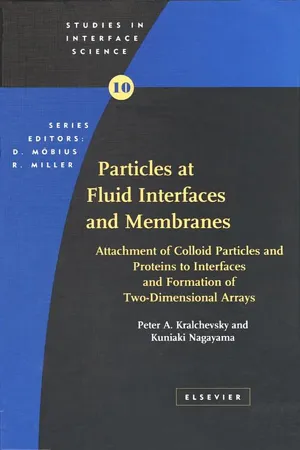
Particles at Fluid Interfaces and Membranes
Attachment of Colloid Particles and Proteins to Interfaces and Formation of Two-Dimensional Arrays
- 668 pages
- English
- ePUB (mobile friendly)
- Available on iOS & Android
eBook - ePub
Particles at Fluid Interfaces and Membranes
Attachment of Colloid Particles and Proteins to Interfaces and Formation of Two-Dimensional Arrays
About this book
In the small world of micrometer to nanometer scale many natural and industrial processes include attachment of colloid particles (solid spheres, liquid droplets, gas bubbles or protein macromolecules) to fluid interfaces and their confinement in liquid films. This may lead to the appearance of lateral interactions between particles at interfaces, or between inclusions in phospholipid membranes, followed eventually by the formation of two-dimensional ordered arrays. The book is devoted to the description of such processes, their consecutive stages, and to the investigation of the underlying physico-chemical mechanisms. The first six chapters give a concise but informative introduction to the basic knowledge in surface and colloid science, which includes both traditional concepts and some recent results. Chapters 1 and 2 are devoted to the basic theory of capillarity, kinetics of surfactant adsorption, shapes of axisymmetric fluid interfaces, contact angles and line tension. Chapters 3 and 4 present a generalization of the theory of capillarity to the case, in which the variation of the interfacial (membrane) curvature contributes to the total energy of the system. The generalized Laplace equation is applied to determine the configurations of free and adherent biological cells. Chapters 5 and 6 are focused on the role of thin liquid films and hydrodynamic factors in the attachment of solid and fluid particles to an interface. Surface forces of various physical nature are presented and their relative importance is discussed. Hydrodynamic interactions of a colloidal particle with an interface (or another particle) are also considered.Chapters 7 to 10 are devoted to the theoretical foundation of various kinds of capillary forces. When two particles are attached to the same interface (membrane), capillary interactions, mediated by the interface or membrane, appear between them. Two major kinds of capillary interactions are described: (i) capillary immersion force related to the surface wettability (Chapter 7), (ii) capillary flotation force originating from interfacial deformations due to particle weight (Chapter 8). Special attention is paid to the theory of capillary immersion forces between particles entrapped in spherical liquid films (Chapter 9). A generalization of the theory of immersion forces allows one to describe membrane-mediated interactions between protein inclusions into a lipid bilayer (Chapter 10).Chapter 11 is devoted to the theory of the capillary bridges and the capillary-bridge forces, whose importance has been recognized in phenomena like consolidation of granules and soils, wetting of powders, capillary condensation, long-range hydrophobic attraction, etc. The nucleation of capillary bridges is also examined.Chapter 12 considers solid particles, which have an irregular wetting perimeter upon attachment to a fluid interface. The undulated contact line induces interfacial deformations, which engender a special lateral capillary force between the particles. The latter contributes to the dilatational and shear elastic moduli of particulate adsorption monolayers.Chapter 13 describes how lateral capillary forces, facilitated by convective flows and some specific and non-specific interactions, can lead to the aggregation and ordering of various particles at fluid interfaces or in thin liquid films. Recent results on fabricating two-dimensional (2D) arrays from micrometer and sub-micrometer latex particles, as well as 2D crystals from proteins and protein complexes, are reviewed. Chapter 14 presents applied aspects of the particle-surface interaction in antifoaming and defoaming. The mechanisms of antifoaming action involve as a necessary step the entering of an antifoam particle at the air-water interface. The considered mechanisms indicate the factors for control of foaminess.
Information
Topic
Physical SciencesSubtopic
Fluid MechanicsTable of contents
- Cover image
- Title page
- Table of Contents
- Copyright page
- Preface
- Chapter 1: Planar Fluid Interfaces
- Chapter 2: Interfaces of Moderate Curvature: Theory of Capillarity
- Chapter 3: Surface Bending Moment and Curvature Elastic Moduli
- Chapter 4: General Curved Interfaces and Biomembranes
- Chapter 5: Liquid Films and Interactions between Particle and Surface
- Chapter 6: Particles at Interfaces: Deformations and Hydrodynamic Interactions
- Chapter 7: Lateral Capillary Forces between Partially Immersed Bodies
- Chapter 8: Lateral Capillary Forces Between Floating Particles
- Chapter 9: Capillary Forces Between Particles Bound to a Spherical Interface
- Chapter 10: Mechanics of Lipid Membranes and Interaction Between Inclusions
- Chapter 11: Capillary Bridges and Capillary-Bridge Forces
- Chapter 12: Capillary Forces Between Particles of Irregular Contact Line
- Chapter 13: Two-Dimensional Crystallization of Particulates and Proteins
- Chapter 14: Effect of Oil Drops and Particulates on the Stability of Foams
- Appendix 1A: Equivalence of the two forms of the Gibbs adsorption equation
- Appendix 8A: Derivation of Equation (8.31)
- Appendix 10A: Connections between two models of lipid membranes
- Index
- Notation
Trusted by 375,005 students
Access to over 1.5 million titles for a fair monthly price.
Study more efficiently using our study tools.
Frequently asked questions
Yes, you can cancel anytime from the Subscription tab in your account settings on the Perlego website. Your subscription will stay active until the end of your current billing period. Learn how to cancel your subscription
No, books cannot be downloaded as external files, such as PDFs, for use outside of Perlego. However, you can download books within the Perlego app for offline reading on mobile or tablet. Learn how to download books offline
Perlego offers two plans: Essential and Complete
- Essential is ideal for learners and professionals who enjoy exploring a wide range of subjects. Access the Essential Library with 800,000+ trusted titles and best-sellers across business, personal growth, and the humanities. Includes unlimited reading time and Standard Read Aloud voice.
- Complete: Perfect for advanced learners and researchers needing full, unrestricted access. Unlock 1.5M+ books across hundreds of subjects, including academic and specialized titles. The Complete Plan also includes advanced features like Premium Read Aloud and Research Assistant.
We are an online textbook subscription service, where you can get access to an entire online library for less than the price of a single book per month. With over 1.5 million books across 990+ topics, we’ve got you covered! Learn about our mission
Look out for the read-aloud symbol on your next book to see if you can listen to it. The read-aloud tool reads text aloud for you, highlighting the text as it is being read. You can pause it, speed it up and slow it down. Learn more about Read Aloud
Yes! You can use the Perlego app on both iOS and Android devices to read anytime, anywhere — even offline. Perfect for commutes or when you’re on the go.
Please note we cannot support devices running on iOS 13 and Android 7 or earlier. Learn more about using the app
Please note we cannot support devices running on iOS 13 and Android 7 or earlier. Learn more about using the app
Yes, you can access Particles at Fluid Interfaces and Membranes by P. Kralchevsky,K. Nagayama in PDF and/or ePUB format, as well as other popular books in Physical Sciences & Fluid Mechanics. We have over 1.5 million books available in our catalogue for you to explore.