- 928 pages
- English
- ePUB (mobile friendly)
- Available on iOS & Android
eBook - ePub
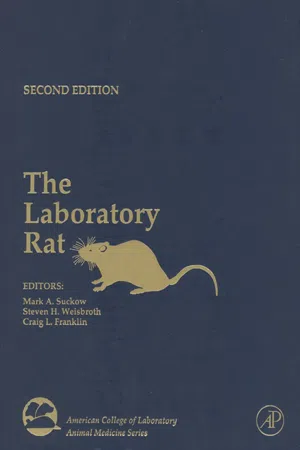
The Laboratory Rat
About this book
The Laboratory Rat, Second Edition features updated information on a variety of topics including: rat genetics and genomics, both spontaneous and induced disease; state-of-the-art technology for housing and husbandry; occupational health, and experimental models. A premier source of information on the laboratory rat that will be of interest to veterinary and medical students, senior graduate, graduate students, post-docs and researchers who utilize animals in biomedical research.
- At least 50% new information than first edition
- Includes topics on rat genetics and genomics, occupational health, and experimental models
- The premier source of information on the laboratory rat
Information
Chapter 1
Historical Foundations
J. Russell Lindsey
Henry J. Baker
Publisher Summary
This chapter traces the biomedical history including the early events and personalities involved in establishment of Rattus norvegicus as a leading laboratory animal. With the coming of modern civilization, a suitable ecological niche became available to the species as an economic pest, allowing its numbers to increase rapidly and spread over the world in close association with man. Regardless of the exact details, the Norway rat became the first mammalian species to be domesticated primarily for scientific purposes. There is some evidence available to suggest that rats probably were used sporadically for nutrition experiments in Europe prior to 1850. Use of the rat in behavioral research began in the Department of Neurology at Clark University in Worcester, Massachusetts. The first behavioral studies using rats were done on an investigation of the effect of alcohol, diet, and barometric changes on animal activity. The Norway rat probably was first used as an experimental animal in a few nutrition studies conducted in Europe prior to 1850. Its popularity for this purpose continued upward as it was used increasingly in several nutrition laboratories in Europe for next several years.
I. ORIGIN OF THE LABORATORY RAT
The purpose of this chapter is to retrace, to around the mid 1970s, one of the most fascinating stories of biomedical history: that of the early events and personalities involved in establishment of Rattus norvegicus as a leading laboratory animal. From the outset, three features of the story deserve acknowledgment. First, it will be possible in the brief space of this chapter to touch only the highlights (but these cannot be treated equally because many important details already have been lost). Second, it is predominantly an American story, as most of the strains of rats in use today around the world trace their ancestry to stocks in the United States. Third, the story is literally one of ascendancy from the gutter to a place of nobility, for what creature is more lowly than the rat as a wild pest or more noble than the same species that has contributed so much to the advancement of knowledge as the laboratory rat!
A. Earliest Records
The earliest records of R. norvegicus are a bit sketchy, but there appears to be good agreement on the major events concerning the species (Donaldson, 1912a; Donaldson, 1912b; Castle, 1947; Richter, 1954; Robinson, 1965). Its original natural habitat is thought to have been the temperate regions of Asia, specifically the area of the Caspian Sea, Tobolsk and Lake Baykal in Russia, and possibly extending across China and Mongolia (Hedrich, 2000). With the coming of modern civilization, a suitable ecological niche became available to the species as an economic pest, allowing its numbers to increase rapidly and spread over the world in close association with man. It is said to have reached Europe early in the 18th century, England between 1728 and 1730, North America by 1755, and northeastern United States by 1775, arriving on ships with early settlers. That the species did at one time in history spread through Norway is readily accepted, but the name “Norway rat” or “Norwegian rat” actually has no meaning other than, possibly, to reflect the species name, i.e., norvegicus (Hedrich, 2000).
Richter (1954) has summarized the likely sequence of events in the domestication of R. norvegicus, as follows:
It is quite likely that Norway rats come into captivity as albinos. We know that rat-baiting was popular in France and England as early as 1800, and in America soon afterward. This sport flourished for seventy years or more, until it finally was stopped by decree. In this sport 100 to 200 recently trapped wild Norways were placed at one time in a fighting pit. A trained terrier was put into the pit. A keeper measured the time until the last rat was killed. Sportsmen bet on the killing times of their favorite terriers. For this sport many Norway rats had to be trapped and held in pounds in readiness for contests. Records indicate that albinos were moved from such pounds and kept for show purposes and or breeding. It is thus very likely that these show rats, that probably had been tamed by frequent handling, found their way at one time or another into laboratories.
B. Earliest Experiments
Regardless of the exact details, the Norway rat became the first mammalian species to be domesticated primarily for scientific purposes (Richter, 1959). There is some evidence to suggest that rats probably were used sporadically for nutrition experiments in Europe prior to 1850 (Verzar, 1973). However, the work generally recognized as the first use of the r...
Table of contents
- Cover image
- Title page
- Table of Contents
- List of Contributors
- Preface
- Foreword
- List of Reviewers for Chapters in This Volume
- Chapter 1: Historical Foundations
- Chapter 2: Ethical and Legal Perspectives
- Chapter 3: Taxonomy and Stocks and Strains
- Chapter 4: Morphophysiology
- Chapter 5: Clinical Pathology of the Rat
- Chapter 6: Reproduction and Breeding
- Chapter 7: Assisted Reproductive Technologies and Genetic Modifications in Rats
- Chapter 8: Analysis of Behavior in Laboratory Rats
- Chapter 9: Nutrition
- Chapter 10: Housing and Environment
- Chapter 11: Bacterial, Mycoplasmal and Mycotic Infections
- Chapter 12: Viral Disease
- Chapter 13: Parasitic Diseases
- Chapter 14: Neoplastic Disease
- Chapter 15: Metabolic, Traumatic, and Miscellaneous Diseases
- Chapter 16: Medical Management and Diagnostic Approaches
- Chapter 17: Occupational Health and Safety
- Chapter 18: Experimental Modeling and Research Methodology
- Chapter 19: Anesthesia and Analgesia
- Chapter 20: Euthanasia and Necropsy
- Chapter 21: Integrating Biology with Rat Genomic Tools
- Chapter 22: Gnotobiotics
- Chapter 23: Spontaneous, Surgically and Chemically Induced Models of Disease
- Chapter 24: The Nude Rat
- Chapter 25: Gerontology and Age-Associated Lesions
- Chapter 26: Cardiovascular Research
- Chapter 27: Toxicology
- Chapter 28: Embryology and Teratology
- Chapter 29: Immunology
- Chapter 30: Wild and Black Rats
- Appendix 1: Selected Normative Data
- Subject Index
Trusted by 375,005 students
Access to over 1.5 million titles for a fair monthly price.
Study more efficiently using our study tools.
Frequently asked questions
Yes, you can cancel anytime from the Subscription tab in your account settings on the Perlego website. Your subscription will stay active until the end of your current billing period. Learn how to cancel your subscription
No, books cannot be downloaded as external files, such as PDFs, for use outside of Perlego. However, you can download books within the Perlego app for offline reading on mobile or tablet. Learn how to download books offline
Perlego offers two plans: Essential and Complete
- Essential is ideal for learners and professionals who enjoy exploring a wide range of subjects. Access the Essential Library with 800,000+ trusted titles and best-sellers across business, personal growth, and the humanities. Includes unlimited reading time and Standard Read Aloud voice.
- Complete: Perfect for advanced learners and researchers needing full, unrestricted access. Unlock 1.5M+ books across hundreds of subjects, including academic and specialized titles. The Complete Plan also includes advanced features like Premium Read Aloud and Research Assistant.
We are an online textbook subscription service, where you can get access to an entire online library for less than the price of a single book per month. With over 1.5 million books across 990+ topics, we’ve got you covered! Learn about our mission
Look out for the read-aloud symbol on your next book to see if you can listen to it. The read-aloud tool reads text aloud for you, highlighting the text as it is being read. You can pause it, speed it up and slow it down. Learn more about Read Aloud
Yes! You can use the Perlego app on both iOS and Android devices to read anytime, anywhere — even offline. Perfect for commutes or when you’re on the go.
Please note we cannot support devices running on iOS 13 and Android 7 or earlier. Learn more about using the app
Please note we cannot support devices running on iOS 13 and Android 7 or earlier. Learn more about using the app
Yes, you can access The Laboratory Rat by Mark A. Suckow,Steven H. Weisbroth,Craig L. Franklin in PDF and/or ePUB format, as well as other popular books in Biological Sciences & Zoology. We have over 1.5 million books available in our catalogue for you to explore.